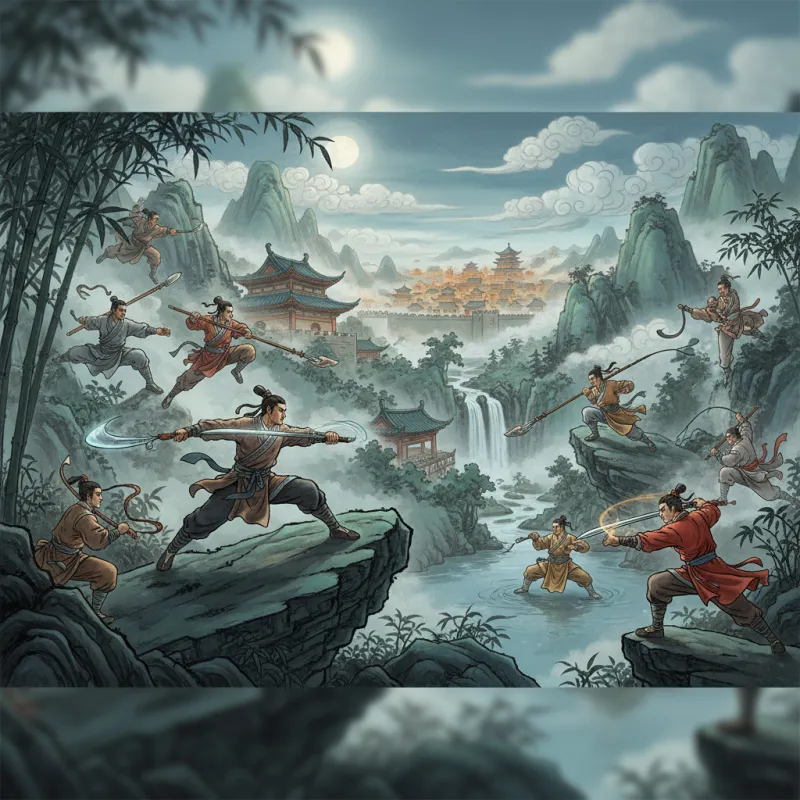
A blade flashes in moonlight, and before the echo of steel fades, three assassins lie dead at the hero's feet. The weapon? Not the sword you'd expect, but a simple bamboo flute transformed into an instrument of death. This is the essence of wuxia weaponry—where even the most mundane object becomes lethal in skilled hands, and where the choice of weapon reveals everything about a warrior's philosophy, sect allegiance, and place in the jianghu (江湖, jiānghú).
The Philosophy Behind the Blade
In wuxia fiction, weapons aren't mere tools—they're extensions of a martial artist's soul. Jin Yong understood this better than anyone when he created Dugu Qiubai (独孤求败, Dúgū Qiúbài), the legendary swordsman who progressed through five stages of weaponry, ultimately achieving mastery with no weapon at all. This progression from sharp sword to heavy iron blade to wooden sword to no sword mirrors the Daoist concept of returning to simplicity, of achieving more through less.
The relationship between warrior and weapon in wuxia operates on multiple levels. There's the practical consideration—a jian sword suits the elegant, scholarly martial artist, while a dao saber fits the rough-and-tumble soldier. But there's also the symbolic weight. When Guo Jing wields his heavy iron staff in "The Legend of the Condor Heroes," it reflects his straightforward, honest nature. Contrast this with Huang Yaoshi's jade flute, which speaks to his refined, unconventional character and his mastery of both martial and musical arts.
The Eighteen Arms of Wushu
Traditional Chinese martial arts recognize the Shíbā Bānwǔyì (十八般武艺, shíbā bānwǔyì)—the Eighteen Arms or eighteen categories of weapons and martial techniques. While the exact list varies by source and dynasty, the core weapons remain consistent: sword, saber, spear, staff, bow, crossbow, halberd, axe, hook, fork, whip, mace, hammer, talon, shield, and various others depending on the era.
Wuxia authors cherry-pick from this arsenal based on narrative needs. Gu Long, for instance, had a particular fondness for unusual weapons that reflected his characters' psychological complexity. In "The Sentimental Swordsman, Ruthless Sword," Li Xunhuan's flying daggers become an extension of his melancholic personality—weapons that strike from a distance, just as he keeps emotional distance from those he loves.
The spear, or qiang (枪, qiāng), holds the title "King of Weapons" in Chinese martial arts, yet it appears less frequently in wuxia than swords. Why? Partly because swords carry more romantic and scholarly associations, fitting the genre's emphasis on wandering heroes rather than battlefield soldiers. When spears do appear—like Yang Guo's mastery of the Yang Family Spear in "The Return of the Condor Heroes"—they often signal a character's connection to military heritage or formal martial training.
Swords: The Gentleman's Choice
The jian (剑, jiàn), the straight double-edged sword, reigns supreme in wuxia literature. It's called the "Gentleman of Weapons," and for good reason. Confucian scholars wore jians as symbols of their status, and this cultural cachet transferred directly into wuxia fiction. The jian represents refinement, precision, and intellectual martial arts—think of the Huashan Sect's sword techniques in Jin Yong's works, which emphasize speed and technique over brute force.
But not all swords are created equal in wuxia cosmology. Legendary blades carry their own histories and powers. The Yitian Sword (倚天剑, Yǐtiān Jiàn) and Dragon Saber (屠龙刀, Túlóng Dāo) in "The Heaven Sword and Dragon Saber" aren't just sharp—they contain hidden martial arts manuals and represent the ultimate prizes in the jianghu. This tradition of named, storied weapons draws from actual Chinese history, where swords like Ganjiang and Moye became legendary.
The dao (刀, dāo), the single-edged saber, serves as the jian's rougher cousin. It's the weapon of soldiers, bandits, and those who learned their martial arts through hard experience rather than formal sect training. When Qiao Feng wields his saber in "Demigods and Semi-Devils," it perfectly matches his straightforward, powerful fighting style—no fancy flourishes, just devastating effectiveness.
Flexible Weapons and Hidden Dangers
Some of the most memorable weapons in wuxia are the flexible ones—whips, chains, ropes, and ribbons that defy conventional combat logic. These weapons require exceptional skill and often appear in the hands of female martial artists or unorthodox practitioners. The soft whip exemplifies this category, capable of both offense and defense, striking from unexpected angles.
Huang Rong's Dog-Beating Staff technique in Jin Yong's Condor trilogy showcases how a seemingly simple weapon becomes formidable through technique. The staff itself is ordinary bamboo, but the thirty-six moves of the Dog-Beating Staff technique, passed down through Beggar Clan leaders, transform it into one of the jianghu's most respected weapons.
Hidden weapons, or anqi (暗器, ànqì), occupy a morally ambiguous space in wuxia. They're the tools of assassins and those who can't win in fair combat—yet they're also the equalizers that allow the weak to challenge the strong. The Tang Sect of Sichuan built their entire reputation on poison and hidden weapons, creating a fascinating ethical tension. Are they dishonorable cowards or pragmatic survivors? Wuxia authors love this gray area.
Unconventional Arms and Improvised Weapons
The true masters in wuxia fiction often transcend conventional weaponry entirely. This concept reaches its apex in the philosophy of "picking flowers and plucking leaves"—the ability to use anything as a weapon. When Duan Yu in "Demigods and Semi-Devils" defeats enemies using the Six Meridians Divine Sword technique, projecting sword energy from his fingertips, he represents the ultimate evolution: the body itself as weapon.
Everyday objects transformed into deadly weapons populate wuxia stories. Monks use Buddhist prayer beads as projectiles. Scholars wield writing brushes like daggers. The Peach Blossom Island's martial arts in Jin Yong's works incorporate musical instruments—flutes, zithers, and drums—as both weapons and cultivation tools. This reflects a deeper Chinese cultural belief that true mastery transcends the physical object.
Gu Long took this concept further in his novels, where characters like Chu Liuxiang rarely draw weapons at all, preferring wit and agility. The message is clear: the weapon doesn't make the warrior; the warrior makes the weapon. A chopstick in a master's hand is deadlier than a sword in a novice's grip.
Weapons as Sect Identity
In wuxia's intricate social landscape, weapons often serve as calling cards, immediately identifying a martial artist's sect affiliation and training lineage. The Wudang Sect's sword techniques emphasize Daoist principles of yielding and circular motion, while Shaolin's staff methods reflect Buddhist discipline and straightforward power. When a character appears wielding a particular weapon in a distinctive style, knowledgeable jianghu observers can immediately place their background.
This extends to weapon combinations too. The Emei Sect, traditionally associated with female practitioners, favors weapons like the Emei daggers—short, paired blades that emphasize speed and precision. The Kunlun Sect's three immortal swords represent their Daoist heritage. These aren't arbitrary choices by authors; they're carefully constructed to reinforce sect philosophies and create a coherent martial arts ecosystem.
The concept of sect-specific weapons creates dramatic possibilities. When a character masters multiple weapon styles from different sects, it signals either exceptional talent or a complicated backstory involving betrayal, secret training, or forbidden knowledge. Yang Guo's ability to synthesize techniques from multiple sources in "The Return of the Condor Heroes" marks him as a true jianghu maverick.
The Modern Evolution of Wuxia Weaponry
Contemporary wuxia and its cousin genre xianxia have pushed weapon concepts into increasingly fantastical territory. Modern web novels feature spirit weapons that grow with their wielders, divine armaments that choose their masters, and weapons forged from celestial materials. While purists might scoff, this evolution continues wuxia's tradition of using weapons as narrative devices to explore character growth and philosophical themes.
The influence flows both ways. Video games, films, and television adaptations have reshaped how readers imagine wuxia weapons. The wire-fu aesthetics of films like "Crouching Tiger, Hidden Dragon" and "Hero" have created visual expectations that newer written works sometimes incorporate. The weapon becomes not just a tool but a special effect, a way to visualize internal energy and martial prowess.
Yet the core appeal remains unchanged. Whether it's a simple wooden sword or a heaven-forging divine blade, weapons in wuxia fiction continue to serve as mirrors reflecting their wielders' hearts, symbols of sect loyalty and personal philosophy, and catalysts for the eternal dance between honor and survival in the jianghu. The blade may change, but the hand that wields it—and the story it tells—remains timeless.
Related Reading
- Legendary Weapons of Wuxia: The Swords That Have Names
- Hidden Weapons: The Assassin's Arsenal
- The Green Destiny: Most Famous Sword in Wuxia Cinema
- The Most Famous Swords in Wuxia Fiction: A Definitive Ranking
- The Heavenly Sword and Dragon Saber: Twin Weapons of Destiny
- The Beggar Sect: The Largest and Most Unlikely Martial Arts Organization
- The Enigmatic World of Jianghu: A Deep Dive into Wuxia Fiction and Kung Fu Novels
- The Jianghu Code: Honor Among Martial Artists
Explore Chinese Culture
- Explore Jin Yong's martial arts novels
- Explore cultivation fiction and immortal heroes
- Explore the real history behind wuxia