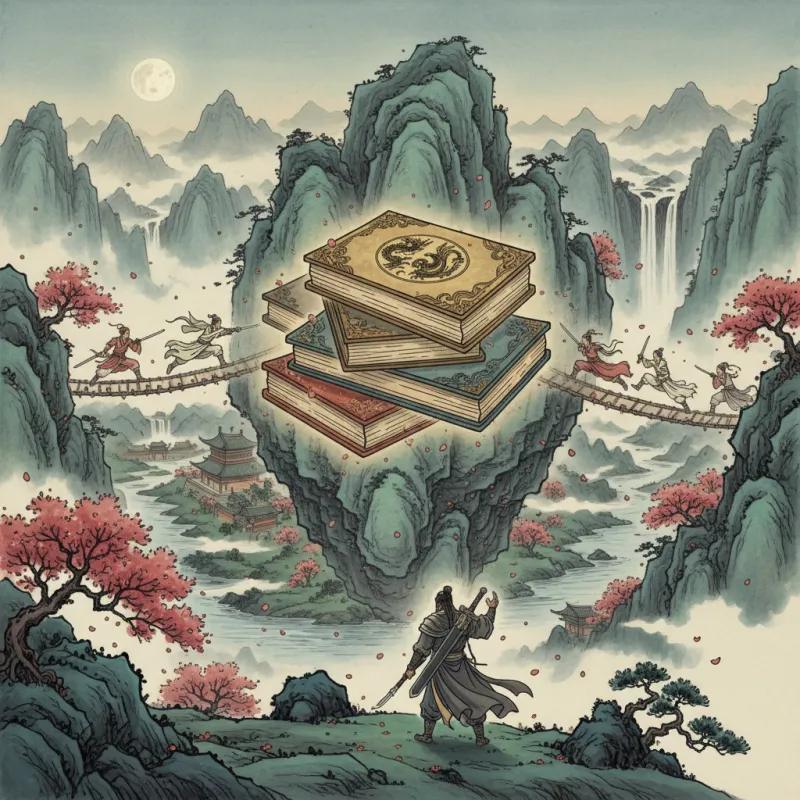
A dying master clutches a blood-stained scroll, his final breath spent whispering its location to a trembling disciple. Three rival sects wage war over a single book hidden in a cave. An orphan stumbles upon a tattered manual in a forgotten library and emerges ten years later as the most feared fighter in the jianghu (江湖 jiānghú, the martial world). If you've read even a handful of wuxia novels, you know this pattern: martial arts manuals (武功秘籍 wǔgōng mìjí) are the nuclear codes of the martial world, and everyone wants them.
Why Paper Beats Steel
Here's the uncomfortable truth that wuxia fiction understands perfectly: a legendary sword might make you 20% more effective in combat, but the right manual can multiply your power tenfold. Jin Yong knew this when he made the Nine Yin Manual (九陰真經 Jiǔ Yīn Zhēnjīng) the most coveted object in The Legend of the Condor Heroes. Not a magic weapon. Not a treasure map. A book.
The logic is brutal and elegant. A master swordsmith might forge a dozen legendary blades in his lifetime, but a martial arts genius who spends fifty years perfecting a technique can only pass it on through teaching or writing. When that master dies, the knowledge dies with them — unless it's been recorded. The manual becomes a bottled lifetime of genius, portable and transferable. You can steal a manual. You can't steal fifty years of training from someone's corpse.
This is why manuals drive more wuxia plots than any other MacGuffin. Gu Long's Peacock Plume features fighters who would rather die than reveal where they learned their techniques. In Demi-Gods and Semi-Devils, the Beiming Divine Art (北冥神功 Běimíng Shéngōng) manual literally allows its practitioner to absorb other people's internal energy — it's not just knowledge, it's a force multiplier that makes you stronger by defeating opponents.
The Anatomy of a Legendary Manual
Not all manuals are created equal, and wuxia fiction has developed a clear hierarchy. At the bottom are basic training texts that any sect might possess — the equivalent of a community college textbook. These teach foundational skills: how to circulate qi (氣 qì, internal energy), basic stances, common weapon forms. Useful, but not worth killing over.
Mid-tier manuals contain the signature techniques of established sects. The Shaolin 72 Arts (少林七十二藝 Shàolín Qīshí'èr Yì) or the Wudang Sword Manual (武當劍譜 Wǔdāng Jiànpǔ) fall into this category. These are jealously guarded but not unique — the sect has copies, and senior disciples have memorized portions. Stealing one might start a vendetta, but it won't reshape the martial world.
The top tier is where things get interesting. These are the manuals that appear once in a generation, created by transcendent geniuses who broke through the limits of conventional martial arts. The Nine Yang Manual (九陽真經 Jiǔ Yáng Zhēnjīng), the Sunflower Manual (葵花寶典 Kuíhuā Bǎodiǎn), the Six Meridians Divine Sword (六脈神劍 Liù Mài Shénjiàn) — these texts don't just teach techniques, they reveal entirely new paradigms of martial cultivation. They're the equivalent of Newton's Principia or Einstein's relativity papers, except they also teach you how to shoot energy beams from your fingers.
What makes a manual legendary? Three factors: power ceiling (how strong can you become?), accessibility (can anyone learn it, or does it require rare prerequisites?), and completeness (is it the full text, or a fragment?). The Sunflower Manual scores high on power but catastrophically low on accessibility — it requires self-castration, which tends to limit the applicant pool. The Nine Yin Manual is powerful and complete but requires years of dedicated study and high comprehension. Fragments are their own category of frustration: imagine having pages 1-50 and 201-250 of a 300-page manual, with the crucial breakthrough technique on page 175.
The Economics of Forbidden Knowledge
Wuxia manuals operate on scarcity economics. A sect's power is directly proportional to the quality of its manuals and its ability to keep them secret. This creates a paranoid ecosystem where every major sect maintains a forbidden library (藏經閣 cángjīng gé), usually in the most inaccessible location possible: mountain peaks, underground chambers, islands surrounded by deadly currents.
The security measures are elaborate. The Shaolin Temple's Sutra Repository requires permission from the abbot and is guarded by senior monks who've taken vows never to leave. Some sects split manuals into pieces, storing different sections in different locations. Others write them in code, cipher, or deliberately obscure classical Chinese that requires years of literary study to parse. The Sunflower Manual in Jin Yong's work was hidden inside a Buddhist sutra, disguised as religious commentary — you had to know what you were looking for.
But here's the paradox: the more valuable the manual, the more people will risk everything to steal it. This creates the central tension in dozens of wuxia plots. In Smiling, Proud Wanderer, the Sunflower Manual causes multiple massacres, betrayals, and the destruction of entire sects. People don't just want it — they're willing to burn down the world to possess it. The manual becomes a curse, destroying everyone who touches it, yet remaining irresistibly attractive.
The black market for manuals is equally fascinating. Incomplete copies, forgeries, and "interpretations" circulate through the jianghu like samizdat literature. A fragment of a legendary manual might sell for a fortune, even if it's only 30% accurate. Some unscrupulous masters deliberately release fake manuals to mislead rivals or create chaos. Others sell "commentary" texts that claim to explain the secrets of famous manuals without actually reproducing the techniques — the wuxia equivalent of "get rich quick" schemes.
Learning From Paper: The Practical Challenges
Here's where wuxia fiction gets surprisingly realistic: reading a manual doesn't automatically make you powerful. The text is necessary but not sufficient. You need the right foundation, the right comprehension, and often the right body type or innate talent.
Zhang Wuji in The Heaven Sword and Dragon Saber can learn the Nine Yang Manual because he's already been poisoned by extreme yin energy — the yang techniques balance him out. For anyone else, the same manual might cause qi deviation (走火入魔 zǒuhuǒ rùmó) and death. Linghu Chong in Smiling, Proud Wanderer can absorb multiple sword styles because he has no preconceptions, but a master with decades of training in one style would find their existing knowledge interfering with the new techniques.
The best manuals acknowledge this. They include warnings, prerequisites, and progressive training sequences. The Nine Yin Manual famously begins with a Sanskrit section on Buddhist philosophy — not as decoration, but as a mental framework necessary to safely practice the techniques. Skip the philosophy and go straight to the combat moves, and you'll likely cripple yourself.
Some manuals are deliberately incomplete, requiring oral transmission from a master to fill in the gaps. The written text provides the framework, but the crucial details — breathing patterns, visualization techniques, the exact angle of a strike — must be taught in person. This is why even when a manual is stolen, it doesn't always lead to mastery. The thief has the recipe but not the cooking technique.
The Dark Side: Manuals That Destroy Their Users
Not all legendary manuals are benevolent. Some are traps, deliberately designed to harm practitioners. Others are simply too powerful for human bodies to handle, like trying to run nuclear reactor code on a calculator.
The Sunflower Manual is the most famous example of a double-edged manual. Yes, it grants incredible speed and power. But the self-castration requirement isn't arbitrary sadism — the techniques generate so much yang energy that an intact male body literally can't handle it without exploding from the inside. Dongfang Bubai masters it and becomes nearly invincible, but at the cost of his identity and sanity. The manual doesn't just change your martial arts; it changes who you are.
The Beiming Divine Art presents a different problem: it's addictive. Once you start absorbing other people's internal energy, why would you ever stop? It's faster than training, more efficient, and makes you stronger with each victim. The manual turns practitioners into predators, hunting other martial artists like vampires. Ding Chunqiu in Demi-Gods and Semi-Devils becomes a monster not because the technique is evil, but because it makes evil so convenient.
Then there are the manuals that are simply beyond human capacity. The Six Meridians Divine Sword requires such precise control of internal energy that even Duan Yu, who has enormous reserves of qi, can only use it intermittently. For anyone with less talent, attempting the technique would be like trying to thread a needle while riding a galloping horse — you'd exhaust yourself before accomplishing anything.
The Meta-Manual: When Books Reference Books
The most sophisticated wuxia novels create entire genealogies of manuals, showing how martial knowledge evolves over generations. The Nine Yin Manual and Nine Yang Manual are complementary opposites, created by different masters but forming a complete system when combined. The Eighteen Dragon-Subduing Palms (降龍十八掌 Jiàng Lóng Shíbā Zhǎng) was originally twenty-eight palms, but a later master refined it down to eighteen more powerful moves — the manual itself underwent revision and improvement.
This creates fascinating scenarios where characters must collect multiple manuals to understand a complete system. In The Return of the Condor Heroes, Yang Guo needs to understand both the Nine Yin Manual and the Jade Maiden Heart Sutra (玉女心經 Yùnǚ Xīnjīng) to create his own ultimate technique. He's not just learning from books; he's synthesizing knowledge across texts, like a scholar doing comparative literature analysis.
Some manuals explicitly reference others, creating a web of martial knowledge. A manual might say "this technique counters the Seven Wounds Fist" or "requires foundation in the Muscle-Tendon Change Classic." You need to understand the broader context of jianghu martial arts to make sense of any individual text. It's like trying to read advanced mathematics without knowing algebra — the symbols are there, but the meaning is inaccessible.
Why We're Obsessed With Martial Manuals
The manual as plot device works because it taps into something universal: the fantasy that knowledge alone can transform you. No special bloodline required, no chosen-one prophecy, just you and a book. It's democratic in a way that legendary weapons aren't — anyone who finds the manual and has the discipline to study it can potentially become powerful.
But wuxia fiction is too smart to make it that simple. The manual is necessary but not sufficient. You still need talent, dedication, the right circumstances, and often a bit of luck. Zhang Wuji doesn't become powerful just because he reads the Nine Yang Manual — he spends years trapped in a cave with nothing else to do, giving him the time and focus that most people never have. The manual provides the path, but you still have to walk it.
This is why manual-hunting plots remain compelling even after you've read dozens of them. Each manual represents a different philosophy of power, a different trade-off between cost and benefit. Do you pursue the quick power of the Sunflower Manual at the cost of your identity? The slow, steady cultivation of orthodox techniques? The risky absorption methods of the Beiming Divine Art? The manual you choose reveals who you are.
In the end, martial arts manuals are wuxia fiction's way of asking: if you could have any knowledge, any skill, what would you be willing to sacrifice for it? The answer to that question determines whether you become a hero, a villain, or just another corpse in a cave, clutching a blood-stained scroll.
Related Reading
- The Heavenly Sword and Dragon Saber: Twin Weapons of Destiny
- Legendary Weapons of Wuxia: The Swords That Have Names
- Hidden Weapons: The Assassin's Arsenal
- The Green Destiny: Most Famous Sword in Wuxia Cinema
- Unveiling Jianghu: The Rich Tapestry of Wuxia and Kung Fu Novels
- Exploring Chinese Martial Arts Fiction and Jianghu Culture in Kung Fu Novels
- Sacred Objects of Chinese Mythology: Seals, Mirrors, and Cauldrons
Explore Chinese Culture
- Explore Jin Yong's martial arts novels
- Explore cultivation fiction and immortal heroes
- Explore the real history behind wuxia