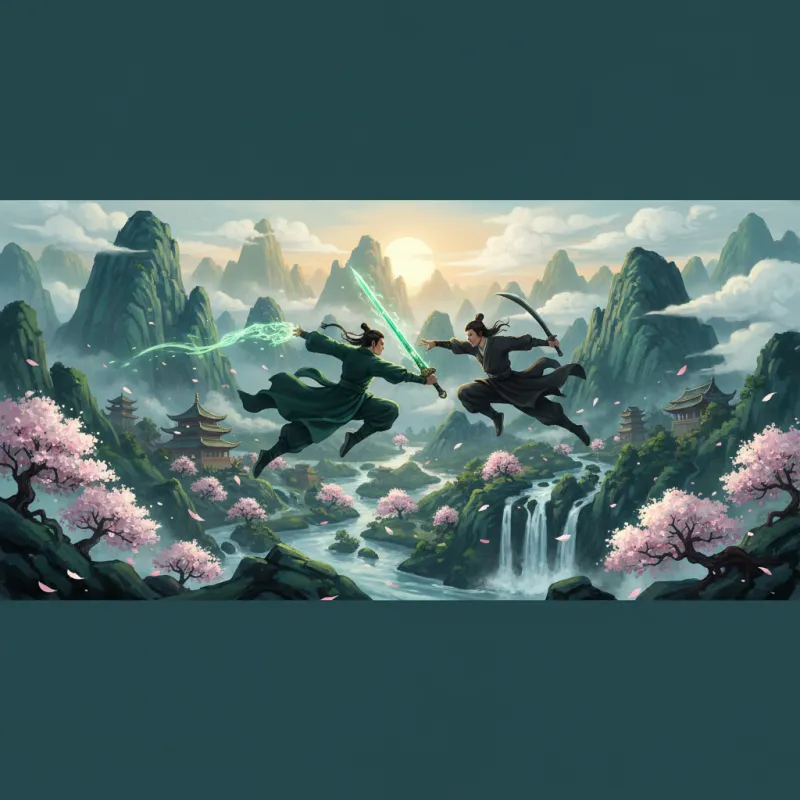
A blade flashes green in moonlight, and suddenly the entire jianghu holds its breath. When Li Mu Bai unsheathes the Green Destiny in Crouching Tiger, Hidden Dragon, audiences worldwide witnessed something extraordinary—not just a weapon, but a four-hundred-year-old curse wrapped in jade-colored steel. This wasn't your typical wuxia sword spinning through wire-fu choreography. The Green Destiny (青冥剑, Qīngmíng Jiàn) carried weight, history, and a body count that stretched back through generations of masters who couldn't resist its call.
A Sword Born from Cinema, Not Pages
Here's what most people get wrong: the Green Destiny didn't emerge from classical wuxia literature like Jin Yong's or Gu Long's novels. Wang Dulu created this blade specifically for his 1941 novel Crouching Tiger, Hidden Dragon (卧虎藏龙, Wò Hǔ Cáng Lóng), the fourth book in his Crane-Iron Pentalogy. But the sword remained relatively obscure in Chinese popular culture until Ang Lee's 2000 film adaptation catapulted it into global consciousness. Unlike the Heaven Reliant Sword from The Heaven Sword and Dragon Saber, which had decades of reader devotion before hitting screens, the Green Destiny achieved legendary status almost entirely through cinema.
This reverse journey—from page to screen to legend—makes the Green Destiny unique among wuxia weapons. The film's four Academy Awards and $213 million box office didn't just make it successful; they fundamentally altered how Western audiences understood Chinese martial arts cinema. The sword became shorthand for the entire genre, its jade-green blade appearing in countless parodies, homages, and cultural references that had nothing to do with Wang Dulu's original vision.
The Philosophy of an Unsheathed Blade
Li Mu Bai's relationship with the Green Destiny embodies the central tension in wuxia philosophy: can a weapon of death lead to enlightenment? Throughout the film, the Wudang master treats the sword with reverence bordering on dread. He's killed with it, certainly, but he's also been changed by it—and not for the better. His decision to give up the blade represents his attempt to transcend the jianghu's endless cycle of revenge and violence.
The sword's jade-green color isn't arbitrary aesthetics. In Chinese symbolism, jade represents purity, moral integrity, and the connection between heaven and earth. Yet this jade-colored blade has spilled blood across four centuries. That contradiction—a pure weapon used for impure purposes—drives much of the film's philosophical depth. When Jen Yu (玉娇龙, Yù Jiāo Lóng) steals the Green Destiny, she's not just taking a valuable weapon; she's claiming the right to define her own destiny outside Confucian expectations of female propriety.
The sword's supernatural sharpness adds another layer. It cuts through iron, stone, and lesser blades like they're paper—a physical manifestation of absolute martial supremacy. But as Li Mu Bai warns, "The sword's power is in its owner's hand." This isn't a Divine Sword that grants automatic mastery. The Green Destiny amplifies what's already there: skill, yes, but also anger, pride, and the hunger for recognition that ultimately destroys its wielders.
Craftsmanship and Cinematic Reality
Master sword-maker Peter Lyon forged the actual Green Destiny props for the film—four identical blades to accommodate different shooting requirements. The hero sword, used for close-ups, featured a flexible wushu blade that could bend dramatically without breaking during the bamboo forest fight sequence. The stunt versions were lighter, designed for the wire work that made Chow Yun-fat and Zhang Ziyi appear to defy gravity.
The jade-green finish came from a specialized anodizing process applied to high-carbon steel. Lyon wanted a color that would read clearly on camera while maintaining the weapon's credibility as an ancient artifact. Traditional Chinese swords—jian (剑)—typically featured plain steel or bronze, but the Green Destiny needed to stand out visually in a film filled with spectacular imagery. The result walks a fine line between historical plausibility and cinematic necessity.
Yuen Woo-ping's choreography transformed the sword from prop to character. Watch the tea house fight where Li Mu Bai uses the Green Destiny to disarm an entire gang without drawing blood—the blade becomes an extension of his restraint, his desire to transcend violence even while demonstrating absolute mastery of it. Compare this to Jen's wild, aggressive style when she wields the same weapon. The sword doesn't change; the wielder's internal state determines everything.
The Curse of Legendary Weapons
Wang Dulu embedded a warning in his original novel that the film amplifies: legendary weapons attract legendary trouble. The Green Destiny's four-hundred-year history is soaked in blood, each previous owner meeting a violent end. Li Mu Bai's master died because of this sword. The weapon's reputation draws challengers, thieves, and those who believe possessing it will grant them status in the jianghu.
This curse motif appears throughout wuxia literature, but rarely with such psychological sophistication. The Green Destiny doesn't corrupt through supernatural evil like some demonic blade. Instead, it corrupts through reputation and expectation. Once you're known as the Green Destiny's master, you can never be just another wandering swordsman. You become a target, a legend, a symbol—everything Li Mu Bai desperately wants to escape.
Jen Yu's theft of the sword represents youthful arrogance colliding with centuries of accumulated karma. She sees only the power, the freedom, the ability to carve her own path through a society that wants to marry her off to a man she doesn't love. She doesn't understand that the sword comes with obligations, with a history that will hunt her down regardless of her skill. Her final fate—ambiguous in the film, tragic in the novel—suggests that some weapons are too heavy for any single person to carry.
Cultural Impact Beyond the Screen
The Green Destiny's influence extends far beyond Crouching Tiger, Hidden Dragon. It became the template for how Western media depicts Chinese swords—elegant, mystical, imbued with philosophical significance rather than just being sharp metal. Video games from World of Warcraft to Ghost of Tsushima feature jade-colored blades that clearly reference Lee's film. The sword appears in everything from Kill Bill homages to Kung Fu Panda jokes.
This cultural penetration has a double edge. On one hand, the Green Destiny introduced millions to wuxia aesthetics and philosophy. On the other, it created a stereotype that all Chinese swords must be mystical artifacts with deep spiritual significance. Real Chinese martial arts history features plenty of mundane weapons used by ordinary soldiers, but the Green Destiny's shadow makes those harder to see.
In China itself, the sword's reception was more complicated. Many viewers felt the film catered too much to Western orientalist fantasies about mystical China. The wire work, while spectacular, departed from the more grounded martial arts choreography popular in Hong Kong cinema of the 1990s. Yet the film's international success couldn't be denied, and the Green Destiny became a point of cultural pride—a Chinese creation that conquered global cinema on its own terms.
The Sword's Literary Lineage
Wang Dulu's original Crane-Iron Pentalogy presents the Green Destiny differently than Lee's adaptation. In the novels, the sword's history is more detailed, its supernatural properties less pronounced. Wang wrote during the Republican era (1912-1949), when Chinese intellectuals were grappling with modernity's challenge to traditional values. His wuxia stories blend Confucian ethics with Buddhist philosophy, using martial arts as a lens to examine moral choices.
The Green Destiny in Wang's novels represents the burden of excellence. Li Mu Bai inherited the sword from his master, along with the responsibility to use it righteously. But righteousness in the jianghu is never simple. Every time he draws the blade, he must weigh competing obligations: loyalty to his sect, justice for victims, mercy for opponents who might reform. The sword doesn't make these choices easier; it makes them more consequential.
Lee's film condenses this complexity into a more accessible narrative, but the core remains. The Green Destiny isn't just a weapon—it's a test. Can you wield ultimate power without being consumed by it? Can you maintain your humanity while carrying a tool designed to end human life? These questions resonate across cultures, which explains why a sword from a 1941 Chinese novel became a global icon sixty years later.
Legacy and the Weight of Fame
Twenty-five years after Crouching Tiger, Hidden Dragon, the Green Destiny remains the most recognizable sword in wuxia cinema. Its jade-green blade appears in film retrospectives, martial arts exhibitions, and countless fan replicas. The sword transcended its origins to become a symbol of the entire genre—for better and worse.
What makes the Green Destiny endure isn't just its visual distinctiveness or the film's success. It's the sword's thematic resonance: the idea that our greatest strengths can become our deepest traps, that legendary status is often a curse disguised as a blessing, that true mastery means knowing when to sheathe the blade rather than draw it. Li Mu Bai's final lesson isn't about sword technique—it's about letting go.
In the end, the Green Destiny's fame mirrors its fictional history. Both the sword and the film that made it famous carry weight that subsequent works struggle to match. Just as Li Mu Bai couldn't escape the blade's reputation, wuxia cinema can't escape Crouching Tiger, Hidden Dragon's shadow. The sword remains unsheathed in our cultural imagination, still cutting through assumptions about what Chinese martial arts stories can be and who they can reach.
Related Reading
- Legendary Weapons of Wuxia: The Swords That Have Names
- Martial Arts Manuals: The Most Sought-After Treasures in Wuxia
- The Art of War: Exploring Weapons in Chinese Martial Arts (Wuxia) Fiction
- Legendary Swords in Wuxia Fiction
- Hidden Weapons: The Dark Arts of Wuxia Combat
- Sun Wukong: The Great Sage Who Challenged Heaven
- Sacred Objects of Chinese Mythology: Seals, Mirrors, and Cauldrons
- Animal Spirits and the Path to Becoming Yaoguai
Explore Chinese Culture
- Explore Jin Yong's martial arts novels
- Explore cultivation fiction and immortal heroes
- Explore the real history behind wuxia