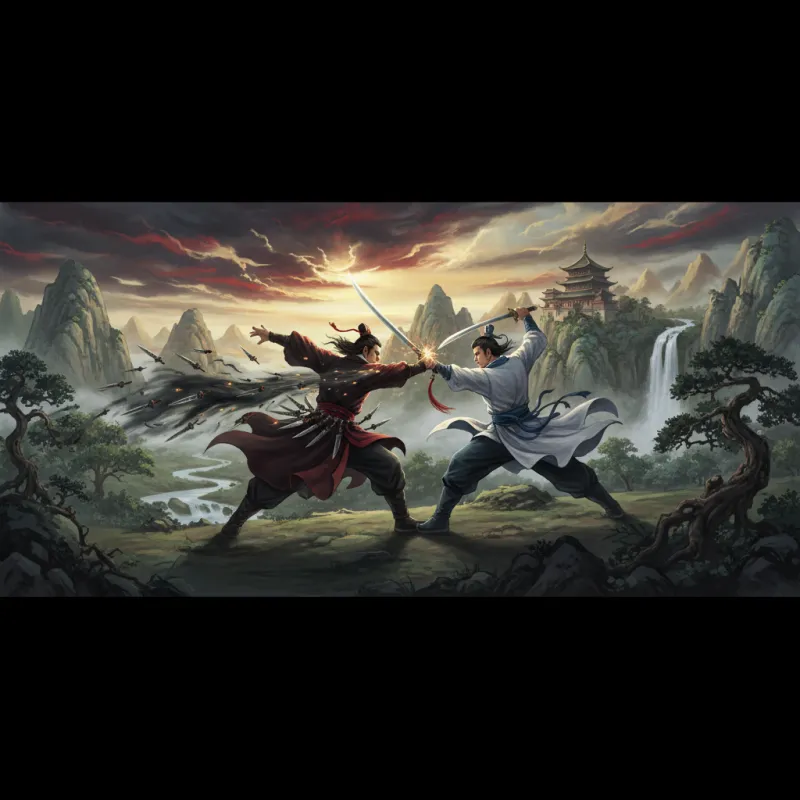
A needle no thicker than a horse's hair pierces through a man's throat at thirty paces. He clutches his neck, eyes wide with confusion, and collapses before his sword clears its scabbard. His killer stands in the shadows, sleeves still, face expressionless. No one saw the flick of fingers. No one heard the whisper of steel through air. This is the way of 暗器 (ànqì) — hidden weapons — where death arrives without announcement and masters die without knowing who killed them.
The Weapons Orthodox Schools Won't Discuss
While legendary swords and staff techniques dominate the training halls of respectable martial sects, hidden weapons occupy a morally ambiguous space in 武林 (wǔlín, the martial world). The Shaolin Temple teaches staff and fist. Wudang Mountain perfects the sword. But hidden weapons? Those belong to assassins, poison masters, and the desperate.
Yet every grandmaster worth their salt knows at least three hidden weapon techniques. They have to. Because the jianghu doesn't care about your moral superiority when a 飞针 (fēizhēn, flying needle) is heading for your 百会穴 (bǎihuì xué, the acupoint at the crown of your head).
The Song Dynasty military manual Wujing Zongyao (武经总要, compiled in 1044 CE) catalogued forty-seven types of projectile weapons used by imperial armies. These weren't toys — they were battlefield instruments designed to kill armored soldiers at range. When the Song fell and its military knowledge scattered, these techniques filtered into civilian martial arts, evolving into the hidden weapon traditions we see in wuxia fiction.
By the Ming Dynasty (1368-1644), hidden weapons had become a recognized martial discipline. The Shaolin Stick Method Elaboration (少林棍法阐宗) from this period includes a chapter on 暗器法 (ànqì fǎ, hidden weapon methods), though the temple would never admit to teaching such "dishonorable" techniques publicly.
The Classic Arsenal
飞镖 (Fēibiāo) — Flying Darts: The gentleman's choice among hidden weapons. Shaped like willow leaves or plum blossoms, these weighted darts require years of practice to master. In Jin Yong's The Heaven Sword and Dragon Saber, the Golden Flower Granny uses 金花婆婆飞镖 (jīnhuā pópo fēibiāo) with such precision she can pin a fly to a wall without damaging the wings. The key isn't strength — it's the wrist rotation that imparts spin and stability.
袖箭 (Xiùjiàn) — Sleeve Arrows: Spring-loaded mechanisms hidden inside wide sleeves, capable of firing multiple projectiles in rapid succession. Gu Long's protagonist Chu Liuxiang encounters these constantly, usually fired by desperate enemies who've already lost the conventional fight. The Tang Dynasty actually banned these devices in 714 CE after several assassination attempts on imperial officials, which only made them more popular in the underworld.
飞针 (Fēizhēn) — Flying Needles: The most feared hidden weapon because they're nearly invisible in flight and can be coated with any number of poisons. In Demi-Gods and Semi-Devils, the Xingxiu Sect's Ding Chunqiu uses 毒针 (dúzhēn, poison needles) as his signature technique, often targeting acupoints to paralyze rather than kill — a crueler fate in many ways.
铁蒺藜 (Tiějílí) — Iron Caltrops: Four-pointed metal spikes designed so one point always faces upward. Scatter these across a pursuit path and watch your enemies' light-footed qinggong become a liability. The Mongol armies used these extensively during their conquest of China, and the technique never left.
飞爪 (Fēizhuǎ) — Flying Claws: Weighted claws attached to chains, used both as grappling hooks and as weapons. Wei Xiaobao in The Deer and the Cauldron gets caught by these more than once, usually because he's too busy scheming to watch where he's walking.
The Physics of Killing Quietly
Hidden weapons operate on principles that seem simple but require extraordinary skill to execute. A flying dart must be released with the right spin, angle, and force to maintain stability over distance. Too much force and it tumbles. Too little and it drops short. The wrist must snap at precisely the right moment, transferring energy without telegraphing the motion.
Master practitioners can throw needles that penetrate wood from twenty paces. This isn't fiction — it's physics. A needle weighing less than a gram, traveling at sufficient velocity, concentrates all its kinetic energy on a point smaller than a pinhead. The pressure per square inch becomes enormous.
The real skill isn't the throw itself. It's the concealment. A hidden weapon master must be able to draw, aim, and release without any visible preparation. The motion must blend seamlessly into ordinary gestures — adjusting a sleeve, brushing away a fly, scratching an ear. In The Smiling, Proud Wanderer, Yue Buqun's hidden needle technique is so subtle that even his own disciples don't realize he's using it until bodies start dropping.
Poison: The Hidden Weapon's Best Friend
A clean needle wound might not kill you. A poisoned needle wound definitely will. This is why hidden weapons and poison arts (毒术, dúshù) are inseparable in wuxia tradition.
The Five Poison Sect (五毒教, Wǔdú Jiào) specializes in coating their weapons with toxins derived from scorpions, snakes, centipedes, toads, and spiders. In The Return of the Condor Heroes, Li Mochou's 冰魄银针 (bīngpò yínzhēn, Ice Soul Silver Needles) are soaked in a poison so potent that even a scratch causes excruciating death within hours.
Historical records confirm that poison-coated weapons were common in Chinese warfare and assassination. The Bencao Gangmu (本草纲目, Compendium of Materia Medica, 1578) by Li Shizhen documents numerous toxic substances used for this purpose, including aconite, arsenic compounds, and extracts from poisonous plants.
The antidote game becomes crucial. Many hidden weapon masters carry both poisons and their counters, creating a pharmaceutical arms race. Huang Yaoshi in The Legend of the Condor Heroes is as much a poison expert as a martial artist, capable of concocting antidotes on the fly from wild herbs.
The Moral Paradox
Orthodox martial sects maintain a complicated relationship with hidden weapons. Publicly, they condemn them as cowardly, dishonorable, the tools of assassins and villains. The Wudang Sect's code explicitly forbids disciples from using hidden weapons in formal duels. Shaolin's precepts emphasize open, honest combat.
Yet privately, every major sect teaches hidden weapon defense, which requires understanding hidden weapon offense. And in moments of desperation — when facing overwhelming odds or protecting innocents — even the most righteous heroes reach for a concealed dart.
This hypocrisy is one of wuxia fiction's most interesting themes. In Demi-Gods and Semi-Devils, the "righteous" sects massacre the Xingxiu Sect partly because of their poison and hidden weapon use, yet these same sects employ similar techniques when convenient. Jin Yong doesn't let anyone off the hook morally.
The truth is that hidden weapons democratize combat. A weak fighter with good aim and a poisoned needle can kill a martial arts grandmaster. This terrifies the orthodox establishment because it undermines the hierarchy they've built through decades of training. Hidden weapons suggest that skill, honor, and righteousness might not be enough — that anyone can be killed by anyone if the circumstances align.
Training the Shadow Arts
Learning hidden weapons requires different skills than conventional martial arts. You're not building strength or perfecting forms. You're developing fine motor control, distance judgment, and the ability to calculate trajectories instinctively.
Traditional training methods include:
Candle Flame Extinguishing: Throwing needles to snuff out candles from increasing distances without knocking over the candle itself. This develops precision and force control.
Moving Target Practice: Throwing darts at suspended objects swaying in the wind, or at targets carried by running assistants. Combat rarely offers stationary victims.
Blind Throwing: Practicing releases while blindfolded or in darkness, relying on sound and spatial memory. Many hidden weapon attacks happen in poor visibility conditions.
Rapid Draw Drills: Concealing weapons in various locations on the body and practicing drawing them in under a second. Speed of deployment often matters more than throwing accuracy.
The mental training is equally important. A hidden weapon specialist must cultivate patience, waiting for the perfect moment to strike. They must learn to kill without hesitation, because hidden weapons rarely offer second chances. And they must accept that they'll be feared and despised by the very people they might be protecting.
The Modern Relevance
Hidden weapons have largely disappeared from modern martial arts practice, relegated to historical demonstrations and wuxia fiction. But their principles remain relevant. The idea of using minimal force at maximum efficiency, of striking from unexpected angles, of turning everyday objects into weapons — these concepts inform modern self-defense thinking.
More importantly, hidden weapons represent something essential about the jianghu worldview: that survival often requires setting aside idealistic notions of fair play. The martial world isn't a tournament with rules and referees. It's a place where people die in dark alleys, where poison works better than righteousness, and where the most honorable fighter isn't always the one who walks away.
When Linghu Chong in The Smiling, Proud Wanderer finally learns to defend against hidden weapons, he doesn't become a better swordsman — he becomes a more complete martial artist, one who understands that the jianghu contains threats that can't be faced with sword techniques alone.
The shadow arsenal endures in fiction because it represents the uncomfortable truth that martial arts, for all their philosophy and beauty, ultimately exist to harm other human beings. Hidden weapons just do it more honestly, without the pretense of honor or the illusion of fair combat. They're the dark mirror that shows what martial arts really are when you strip away the poetry and the posturing.
In the end, every master knows: the deadliest weapon isn't the one everyone can see. It's the one nobody notices until it's already too late.
Related Reading
- Martial Arts Manuals: The Most Sought-After Treasures in Wuxia
- The Art of War: Exploring Weapons in Chinese Martial Arts (Wuxia) Fiction
- The Green Destiny: Most Famous Sword in Wuxia Cinema
- The Heavenly Sword and Dragon Saber: Twin Weapons of Destiny
- Shanhai Jing in Modern Art: Contemporary Illustrations of Ancient Beasts
- Animal Spirits and the Path to Becoming Yaoguai
- Romance in Wuxia: Love, Duty, and the Tragedy Between
Explore Chinese Culture
- Explore Jin Yong's martial arts novels
- Explore cultivation fiction and immortal heroes
- Explore the real history behind wuxia