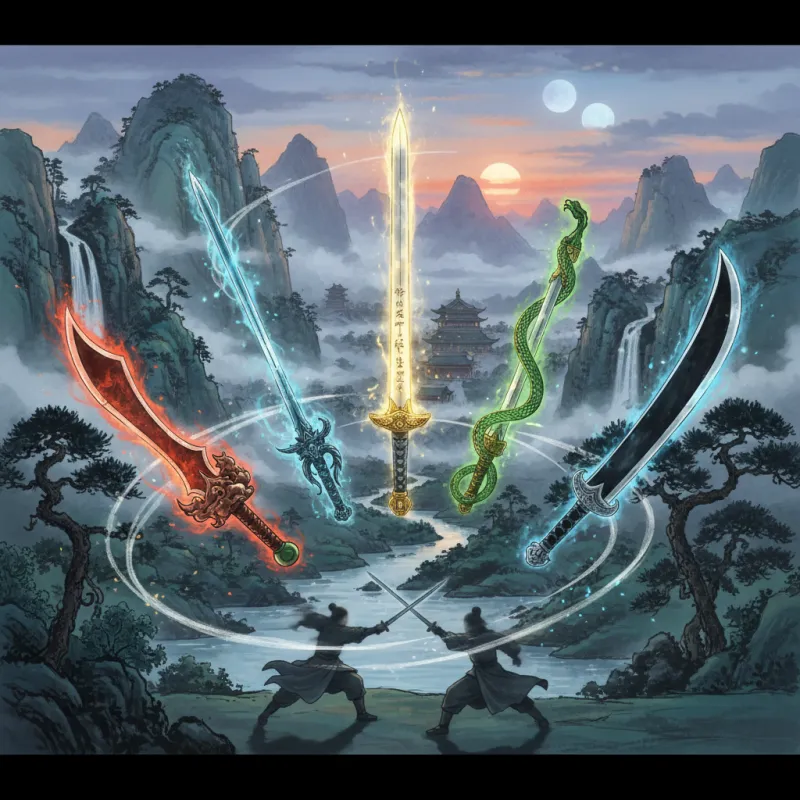
The moment Xie Xiaofeng touches the Shen Dao (神刀, Divine Saber), he knows his life is over. Not because the blade will kill him — though it might — but because from this moment forward, he will never again be just a man. He will be the man who carries the Shen Dao. Every martial artist in the jianghu will measure themselves against him. Every ambitious swordsman will see him as a stepping stone. The weapon has chosen him, and in doing so, has sentenced him to a life where peace is impossible.
This is what legendary weapons do in wuxia fiction. They don't just cut — they define. They transform their wielders from people into symbols, from martial artists into myths. And unlike the glowing swords of Western fantasy that conveniently appear when needed and disappear when the plot demands it, wuxia weapons are relentlessly present. They cannot be ignored. They cannot be put down. They are the kind of inheritance that destroys families.
The Sword That Ends Friendships
Consider the Heavenly Sword (倚天剑, Yǐtiān Jiàn) and Dragon Saber (屠龙刀, Túlóng Dāo) from Jin Yong's The Heaven Sword and Dragon Saber (倚天屠龙记). These aren't just powerful weapons — they're puzzles wrapped in metal, containing secrets that everyone in the martial world wants. The famous couplet associated with them promises ultimate power: "The supreme blade of the martial world, the Dragon Saber. Command the realm, none dare disobey. If Heavenly Sword does not appear, who can compete?"
What makes these weapons fascinating isn't their sharpness. It's that they turn everyone who encounters them into liars and betrayers. Xie Xun, who possesses the Dragon Saber, watches it destroy his family, drive him mad, and turn him into the Golden Lion King — a title that sounds glorious but really means "the man everyone wants to kill." The weapons create a gravity well of ambition and violence that pulls in everyone nearby. Friends become enemies. Allies become assassins. The mere rumor that someone knows where these weapons are hidden is enough to start a war.
Jin Yong understood something crucial: in the jianghu, a legendary weapon is not an advantage. It's a target painted on your back in blood.
Weapons That Remember
The Sword of the Yue Maiden (越女剑, Yuènǚ Jiàn) carries a different kind of weight. In Jin Yong's short story of the same name, set during the Spring and Autumn period (770-476 BCE), the sword represents not just martial skill but the transmission of knowledge itself. The Yue Maiden, A Qing, creates a sword technique so profound that it becomes the foundation for all later swordsmanship in Jin Yong's universe.
But here's what's haunting: A Qing herself fades from history. The sword technique survives. The weapon — or rather, the idea of the weapon and how to use it — outlives its creator by thousands of years. This is the other function of legendary weapons in wuxia: they are memory made tangible. They carry forward the martial philosophy of their creators long after those creators have turned to dust.
When Linghu Chong learns the Dugu Nine Swords (独孤九剑) in The Smiling, Proud Wanderer (笑傲江湖), he's not just learning a technique. He's channeling the martial philosophy of Dugu Qiubai (独孤求败, "Lonely Seeking Defeat"), a swordsman so skilled he spent his final years desperately searching for someone worthy of fighting him. The wooden sword Dugu Qiubai eventually used — having progressed beyond metal — becomes more legendary than any blade forged in fire. It represents the ultimate paradox: the greatest weapon is no weapon at all.
The Curse of Recognition
Gu Long understood the curse of legendary weapons better than anyone. In his Sentimental Swordsman, Ruthless Sword (多情剑客无情剑), Li Xunhuan carries the Little Li Flying Dagger (小李飞刀, Xiǎo Lǐ Fēidāo). The weapon itself is unremarkable — just a small throwing knife. But the reputation is everything. "Little Li's Flying Dagger never misses" becomes both his greatest strength and his deepest prison.
Think about what this means practically. Li Xunhuan can never have a bad day. He can never miss. He can never be drunk, distracted, or off his game, because the moment he fails, the legend dies — and with it, the deterrent effect that keeps most challengers away. The weapon's reputation does more work than the weapon itself. But maintaining that reputation requires perfection, every single time, forever.
This is why Gu Long's weapons feel more psychologically brutal than Jin Yong's. Jin Yong's legendary swords are external problems — everyone wants to steal them. Gu Long's legendary weapons are internal prisons — you carry them, but they define you so completely that you cease to exist as anything other than their wielder. The weapon becomes your identity, and your identity becomes your cage.
Swords That Choose Their Masters
The Sword of Goujian (越王勾践剑, Yuèwáng Gōujiàn Jiàn) exists in reality — it was excavated in 1965 from a tomb in Hubei Province, still sharp after more than 2,400 years. But in wuxia fiction, this historical artifact becomes something more: proof that some weapons transcend their makers. The sword outlasted the kingdom of Yue, outlasted the memory of most of Goujian's accomplishments, and emerged from the earth still perfect.
Wuxia authors seized on this idea. Weapons in their stories often have agency. They reject unworthy wielders. They call to their destined masters. In Demi-Gods and Semi-Devils (天龙八部), Duan Yu stumbles upon the Six Meridians Divine Sword (六脉神剑, Liùmài Shénjiàn) — except it's not a physical sword at all, but a technique that turns one's internal energy into invisible blades. The "weapon" exists only in the body and mind of its user.
This represents the evolution of the legendary weapon concept: from physical object to embodied knowledge. The most dangerous weapons in wuxia aren't the ones you can steal. They're the ones that become part of you, that rewrite your meridians and transform your qi. You can't lose them. But you also can't put them down. They're with you until death, and possibly beyond.
The Weight of Inheritance
When a legendary weapon passes from master to student, it's never just a transfer of property. It's a transfer of obligation. In The Book and the Sword (书剑恩仇录), Jin Yong's first novel, the Fragrant Princess's dagger carries the weight of an entire people's hopes for independence. The weapon becomes a symbol of resistance, and whoever holds it becomes responsible for that resistance.
This is why so many wuxia stories feature characters trying to refuse legendary weapons. They understand the trap. Accept the sword, and you accept everything that comes with it: the enemies, the expectations, the impossible standards. In The Return of the Condor Heroes (神雕侠侣), Yang Guo's Dark Iron Heavy Sword (玄铁重剑, Xuántiě Zhòngjiàn) — another weapon once wielded by Dugu Qiubai — weighs sixty-four jin (about 38 kg). The physical weight is manageable for a martial arts master. The symbolic weight is crushing.
The sword represents a specific martial philosophy: overwhelming force, no fancy techniques, just pure power and simplicity. To wield it effectively, Yang Guo must become a certain kind of martial artist. The weapon shapes the wielder as much as the wielder shapes their technique. This is the opposite of Western fantasy's "chosen one" narrative. In wuxia, the weapon doesn't empower you — it conscripts you.
Beyond the Blade
The most sophisticated wuxia authors eventually move beyond physical weapons entirely. In Gu Long's later works, the deadliest martial artists often use no weapons at all, or use weapons so unconventional they barely qualify: a flute, a fan, a piece of cloth. The legendary weapon becomes a crutch, something that marks you as still dependent on external tools.
But even this rejection is a kind of engagement with the legendary weapon tradition. You can only transcend the sword after you've mastered it. The progression goes: ordinary weapon → legendary weapon → no weapon. Each stage represents a deeper understanding of martial arts philosophy. The legendary weapon is the middle stage, the test you must pass through but not remain in.
This is why weapons like the Emei Piercers or the Judge's Brush occupy such interesting spaces in wuxia fiction. They're legendary not because they're the most powerful, but because they represent specific philosophies, specific approaches to combat and life. The weapon is the physical manifestation of a way of thinking.
The Weapon You Cannot Escape
In the end, legendary weapons in wuxia fiction are about fate and choice, or rather, the illusion of choice. You think you're choosing to pick up the sword. But the moment you touch it, you realize the sword chose you long ago. Your entire life has been leading to this moment. And now that you have it, you cannot put it down — not because it's stuck to your hand, but because putting it down means abandoning everything it represents.
This is why Xie Xiaofeng, in Gu Long's The Legend of the Bat (蝙蝠传奇), eventually tries to fake his own death to escape the Shen Dao. The only way to be free of a legendary weapon is to make everyone believe you're dead. Even then, the weapon's reputation haunts him. People don't believe he's really gone. They keep searching. The weapon won't let him rest, even in pretended death.
That's the final truth about legendary weapons in wuxia: they're not about power. They're about the impossibility of anonymity, the burden of reputation, and the way that greatness — once achieved — becomes a prison you can never leave. The sword that makes you famous is the same sword that ensures you'll never know peace again. And everyone in the jianghu knows it. They just can't resist reaching for the blade anyway.
Related Reading
- Martial Arts Manuals: The Most Sought-After Treasures in Wuxia
- The Most Famous Swords in Wuxia Fiction: A Definitive Ranking
- Legendary Swords in Wuxia Fiction
- Hidden Weapons: The Assassin's Arsenal
- Hidden Weapons: The Dark Arts of Wuxia Combat
- The Jianghu Code: Honor Among Martial Artists
- The Wuxia Film Renaissance: Why Hong Kong Cinema Matters
- Sun Wukong: The Great Sage Who Challenged Heaven
Explore Chinese Culture
- Explore Jin Yong's martial arts novels
- Explore cultivation fiction and immortal heroes
- Explore the real history behind wuxia