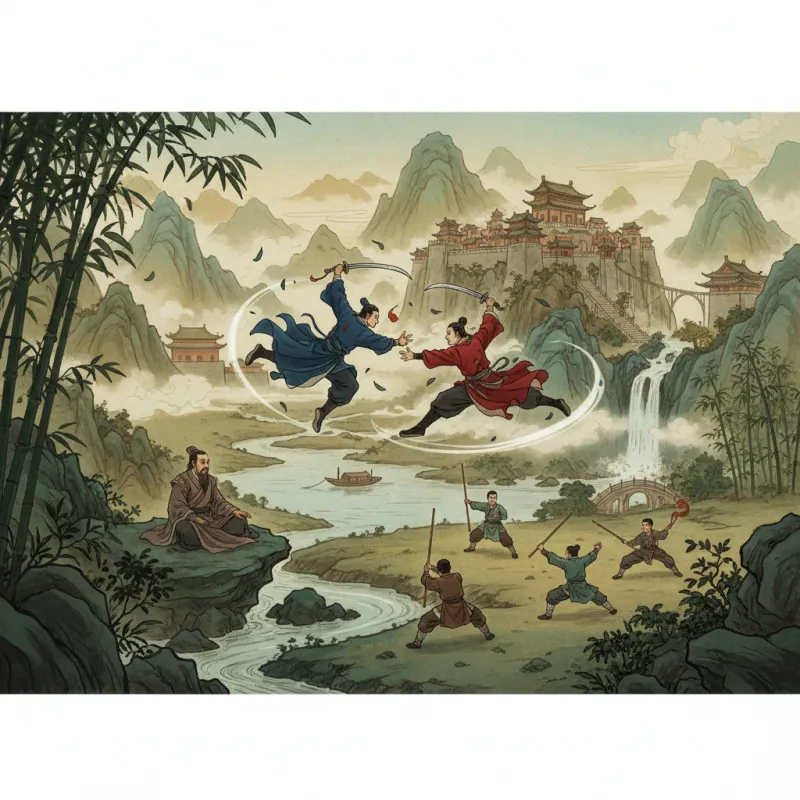
A swordsman stands at the edge of a cliff, his white robes whipping in the mountain wind. Below him, the jianghu—that lawless realm between heaven and earth—stretches endlessly. He could return to the imperial court, accept honors and titles. Instead, he leaps into the mist, choosing freedom over security, righteousness over reward. This moment, repeated across thousands of wuxia novels, captures something essential about Chinese martial arts fiction: the eternal tension between duty and independence, between the structured world of authority and the wild freedom of the rivers and lakes.
The Jianghu: More Than Just "Martial Arts World"
When we translate jianghu (江湖, jiānghú) as "martial arts world," we lose something crucial. The term literally means "rivers and lakes"—those liminal spaces beyond imperial control where outcasts, heroes, merchants, and criminals mingled freely. The jianghu wasn't a fantasy realm; it was a very real social space in Chinese history, particularly during periods of weak central authority. Think of it as the Wild West of Chinese culture, except instead of gunfighters, you had sword-wielding martial artists bound by codes of honor that often superseded imperial law.
The jianghu operates by its own rules. Debts must be repaid—both grudges and favors. A master's death demands vengeance. A sworn brother's betrayal cuts deeper than any blade. These unwritten laws create the dramatic tension that drives wuxia narratives forward. In Jin Yong's The Legend of the Condor Heroes (射雕英雄传, Shèdiāo Yīngxióng Zhuàn), Guo Jing spends years hunting down his father's killers, not because the law demands it, but because jianghu honor requires it.
From Historical Records to Pulp Fiction: The Evolution of Wuxia
The genre's origins lie not in fiction but in historical chronicles. The Records of the Grand Historian (史记, Shǐjì), compiled by Sima Qian around 94 BC, contains the "Biographies of Assassins" chapter—tales of men like Jing Ke, who attempted to assassinate the First Emperor of Qin. These weren't martial arts fantasies; they were historical accounts that emphasized personal courage, loyalty to one's lord, and willingness to sacrifice everything for a cause. The youxia (游侠, yóuxiá)—wandering knights-errant—became cultural archetypes long before anyone wrote novels about them.
The Tang dynasty (618-907 AD) saw the emergence of chuanqi (传奇, chuánqí) tales, short stories that began incorporating supernatural elements alongside martial prowess. But wuxia as we know it truly crystallized during the late Ming and early Qing dynasties (roughly 1600-1800), when novels like Water Margin (水浒传, Shuǐhǔ Zhuàn) popularized the image of outlaws with superior martial skills fighting corrupt officials. These 108 bandits of Mount Liang weren't just criminals—they were righteous rebels forced outside the law by systemic injustice.
The modern wuxia novel emerged in early 20th century Shanghai, where serialized fiction in newspapers created a hungry market for adventure stories. Writers like Xiang Kairan (pen name: Pingjiang Buxiaosheng) pioneered the "new school" wuxia, introducing more elaborate martial arts systems and fantastical abilities. His Strange Tales of the Chivalrous and Gallant (江湖奇侠传, Jiānghú Qíxiá Zhuàn), published in 1923, featured heroes who could leap over rooftops and fight dozens of opponents simultaneously—abilities that would become genre staples.
The Golden Age: Jin Yong and His Contemporaries
When Chinese readers debate the greatest wuxia novelist, the conversation inevitably centers on Jin Yong (金庸, Jīn Yōng), pen name of Louis Cha. Between 1955 and 1972, Jin Yong wrote fifteen novels that redefined the genre. His genius lay in combining historical authenticity with romantic adventure, philosophical depth with page-turning action. The Deer and the Cauldron (鹿鼎记, Lùdǐng Jì) unfolds against the backdrop of the Kangxi Emperor's consolidation of Qing power, with real historical figures interacting with fictional heroes. The protagonist, Wei Xiaobao, subverts every wuxia convention—he's cowardly, lecherous, barely knows kung fu, yet somehow becomes the most successful character in Jin Yong's entire corpus.
Gu Long (古龙, Gǔ Lóng) took a radically different approach. His novels read like hardboiled detective fiction transplanted to ancient China. Short, punchy sentences. Existential heroes drowning their sorrows in wine. Mysteries that unravel through psychological insight rather than martial prowess. Li Xunhuan, the protagonist of Sentimental Swordsman, Ruthless Sword (多情剑客无情剑, Duōqíng Jiànkè Wúqíng Jiàn), kills with a flying dagger that never misses—but his real battles are internal, wrestling with lost love and the burden of his reputation.
Liang Yusheng (梁羽生, Liáng Yǔshēng), often overlooked in favor of Jin Yong and Gu Long, deserves recognition for his meticulous historical research and strong female characters. His Seven Swordsmen from Mountain Tian (七剑下天山, Qī Jiàn Xià Tiānshān) features martial artists resisting Qing rule during the Kangxi era, blending real historical tensions with fictional heroics. The role of women in wuxia literature owes much to Liang's pioneering work.
Kung Fu Systems: The Architecture of Power
Wuxia novels don't just feature fighting—they construct elaborate martial arts systems with internal logic and hierarchy. The distinction between neigong (内功, nèigōng) and waigong (外功, wàigōng)—internal and external martial arts—structures how power works in these fictional worlds. External martial arts focus on physical conditioning, weapon mastery, and technique. Internal martial arts cultivate qi (气, qì), the vital energy that flows through the body's meridians, enabling superhuman feats.
The most powerful martial artists master both. In Jin Yong's Demi-Gods and Semi-Devils (天龙八部, Tiānlóng Bābù), Qiao Feng's Eighteen Dragon-Subduing Palms (降龙十八掌, Jiàng Lóng Shíbā Zhǎng) combines devastating external force with profound internal energy cultivation. Each palm strike carries the power to shatter stone, yet the technique requires decades of internal training to master without destroying one's own body.
Wuxia novels often feature lost or forbidden martial arts manuals—the MacGuffins that drive entire plots. The Nine Yin Manual (九阴真经, Jiǔ Yīn Zhēnjīng) in Jin Yong's Condor trilogy contains the accumulated martial wisdom of a legendary master, and multiple factions war over its possession. These manuals represent more than just fighting techniques; they're repositories of philosophical wisdom, medical knowledge, and spiritual cultivation methods. The evolution of martial arts techniques in wuxia fiction often mirrors real historical developments in Chinese martial arts.
Codes of Honor: The Moral Universe of Wuxia
The jianghu operates according to wulin (武林, wǔlín) ethics—the unwritten codes governing martial artists. Yi (义, yì), often translated as righteousness or loyalty, stands at the center. A true hero keeps promises even when it costs everything. Repays kindness with kindness, enmity with enmity. Protects the weak and challenges the strong.
But wuxia's greatest novels complicate these simple codes. Jin Yong's characters constantly face situations where different obligations conflict. In The Return of the Condor Heroes (神雕侠侣, Shéndiāo Xiálǚ), Yang Guo must choose between avenging his father and protecting his martial arts teacher—who happens to be his father's killer. The novel doesn't offer easy answers; it explores how rigid adherence to codes can create impossible moral dilemmas.
The concept of enqiu (恩仇, ēnchóu)—the ledger of gratitude and grudges—drives countless wuxia plots. Every favor creates an obligation; every insult demands satisfaction. This creates intricate webs of debt and duty spanning generations. The opening of Demi-Gods and Semi-Devils features a massacre at a Shaolin temple, and the novel spends hundreds of thousands of words unraveling the complex history of grudges that led to that moment.
The Wuxia Legacy: From Page to Screen and Beyond
Wuxia's influence extends far beyond Chinese literature. Hong Kong cinema transformed these novels into visual spectacles, with directors like King Hu, Chang Cheh, and later Tsui Hark creating the wire-fu aesthetic that would influence filmmakers worldwide. Ang Lee's Crouching Tiger, Hidden Dragon introduced Western audiences to wuxia's poetic violence and philosophical depth, though purists noted its departures from genre conventions.
Video games like Sword and Fairy (仙剑奇侠传, Xiānjiàn Qíxiá Zhuàn) and Jade Empire adapted wuxia tropes for interactive media, allowing players to experience the progression from novice to martial arts master. The genre's influence appears in unexpected places—the Jedi Knights of Star Wars owe something to wuxia's wandering swordsmen, while Avatar: The Last Airbender explicitly draws on Chinese martial arts philosophy and wuxia narrative structures.
Contemporary Chinese web novels have revitalized the genre for digital natives. Authors like I Eat Tomatoes (我吃西红柿, Wǒ Chī Xīhóngshì) and Er Gen (耳根, Ěr Gēn) write cultivation novels (修真小说, xiūzhēn xiǎoshuō) that blend wuxia with fantasy elements, creating elaborate progression systems where martial artists cultivate toward immortality. These novels, often running millions of characters, have found global audiences through translation platforms.
Why Wuxia Endures
The jianghu persists in Chinese imagination because it represents something essential: a space where individual merit matters more than birth, where personal honor trumps institutional authority, where the powerless can become powerful through dedication and moral clarity. In societies that often felt constrained by rigid hierarchies and corrupt bureaucracies, wuxia offered vicarious freedom.
But the genre's appeal runs deeper than escapism. The best wuxia novels grapple with timeless questions: How do we balance competing loyalties? When does revenge become justice, and when does it perpetuate cycles of violence? Can we maintain our principles in a corrupt world without becoming corrupted ourselves? These questions resonate across cultures and centuries.
The swordsman standing at the cliff's edge, choosing the jianghu over the imperial court—he's not just choosing adventure over security. He's asserting that some things matter more than comfort, that freedom and righteousness justify any sacrifice. That romantic ideal, however impractical in reality, continues to captivate readers because it speaks to something we recognize in ourselves: the desire to live by our own codes, to matter in ways that transcend social hierarchies, to be heroes in our own stories.
The rivers and lakes still call to us, even if we've never held a sword.
Related Reading
- The Origins of Wuxia: From Sima Qian to Jin Yong
- Pangu and the Cosmic Egg: The Chinese Creation Myth
- The Real History Behind Wuxia: Knight-Errants of Ancient China
- Real Chinese Martial Arts Schools That Inspired Wuxia Fiction
- The Knight-Errant (游侠): Real Warriors Who Inspired Wuxia
- Sacred Objects of Chinese Mythology: Seals, Mirrors, and Cauldrons
- Female Martial Artists in Wuxia Fiction
- The Bizarre Plants of the Shanhaijing: Trees That Cure Death and Fruits That Grant Flight
Explore Chinese Culture
- Explore Jin Yong's martial arts novels
- Explore cultivation fiction and immortal heroes
- Explore the real history behind wuxia