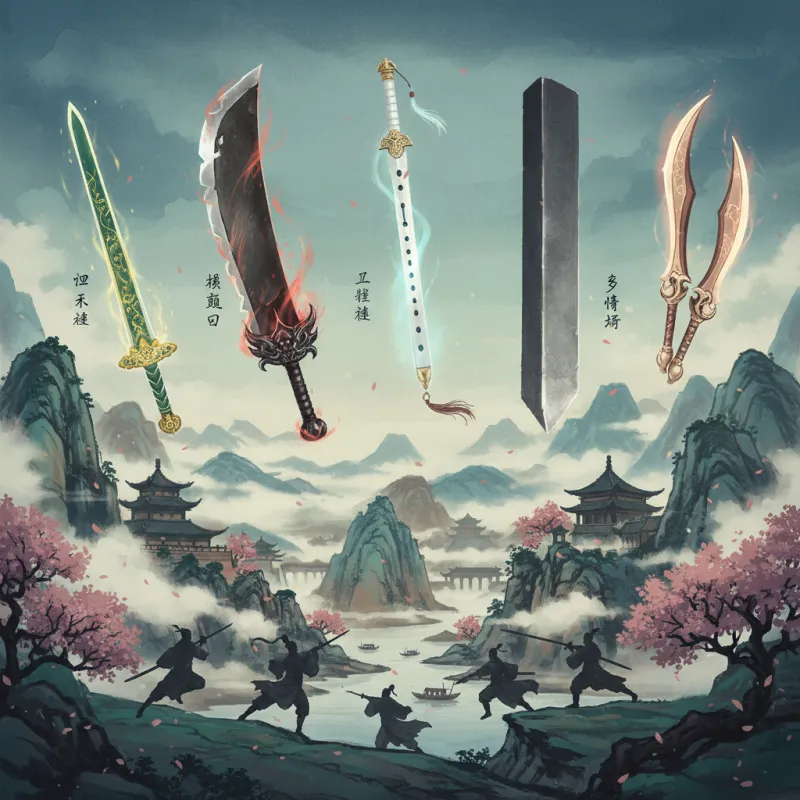
The first time you see a legendary sword in wuxia fiction, you don't see the blade — you see the silence it creates. The room goes still. Conversations die mid-sentence. Even the most arrogant young masters shut their mouths. That's the power these weapons hold: not just the ability to cut through iron like mud, but to command respect through reputation alone. In the jianghu (江湖, jiānghú) — that lawless world of martial artists and wandering heroes — a sword's name can be worth more than a thousand troops.
But which swords truly deserve their legendary status? After decades of wuxia novels, from Jin Yong's classics to Gu Long's philosophical masterpieces, certain blades have transcended their stories to become cultural touchstones. This ranking considers not just martial power, but narrative weight, symbolic meaning, and the unforgettable moments these swords created. Prepare for controversy. Every reader has their own list, and this is mine.
The Criteria: What Makes a Sword Legendary?
Before we dive into the ranking, let's establish the rules. A legendary sword in wuxia fiction needs more than sharpness. The blacksmith's craft matters, yes — but so does the story the blade tells. I'm judging on five factors:
Narrative importance: Does the sword drive the plot, or is it just a prop? The Heaven Relying Sword (倚天剑, Yǐtiān Jiàn) from Jin Yong's Heaven Sword and Dragon Saber literally contains the secrets that every faction in the jianghu is hunting. That's narrative importance.
Wielder significance: A sword is only as legendary as the person holding it. Dugu Qiubai's (独孤求败, Dúgū Qiúbài) heavy iron sword gains meaning from his undefeated record and philosophical evolution as a swordsman.
Symbolic weight: The best swords represent ideas. The Gentleman Sword (君子剑, Jūnzǐ Jiàn) embodies Confucian ideals. The Peacock Plume (孔雀翎, Kǒngquè Líng) — technically not a sword, but we'll allow it — represents the corruption of martial arts into mere assassination tools.
Cultural impact: Has the sword escaped its original novel to become part of broader wuxia consciousness? Everyone knows the Dragon Slaying Saber (屠龙刀, Túlóng Dāo), even people who've never read the book.
Aesthetic and craft: Finally, is the sword itself interesting? Does it have a compelling origin story, unique properties, or memorable design?
With these criteria established, let's begin the ranking.
10-6: The Contenders
10. The Gentleman Sword (君子剑, Jūnzǐ Jiàn) — Yue Buqun's blade in The Smiling, Proud Wanderer earns its place through pure irony. This sword represents everything Confucian and righteous in name, wielded by a man who embodies hypocrisy and ambition. The gap between the sword's name and its master's nature creates one of Jin Yong's most cutting commentaries on orthodox martial arts sects. It's not the most powerful blade on this list, but it's one of the most meaningful.
9. The Sword of the Yue Maiden (越女剑, Yuènǚ Jiàn) — From Jin Yong's short story of the same name, this sword matters because of what it represents: the very origin of Chinese swordsmanship. The Yue Maiden herself, that nameless girl who taught the King of Yue's army, established the philosophical foundation that every later swordsman builds upon. The sword is simple, almost primitive, but it carries the weight of being first.
8. The Deer Carving Saber (鹿刀, Lù Dāo) — Yes, I know it's a saber, not a sword. But Gu Long's The Deer and the Cauldron uses this blade to subvert every wuxia convention. Wei Xiaobao (韦小宝, Wéi Xiǎobǎo) can't use it properly. He doesn't even want it. Yet it drives the entire plot, a MacGuffin that exposes how much of jianghu conflict is just people fighting over symbols they don't understand. For sheer narrative cleverness, it deserves recognition.
7. The Sword of Defeat (败剑, Bài Jiàn) — One of Dugu Qiubai's progression of swords, this sharp blade represents the stage where technique reaches perfection. It's not his final sword — that honor goes to the wooden sword, and ultimately no sword at all — but the Sword of Defeat captures that crucial moment when a martial artist realizes that sharper isn't always better. Many readers overlook this blade in favor of his heavy iron sword, but I find its transitional nature fascinating.
6. The Peacock Plume (孔雀翎, Kǒngquè Líng) — Gu Long's hidden weapon from The Seven Weapons series technically isn't a sword, but its impact on wuxia fiction demands inclusion. This mechanical device, beautiful and deadly, represents the industrialization of martial arts — the moment when craftsmanship and poison replaced honest skill. Gu Long used it to ask uncomfortable questions about whether the jianghu's golden age was already over. As a piece of social commentary disguised as a weapon, it's unmatched.
5-3: The Elite Tier
5. The Dragon Slaying Saber (屠龙刀, Túlóng Dāo) — Another saber, but one too important to exclude. Jin Yong's Heaven Sword and Dragon Saber revolves around this blade and its companion, the Heaven Relying Sword. The saber contains Guo Jing's military treatise, making it a symbol of national defense and righteous warfare. What elevates it above mere plot device is the irony: everyone fights over it, but the real treasure isn't the blade's sharpness — it's the knowledge hidden inside. The saber becomes a meditation on what we value and why.
4. The Heaven Relying Sword (倚天剑, Yǐtiān Jiàn) — The Dragon Slaying Saber's companion piece, forged from Yang Guo's Dark Iron Heavy Sword. While the saber contains military strategy, the Heaven Relying Sword holds the Nine Yin Manual and Eighteen Dragon-Subduing Palms — the pinnacle of internal martial arts. Together, these weapons represent the complete martial artist: external strategy and internal cultivation. The Heaven Relying Sword edges ahead of its companion because of its connection to the Condor Heroes trilogy, linking three generations of heroes across Jin Yong's most beloved works.
3. The Dark Iron Heavy Sword (玄铁重剑, Xuántiě Zhòngjiàn) — Yang Guo's (杨过, Yáng Guò) weapon in Return of the Condor Heroes revolutionized wuxia swordsmanship. Weighing over 80 pounds, this blade has no edge, no point — just overwhelming mass and the philosophy that "the heavy sword has no edge; great skill appears clumsy" (重剑无锋,大巧不工, zhòngjiàn wú fēng, dà qiǎo bù gōng). Yang Guo used it to develop his own style, breaking free from traditional sword techniques. The Dark Iron Heavy Sword represents martial arts evolution itself: the moment when a student surpasses his teachers by rejecting their methods entirely. For more on Yang Guo's martial philosophy, see The Evolution of Sword Techniques in Jin Yong's Novels.
2-1: The Legends
2. Dugu Qiubai's Wooden Sword (独孤求败木剑, Dúgū Qiúbài Mùjiàn) — We never see Dugu Qiubai in person. He's dead before any Jin Yong novel begins, existing only through reputation and the swords he left behind. His wooden sword — the final stage of his martial evolution — represents the ultimate truth of swordsmanship: that the weapon doesn't matter. By the time Dugu Qiubai reached this level, he could defeat any opponent with a stick. The wooden sword is paradoxically the most powerful blade in wuxia fiction because it proves that power comes from the swordsman, not the sword.
This philosophy influenced every major swordsman who came after. Feng Qingyang (风清扬, Fēng Qīngyáng) taught Linghu Chong (令狐冲, Línghú Chōng) that technique matters more than weapons. Yang Guo learned from Dugu's sword cave and developed his own style. Even characters who never encountered Dugu's legacy still operate in his shadow. He's the absent center of Jin Yong's martial universe, and his wooden sword is the proof that he transcended the very concept of weapons.
1. The Sword of the Nameless Hero (无名剑, Wúmíng Jiàn) — Here's where I'll lose some readers. The number one spot doesn't go to a named legendary blade, but to the countless ordinary swords wielded by nameless heroes throughout wuxia fiction. The sword carried by the wandering swordsman who stops an injustice and disappears. The blade used by the minor character who sacrifices himself so the protagonist can escape. The weapon that breaks in a desperate final stand.
These swords matter because they represent what the jianghu actually is: not a world of legendary weapons and unbeatable techniques, but a place where ordinary people make extraordinary choices. Jin Yong understood this. Gu Long understood this. The most powerful moment in Demi-Gods and Semi-Devils isn't when Duan Yu (段誉, Duàn Yù) uses the Six Meridians Divine Sword — it's when Qiao Feng (乔峰, Qiáo Fēng) realizes that all his power can't bridge the gap between Han and Khitan. The most moving scene in The Smiling, Proud Wanderer isn't a sword duel — it's Linghu Chong playing his zither with friends, knowing they'll all die soon.
The Nameless Sword reminds us that wuxia fiction, at its best, isn't about the weapons. It's about the people who carry them and the choices they make. Every legendary blade on this list started as an ordinary sword in someone's hands. The legend came later.
The Swords We Didn't Rank
Some notable exclusions: The Green Destiny from Crouching Tiger, Hidden Dragon is more famous in the West than in Chinese wuxia circles, owing to Ang Lee's film. The Sword of Goujian (越王勾践剑, Yuèwáng Gōujiàn Jiàn) is a real historical artifact, not a wuxia creation, though it appears in some novels. And the various immortal swords from xianxia (仙侠, xiānxiá) fiction — cultivation novels where characters pursue immortality — operate under different rules entirely. Those blades can split mountains and drain seas, but they lack the human drama that makes wuxia swords compelling.
For more on how weapons reflect their wielders' philosophies, see The Symbolism of Weapons in Wuxia Fiction. And if you're interested in how different sects approach sword training, check out Sword Sects vs. Saber Sects: A Cultural Divide.
Why Rankings Matter (And Why They Don't)
Every wuxia reader will disagree with this list. That's the point. These arguments — whether the Heaven Relying Sword outranks the Dark Iron Heavy Sword, whether Dugu Qiubai's wooden sword is truly a "sword" at all — are how we engage with the stories we love. The debates matter more than the conclusions.
But here's what I believe: the best swords in wuxia fiction are the ones that make us think about more than martial arts. They make us consider what we value, how we define strength, and what we're willing to sacrifice for our principles. A sword that only cuts is just a tool. A sword that cuts through our assumptions about heroism, justice, and power — that's a legend.
The blades ranked here have earned their place not through sharpness, but through meaning. They've shaped how generations of readers understand the jianghu and their place in it. And in the end, isn't that what every swordsman seeks? Not just to be remembered, but to mean something.
Related Reading
- The Art of War: Exploring Weapons in Chinese Martial Arts (Wuxia) Fiction
- The Heavenly Sword and Dragon Saber: Twin Weapons of Destiny
- Martial Arts Manuals: The Most Sought-After Treasures in Wuxia
- Hidden Weapons: The Dark Arts of Wuxia Combat
- Legendary Swords in Wuxia Fiction
- Confucianism and Daoism in Wuxia: The Philosophical Heart of Martial Fiction
- Celestial Masters and Heavenly Generals: Daoism's Divine Warriors
- Chinese Internet Ghost Stories: The Creepypasta of the East
Explore Chinese Culture
- Explore Jin Yong's martial arts novels
- Explore cultivation fiction and immortal heroes
- Explore the real history behind wuxia