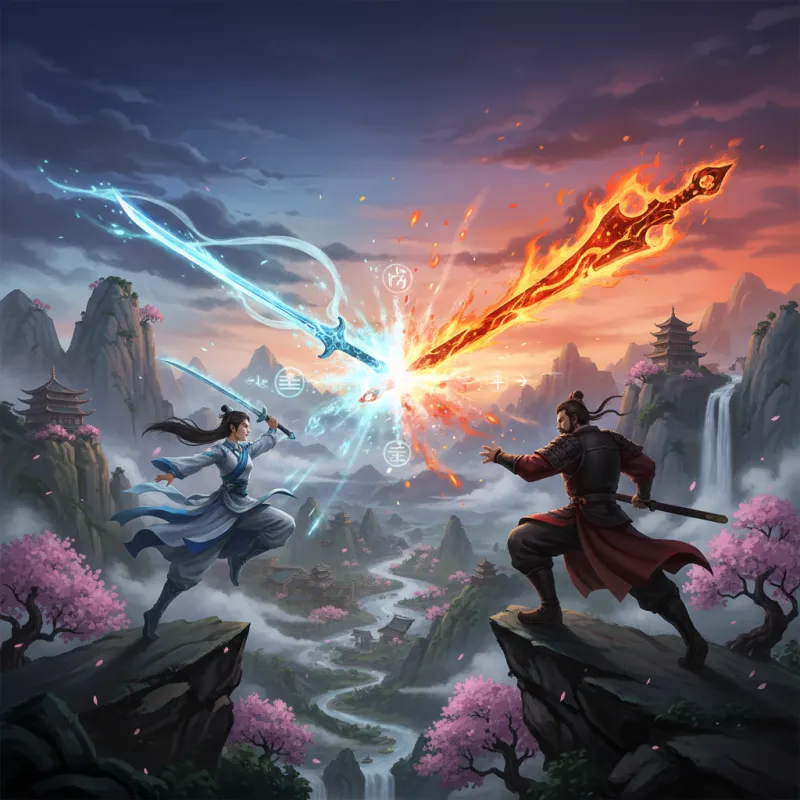
Two weapons. One prophecy. Countless lives lost in pursuit of their secrets. The Heavenly Sword (倚天剑, Yǐtiān Jiàn) and Dragon Saber (屠龙刀, Túlóng Dāo) aren't just legendary blades in Jin Yong's martial arts universe—they're the ultimate MacGuffins that drive an entire generation of jianghu warriors to madness, betrayal, and bloodshed. And here's the kicker: their true power has nothing to do with cutting through armor or channeling internal energy.
The Prophecy That Launched a Thousand Ambushes
"The supreme martial artist rules the world; the precious saber slays the dragon. Command the realm, none dare disobey. Relying on Heaven, who can compete?" (武林至尊,宝刀屠龙,号令天下,莫敢不从,倚天不出,谁与争锋). This sixteen-character verse, whispered in teahouses and shouted on battlefields, transforms two weapons into objects of obsession throughout The Heaven Sword and Dragon Saber (倚天屠龙记, Yǐtiān Túlóng Jì). Jin Yong published this novel between 1961 and 1963, but he set the story during the final decades of the Yuan Dynasty (1271-1368), when Mongol rule was crumbling and Chinese resistance movements were gaining momentum.
The prophecy works because it's deliberately vague. Does "ruling the world" mean martial supremacy? Political power? Both? Jin Yong understood that ambiguity breeds conflict, and conflict drives narrative. Every sect leader, ambitious warrior, and scheming villain interprets these words differently, projecting their own desires onto cold steel.
Forged from Tragedy: The Weapons' True Origin
Here's what separates these weapons from typical legendary swords in wuxia fiction: they're born from love and sacrifice, not conquest. The Heavenly Sword was forged by Guo Jing and Huang Rong—heroes from Jin Yong's earlier novel The Legend of the Condor Heroes—using the blade of Yang Guo's Gentleman Sword. The Dragon Saber came from the Dark Iron Heavy Sword, the weapon that accompanied Yang Guo through his own legendary adventures in The Return of the Condor Heroes.
This genealogy matters. Jin Yong didn't just create powerful weapons; he embedded them with narrative DNA from his previous works. When Zhang Wuji finally discovers what's hidden inside these blades, he's not just uncovering martial arts secrets—he's inheriting the wisdom of heroes who came before him. The weapons become vessels of generational knowledge, a very Confucian concept wrapped in wuxia packaging.
But why hide anything inside weapons at all? Guo Jing and Huang Rong faced an impossible choice: the Mongol invasion was inevitable, and they knew Xiangyang would eventually fall. Rather than let the Nine Yin Manual (九阴真经, Jiǔ Yīn Zhēnjīng) and Eighteen Dragon-Subduing Palms (降龙十八掌, Jiàng Lóng Shíbā Zhǎng) fall into enemy hands, they sealed these supreme martial arts texts inside the weapons, along with Yue Fei's military treatise. It's a time capsule strategy—preserve knowledge for future generations who might need it to resist tyranny.
The Heavenly Sword: Grace and Precision
The Heavenly Sword embodies yin energy—not weakness, but the kind of flexible, adaptive power that flows like water. Its blade is impossibly sharp, capable of cutting through ordinary weapons like silk. In the novel, it becomes associated with the Emei Sect (峨眉派, Éméi Pài), particularly with Abbess Miejue, whose rigid interpretation of righteousness makes her one of the story's most complex antagonists.
Miejue wields the Heavenly Sword with technical perfection but spiritual blindness. She uses a weapon forged by heroes to perpetuate sectarian hatred, particularly against the Ming Cult (明教, Míng Jiào). Jin Yong's commentary here cuts deep: possessing a legendary weapon doesn't make you worthy of it. The sword's true power—the knowledge hidden within—remains inaccessible to her because she's too consumed by vengeance to seek wisdom.
The sword's design reflects classical Chinese aesthetics. Unlike the Dragon Saber's brutal efficiency, the Heavenly Sword is described as elegant, with a slender blade and refined guard. It's the weapon of scholars and strategists, people who understand that the highest martial arts transcend mere violence. When Zhou Zhiruo eventually claims it, she represents another cautionary tale: ambition without moral foundation leads to corruption, regardless of how refined your technique becomes.
The Dragon Saber: Raw Power Unleashed
If the Heavenly Sword is a scalpel, the Dragon Saber is a sledgehammer—and sometimes you need a sledgehammer. This blade represents yang energy: direct, overwhelming, unstoppable force. Its weight alone makes it unsuitable for most martial artists, requiring tremendous internal strength just to wield effectively.
The saber's history is soaked in blood. Xie Xun, the Golden Lion King, uses it to carve a path of vengeance across the jianghu, killing countless people in his quest to avenge his family. The weapon doesn't corrupt him—his trauma does that—but it enables his rage to manifest on a catastrophic scale. This is Jin Yong asking uncomfortable questions: Can a weapon be evil? Or does it simply amplify what's already in the wielder's heart?
Zhang Wuji's relationship with the Dragon Saber is telling. He never truly masters it as a weapon because he's fundamentally unsuited to its brutal philosophy. He's a healer, someone who learned the Nine Yang Divine Skill to protect rather than destroy. When he finally breaks both weapons to reveal their secrets, it's not just a plot resolution—it's a philosophical statement. The real treasure was never the weapons themselves but the knowledge they preserved.
The Breaking: Wisdom Over Weapons
The climactic moment when Zhang Wuji shatters both the Heavenly Sword and Dragon Saber is one of Jin Yong's most subversive narrative choices. Readers spend an entire novel watching characters kill and scheme for these weapons, only to see them destroyed. It's anticlimactic by design.
Inside, Zhang Wuji finds the Nine Yin Manual, the Eighteen Dragon-Subduing Palms, and Yue Fei's military strategies—knowledge that helps the Chinese resistance overthrow Mongol rule and establish the Ming Dynasty. The weapons were never meant to be used; they were meant to be broken. Guo Jing and Huang Rong understood that future generations would need wisdom more than sharp edges.
This twist reframes everything that came before. Every death, every betrayal, every sect war fought over these weapons was ultimately pointless. The prophecy was a test, and almost everyone failed it. Only Zhang Wuji, who never sought the weapons for power, proves worthy of their true gift.
Legacy in Wuxia Culture
The Heavenly Sword and Dragon Saber have transcended their original novel to become archetypal symbols in Chinese popular culture. They appear in countless adaptations—television series, films, video games, and comics—each interpretation adding new layers to their mythology. The 2019 television adaptation alone reached over 4 billion views, proving these weapons still captivate audiences nearly sixty years after Jin Yong first wrote about them.
What makes them endure? They represent a fundamentally Chinese approach to power: the idea that true strength comes from wisdom, not violence. The weapons are powerful, yes, but their ultimate purpose is educational. They're teaching tools disguised as instruments of war, a very Confucian concept that resonates across generations.
Modern wuxia writers continue to reference these weapons, either directly or through obvious homages. Any story featuring twin legendary artifacts that must be united to reveal a greater truth owes a debt to Jin Yong's creation. The formula works because it externalizes internal conflict—the struggle between seeking power and seeking wisdom—into physical objects that characters can fight over.
The Weapons We Choose
In the end, the Heavenly Sword and Dragon Saber ask us to consider what we're really pursuing. Are we chasing power for its own sake, like Abbess Miejue and Zhou Zhiruo? Or are we seeking the wisdom to use power responsibly, like Zhang Wuji eventually learns to do? The weapons themselves are neutral—beautiful, deadly, and ultimately empty vessels waiting to be filled with meaning by whoever wields them.
Jin Yong understood that the best wuxia stories aren't really about martial arts at all. They're about choices, consequences, and the eternal human struggle to become worthy of the power we seek. The Heavenly Sword and Dragon Saber remain legendary not because they're the sharpest blades in the jianghu, but because they force everyone who encounters them to reveal their true character. And in that revelation, we see ourselves reflected back—our ambitions, our flaws, and perhaps, if we're lucky, our capacity for wisdom.
Related Reading
- Hidden Weapons: The Assassin's Arsenal
- Legendary Weapons of Wuxia: The Swords That Have Names
- The Most Famous Swords in Wuxia Fiction: A Definitive Ranking
- Hidden Weapons: The Dark Arts of Wuxia Combat
- The Art of War: Exploring Weapons in Chinese Martial Arts (Wuxia) Fiction
- Yang Guo: The One-Armed Swordsman
- Kunlun Mountain: The Paradise at the Center of the World
- Best Wuxia TV Dramas: A Streaming Guide for International Viewers
Explore Chinese Culture
- Explore Jin Yong's martial arts novels
- Explore cultivation fiction and immortal heroes
- Explore the real history behind wuxia