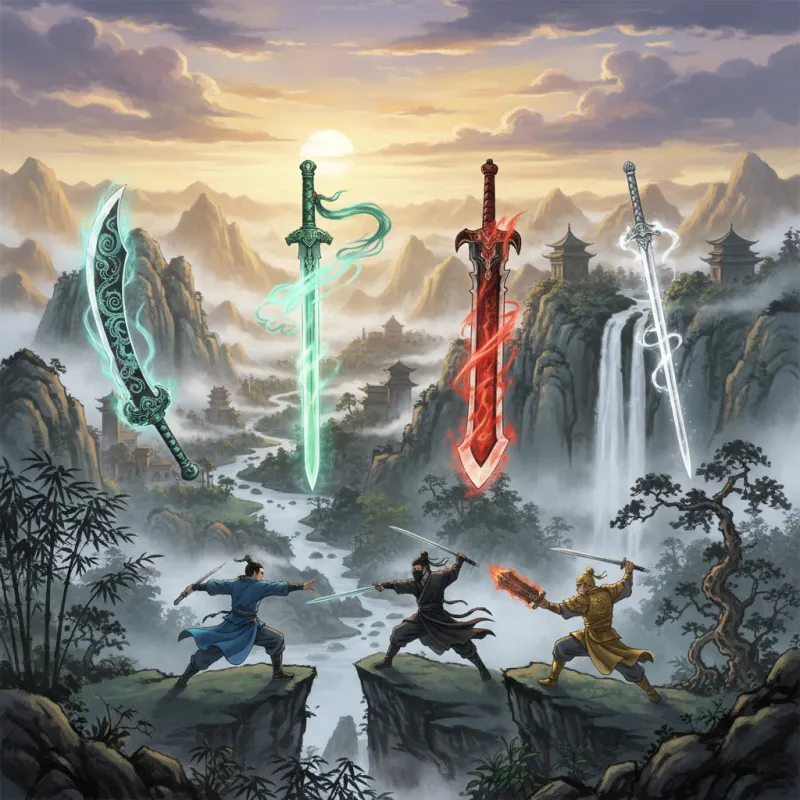
A sword falls from its sheath in a quiet room, and three provinces go to war. This isn't hyperbole — it's the basic plot structure of half the wuxia novels ever written. In Chinese martial arts fiction, legendary weapons don't just cut through armor. They cut through families, sects, and entire generations of martial artists who convince themselves that this time will be different, that they can control the blade's destiny instead of becoming another name in its bloody ledger.
The Western reader expects Excalibur: a sword that makes the worthy hero stronger. The wuxia reader knows better. Every legendary blade in the jianghu (江湖 jiānghú, "rivers and lakes" — the martial arts underworld) is a test that most people fail. The question isn't whether you're strong enough to wield it. The question is whether you're wise enough to walk away.
The Heaven Sword and Dragon Saber: When Weapons Become Destiny
Jin Yong (金庸) didn't just write about the Yǐtiān Jiàn (倚天剑, "Heaven-Relying Sword") and Túlóng Dāo (屠龙刀, "Dragon-Slaying Saber") — he named an entire novel after them. The Heaven Sword and Dragon Saber (倚天屠龙记) spans decades and follows multiple generations, all because two weapons exist and everyone in the martial arts world has decided they need to possess them.
Here's what makes these weapons brilliant as narrative devices: nobody actually knows what makes them special for most of the novel. There's a saying in the jianghu: "Treasured saber slays the dragon, commands the world; Precious sword relies on heaven, none under heaven can rival it" (武林至尊,宝刀屠龙,号令天下,莫敢不从;倚天不出,谁与争锋). Generations of martial artists murder each other over these weapons based entirely on a cryptic poem and the assumption that power must be hidden inside.
The truth? The weapons contain hidden martial arts manuals and military texts. But the real treasure isn't the knowledge — it's that the weapons force every character to reveal who they truly are when power is within reach. Zhang Wuji, the protagonist, spends most of the novel trying to avoid both weapons. He understands what the ambitious fighters don't: possessing these blades means becoming responsible for every death that follows.
The Sword of the Yue Maiden: When Simplicity Becomes Legend
Not every legendary sword needs an elaborate backstory. In Jin Yong's The Sword of the Yue Maiden (越女剑), the protagonist Ah Qing wields a bamboo stick and defeats armies. The "sword" isn't the object — it's the technique, the understanding, the way a young woman from the countryside moves with such perfect economy that trained soldiers can't touch her.
This is the sword technique that supposedly influenced the historical state of Yue during the Spring and Autumn period (770-476 BCE). Jin Yong takes a brief mention from historical texts and builds an entire philosophy: the greatest swordsmanship doesn't require a legendary blade. It requires a legendary swordsman.
The story inverts the usual wuxia formula. Instead of a hero seeking a famous weapon, we watch a weapon (or rather, a technique) become famous because of who wields it. Ah Qing's bamboo stick becomes more feared than any named blade in the kingdom. When she finally receives an actual sword, it's almost anticlimactic — she was already complete without it.
The Gentleman's Sword and Lady's Sword: Gu Long's Romantic Tragedy
Gu Long (古龙) approached legendary weapons differently than Jin Yong. Where Jin Yong's swords carry historical weight and hidden secrets, Gu Long's weapons are extensions of doomed relationships. The Gentleman's Sword (君子剑) and Lady's Sword (淑女剑) from The Legendary Siblings (绝代双骄) aren't just weapons — they're a married couple's matching set, symbols of a love that couldn't survive the jianghu's cruelty.
What makes these swords memorable isn't their combat power. It's that they represent everything the martial arts world destroys: trust, partnership, the possibility of a life beyond revenge and ambition. The swords' owners, Yan Nantian and his wife, are separated by betrayal and conspiracy. The weapons become relics of what could have been, carried by the next generation who don't fully understand the tragedy they've inherited.
Gu Long understood that in wuxia fiction, the most powerful weapons aren't the ones that kill the most enemies. They're the ones that make you feel the weight of every choice that led to drawing the blade. These swords don't make their wielders stronger — they make them lonelier.
The Peacock Plume: When a Weapon Is Too Perfect
Sometimes a legendary weapon's problem is that it works too well. The Peacock Plume (孔雀翎 Kǒngquè Líng) from Gu Long's Seven Weapons series is a hidden projectile weapon that never misses and kills instantly. It's beautiful, elegant, and absolutely devastating. It's also a trap.
The weapon's creator designed it to be perfect, and that perfection is precisely what corrupts its users. When you carry a weapon that guarantees victory, you stop growing as a martial artist. You stop thinking strategically. You become dependent on a tool instead of developing your own skills. The Peacock Plume's wielders in Gu Long's stories consistently discover that having an unbeatable weapon makes them weaker, not stronger.
This connects to a broader theme in wuxia fiction: legendary weapons as crutches. The greatest martial artists in these novels — characters like Dugu Qiubai (独孤求败, "Lonely Seeking Defeat") from Jin Yong's works — eventually abandon weapons entirely. Dugu Qiubai's progression is famous: he starts with a sharp sword, moves to a heavy sword, then a wooden sword, and finally no sword at all. The legendary weapon becomes a stepping stone to transcendence, not the destination.
The Sword of Defeat: Embracing Imperfection
Speaking of Dugu Qiubai, his unnamed sword (often called the "Heavy Iron Sword" or 玄铁重剑 Xuántiě Zhòngjiàn) represents a different philosophy entirely. This isn't a blade forged by master craftsmen with secret techniques. It's a massive, crude chunk of iron that weighs over seventy pounds. It has no edge. It's not beautiful. It's barely even a sword by conventional standards.
And it's one of the most important weapons in wuxia fiction.
The inscription on the sword reads: "After age forty, I was no longer constrained by weapons. Trees, bamboo, stones, all can be swords" (四十岁后,不滞于物,草木竹石均可为剑). This is the endpoint of martial arts mastery in Jin Yong's universe — the understanding that legendary weapons are training wheels. Yang Guo, who inherits this sword in Return of the Condor Heroes (神雕侠侣), spends years learning to wield it before he understands the real lesson: the sword's weight forces you to move with perfect efficiency. Every wasted motion becomes impossible.
The Heavy Iron Sword is legendary not because it's powerful, but because it's honest. It doesn't promise shortcuts or hidden techniques. It just makes you stronger through brutal, unglamorous practice. In a genre filled with magical blades and secret manuals, this chunk of iron might be the most subversive weapon of all.
The Swords We Don't Draw
The most interesting thing about legendary swords in wuxia fiction isn't how they're used — it's how often the wisest characters refuse to use them at all. In Demi-Gods and Semi-Devils (天龙八部), Duan Yu spends the entire novel carrying a legendary sword he never draws. He's taken a Buddhist vow against killing, and the sword remains sheathed through hundreds of chapters of conflict.
This drives other characters insane. They see a powerful weapon going to waste. They offer to take it from him, to put it to "proper use." Duan Yu's refusal isn't weakness — it's the novel's clearest example of strength. He understands what the ambitious fighters don't: drawing a legendary sword means accepting everything that comes with it. The challenges, the enemies, the corruption of believing you're special because you hold a special weapon.
The parallel to cultivation techniques is obvious — both legendary weapons and supreme martial arts can become prisons. The fighter who defines themselves by their sword or their technique stops growing. They become the weapon's wielder instead of their own person. The truly transcendent martial artists in wuxia fiction are the ones who can pick up any weapon, or no weapon, and still be themselves.
Why We Keep Reading About Cursed Swords
Western fantasy has spent decades trying to recapture the magic of Excalibur — the sword that proves the hero's worthiness. Wuxia fiction asks a more interesting question: what if the sword proves nothing except that you were ambitious or foolish enough to pick it up?
The legendary weapons in these novels are narrative engines. They force characters to make choices, reveal their true nature, and face consequences that ripple across generations. The Heaven Sword and Dragon Saber don't just cut through armor — they cut through the pretense that power can be controlled without cost. The Peacock Plume doesn't just kill enemies — it kills the wielder's potential for growth.
These weapons are legendary not because they're powerful, but because they're true. They tell us that in the jianghu, as in life, the most dangerous thing you can possess is something everyone else wants. The smartest characters in wuxia fiction understand this instinctively. They see a legendary sword and think not "how can I use this?" but "how can I avoid becoming another cautionary tale?"
That's why these stories endure. Not because we want to wield the Heaven Sword, but because we recognize the temptation and the trap. Every legendary weapon in wuxia fiction is a mirror, and what it reflects isn't always flattering. The question isn't whether you're strong enough to lift the blade. The question is whether you're wise enough to put it down.
Related Reading
- Hidden Weapons: The Dark Arts of Wuxia Combat
- The Green Destiny: Most Famous Sword in Wuxia Cinema
- The Most Famous Swords in Wuxia Fiction: A Definitive Ranking
- Hidden Weapons: The Assassin's Arsenal
- Martial Arts Manuals: The Most Sought-After Treasures in Wuxia
- The Allure of Wuxia: Exploring Chinese Martial Arts Fiction and Jianghu Culture
- The Complete Guide to Jianghu Heroes in Wuxia Fiction
- Sun Wukong: The Great Sage Who Challenged Heaven
Explore Chinese Culture
- Explore Jin Yong's martial arts novels
- Explore cultivation fiction and immortal heroes
- Explore the real history behind wuxia