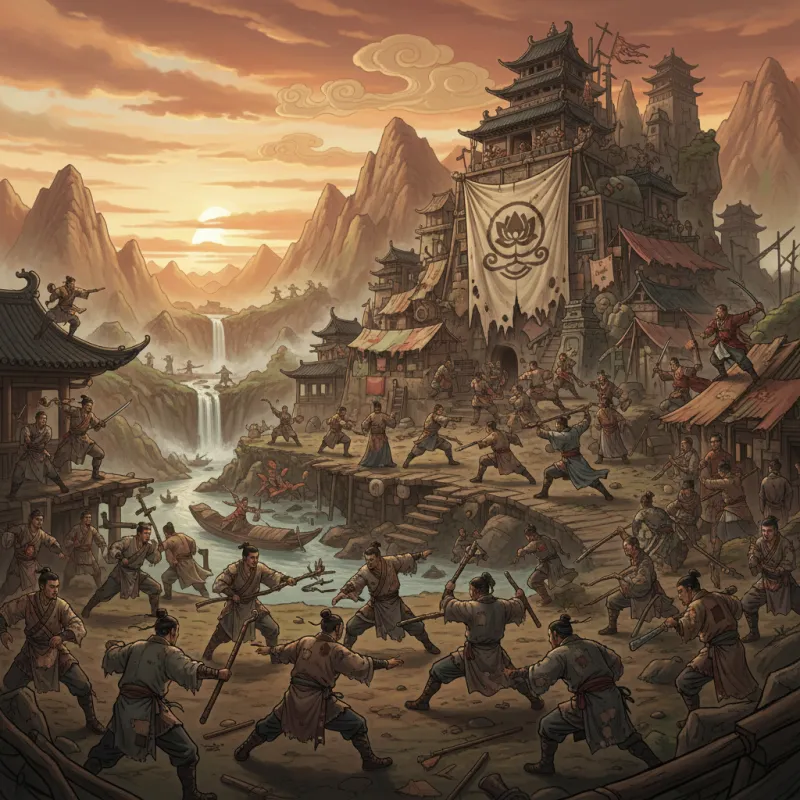
They say the emperor has ten thousand eyes, but the Beggar Sect has ten million. While nobles scheme behind silk curtains and martial artists duel on mountaintops, an army of the dispossessed watches from every street corner, every teahouse, every bridge and crossroads in the realm. The Beggar Sect (丐帮 Gàibāng) shouldn't work—a martial arts organization built from society's castoffs, people who own nothing but their begging bowls and bamboo staffs. Yet in wuxia fiction, they consistently rank among the most formidable forces in the 江湖 (jiānghú, the martial world), proving that power doesn't always flow from the throne downward.
The Paradox of Power Without Property
What makes the Beggar Sect brilliant as a fictional construct is how it inverts every assumption about institutional power. Traditional sects like Shaolin Temple or Wudang derive authority from sacred mountains, ancient lineages, and accumulated wealth. The Beggar Sect has none of this. They own no land. They claim no noble ancestry. Their headquarters is wherever their leader happens to be standing.
And yet they're everywhere. That's the trick. While other sects must maintain fixed locations that can be besieged or infiltrated, the Beggar Sect is fluid, distributed across every town and village in China. Their intelligence network is unmatched because beggars are invisible—people look through them, speak freely around them, discard documents near them. Jin Yong (Louis Cha) understood this when he made the Beggar Sect central to multiple novels: information is power, and nobody gathers information like those society has trained itself not to see.
The Nine-Bag Hierarchy
The Beggar Sect's ranking system is one of wuxia's most memorable organizational structures. Members are distinguished by the number of cloth bags they carry, from one to nine. New initiates start with a single bag. The sect leader carries nine.
This isn't just decorative worldbuilding—it's thematically perfect. In a society obsessed with jade ornaments, silk robes, and ceremonial swords, the Beggar Sect's status symbols are literal sacks for carrying scraps. The more bags you have, the more accomplished a beggar you are. It's a complete inversion of Confucian hierarchy, where status flows from education, family, and official position. Here, status comes from mastering the art of having nothing.
The promotion system varies by author, but generally involves demonstrating martial prowess, contributing to sect operations, and—crucially—maintaining the beggar's code. You can't buy your way up the ranks because you have no money. You can't inherit position because beggars have no families (or have abandoned them). Merit is the only currency, which makes the Beggar Sect paradoxically more meritocratic than the imperial bureaucracy.
The Dog-Beating Staff and Eighteen Dragon-Subduing Palms
Every major sect has signature martial arts, but the Beggar Sect's techniques carry extra symbolic weight. The Dog-Beating Staff Technique (打狗棒法 Dǎ Gǒu Bàng Fǎ) is passed down exclusively to each sect leader—a bamboo staff method designed, as the name suggests, for driving away dogs. It's humble in origin but devastating in application, with techniques named things like "There's No Dog in the World" and "Stick Hits the Dog's Head."
The genius here is that Jin Yong took the most degrading aspect of beggar life—being chased by dogs, treated as less than human—and transformed it into the sect's most treasured martial art. The staff itself is unremarkable, often just a bamboo pole. But in the hands of a master, it becomes a weapon that can match any sword or saber. The technique emphasizes agility, unpredictability, and using the opponent's force against them—perfect for someone who can't rely on superior strength or equipment.
The Eighteen Dragon-Subduing Palms (降龙十八掌 Jiàng Lóng Shíbā Zhǎng) represents the sect's offensive peak. This palm technique, also traditionally passed to the sect leader, is pure overwhelming force—each strike named after hexagrams from the I Ching. "Haughty Dragon Repents" (亢龙有悔 Kàng Lóng Yǒu Huǐ), the most famous move, channels internal energy into a palm strike that can shatter stone and send opponents flying.
What's interesting is the contrast: the Dog-Beating Staff is clever and adaptive, while the Dragon-Subduing Palms are direct and powerful. Together, they represent the Beggar Sect's dual nature—simultaneously cunning and formidable, defensive and aggressive, humble and proud.
Hong Qigong: The Archetype
You can't discuss the Beggar Sect without talking about Hong Qigong (洪七公), the "Nine-Fingered Divine Beggar" from Jin Yong's Legend of the Condor Heroes. He's missing a finger because he cut it off himself as punishment for killing innocents while drunk—a detail that tells you everything about the character. Here's a man powerful enough to rank among the "Five Greats" of the martial world, yet who holds himself to a moral standard so strict he'll mutilate himself for breaking it.
Hong Qigong is perpetually hungry, obsessed with food, and utterly uninterested in the power struggles that consume other martial artists. He teaches Guo Jing the Dragon-Subduing Palms not because Guo is talented (he's famously slow-witted) but because Guo's wife Huang Rong cooks him delicious meals. This is leadership by whim, by appetite, by a moral compass that has nothing to do with Confucian propriety or Buddhist enlightenment.
Later sect leaders in Jin Yong's works—like Huang Rong herself, and eventually her daughter Guo Xiang—continue this tradition of unconventional leadership. The sect doesn't choose leaders based on martial prowess alone. They need someone who understands what it means to be powerless, who won't forget the sect's origins even when wielding techniques that can split mountains.
The Intelligence Network
The Beggar Sect's real superpower isn't martial arts—it's information. In Demi-Gods and Semi-Devils, set during the Song Dynasty, the sect's intelligence network spans the entire empire. They know which officials are corrupt, which merchants are smuggling, which martial artists are feuding. This information flows upward through the hierarchy, from one-bag members on street corners to nine-bag elders who coordinate regional operations.
This makes them invaluable allies and dangerous enemies. When the Mongols invade in Legend of the Condor Heroes, the Beggar Sect becomes crucial to Chinese resistance not because they can field an army, but because they can track troop movements, identify collaborators, and pass messages across occupied territory. Beggars cross borders freely—no one stops them, no one questions them.
The network also serves internal functions. The sect polices itself through constant observation. Break the code—steal, harm innocents, abuse power—and word spreads instantly. There's no hiding from an organization whose members are literally everywhere. This creates a strange kind of accountability: the Beggar Sect may be composed of society's outcasts, but they maintain stricter ethical standards than many "respectable" organizations.
The Beggar's Code and Jianghu Ethics
The Beggar Sect operates under a strict code that varies slightly between authors but generally includes: don't steal, don't harm innocents, help fellow beggars, and maintain sect secrets. These rules are enforced brutally—violators are expelled or executed. This seems harsh until you remember that the sect's entire existence depends on trust. They have no walls, no treasury, no legal protection. All they have is their word and their reputation.
This makes them a fascinating lens for examining jianghu ethics more broadly. The martial world operates outside imperial law, governed instead by unwritten codes of honor, loyalty, and face. The Beggar Sect takes this to an extreme: they're outside society entirely, yet they maintain order through shared values and mutual surveillance. They're anarchists with a rigid hierarchy, outcasts with a strong collective identity.
Jin Yong uses this tension to explore questions about justice and legitimacy. When imperial law fails the common people—and in wuxia, it always does—who has the right to enforce justice? The Beggar Sect's answer is: those who have nothing to gain from corruption, who can't be bribed because they own nothing, who understand suffering because they live it daily.
Why the Beggar Sect Endures
The Beggar Sect appears across wuxia media—novels, films, television, games—because it solves a narrative problem: how do you create a powerful organization that readers can root for without reservation? Sects tied to temples or mountains inevitably become conservative, protecting their interests and territory. Government-aligned groups serve the state, which in wuxia is usually corrupt. Family clans are insular and nepotistic.
The Beggar Sect has none of these problems. They can't become corrupt because they have nothing to corrupt. They can't become conservative because they own nothing to conserve. They can't become elitist because their membership is drawn from the lowest social stratum. This makes them perpetually sympathetic—the underdogs who, through discipline and skill, punch far above their weight.
There's also something deeply satisfying about watching beggars humble arrogant nobles and defeat supposedly superior martial artists. It's a fantasy of justice, of merit triumphing over birth, of the last becoming first. In a genre that often grapples with rigid social hierarchies and the abuse of power, the Beggar Sect represents the possibility that power structures can be challenged, that the dispossessed can organize, that society's invisible people might be its most formidable force.
The Beggar Sect works as fiction because it works as metaphor—for resistance, for solidarity among the marginalized, for the idea that true strength comes not from what you own but from what you're willing to fight for. They're an army in rags, and they've been winning battles for decades.
Related Reading
- Exploring Chinese Martial Arts Fiction and Jianghu Culture in Kung Fu Novels
- Shaolin Temple: The Birthplace of Chinese Martial Arts
- Wudang Mountain: The Daoist Heart of Internal Martial Arts
- Sects and Clans in Wuxia: The Organizations That Rule the Martial World
- The Knight-Errant (游侠): Real Warriors Who Inspired Wuxia
- Women Warriors in Wuxia: Beyond the Love Interest
- The Tang Clan: Masters of Hidden Weapons and Poison
Explore Chinese Culture
- Explore Jin Yong's martial arts novels
- Explore cultivation fiction and immortal heroes
- Explore the real history behind wuxia