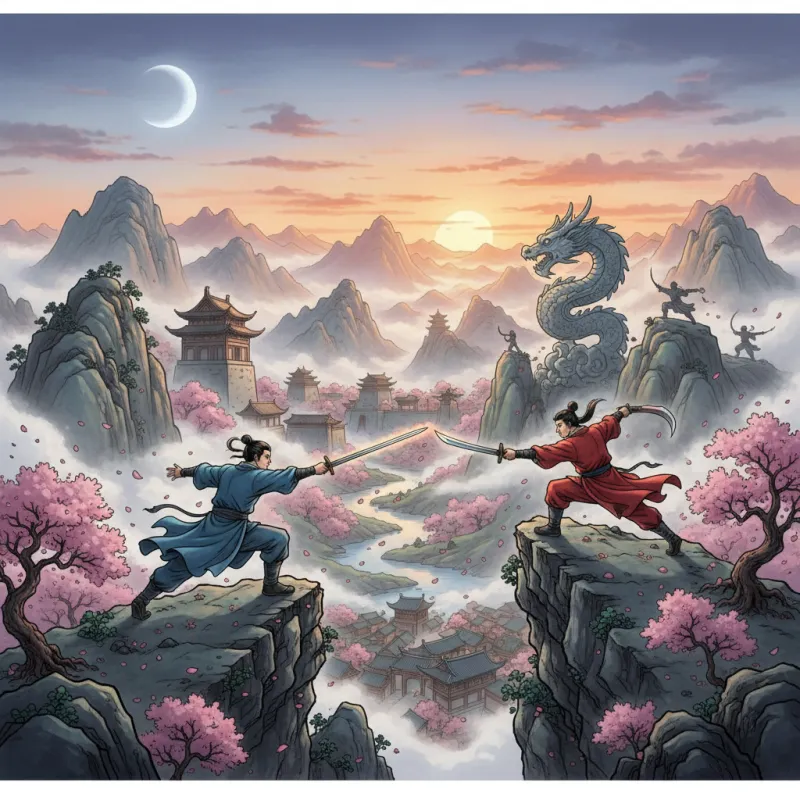
A blade flashes in moonlight. Two warriors face each other on a mountain pass, and before steel meets steel, they bow. One whispers, "I've heard of your reputation." The other replies, "Your master taught mine forty years ago." The fight that follows—or doesn't—will be decided not by skill alone, but by an invisible web of obligations, debts, and principles that every true martial artist carries like a second shadow. This is the Jianghu Code (江湖规矩, jiānghú guījǔ), and it's far more complex than Hollywood's "honor among thieves."
The Weight of a Promise
In Jin Yong's The Legend of the Condor Heroes (射雕英雄传), Guo Jing makes a promise to his sworn brother Yang Kang's mother—a promise that haunts him for decades and shapes the entire trajectory of the sequel novel. This isn't melodrama; it's the fundamental currency of jianghu (江湖, literally "rivers and lakes"). Your word isn't just your bond—it's your identity. Break it, and you're not merely dishonored; you cease to exist as a legitimate member of the martial world.
The concept of xinyong (信用, trustworthiness) operates differently here than in conventional society. A government official might lie to preserve the state. A merchant might deceive to protect profits. But a jianghu warrior who breaks their word? They've committed something closer to suicide. When Qiao Feng in Demigods and Semi-Devils (天龙八部) discovers his true identity, his anguish isn't just personal—it's the realization that his entire existence might be built on a broken promise to his people.
This explains why martial artists in wuxia novels often choose death over dishonor. It's not stubbornness; it's rational calculation. In a world where your reputation is your only collateral, where contracts are sealed with cupped fists rather than signatures, credibility isn't a virtue—it's survival.
The Hierarchy Nobody Admits Exists
Ask any jianghu warrior about hierarchy, and they'll tell you the martial world values skill above all. Then watch them navigate an actual encounter. The elaborate dance of seniority, lineage, and reputation makes Confucian court protocol look simple.
Shifu (师父, master) and tudi (徒弟, disciple) relationships create binding obligations that transcend blood family. When you address someone as "shixiong" (师兄, senior martial brother) or "shimei" (师妹, junior martial sister), you're not being polite—you're acknowledging a legal relationship in jianghu law. These bonds explain seemingly irrational behavior throughout wuxia literature. Why does Linghu Chong in The Smiling, Proud Wanderer (笑傲江湖) endure years of suspicion from his sect? Because abandoning your shifu is worse than death.
But here's where it gets interesting: the system has escape valves. The concept of "leaving the sect" (离开师门, líkāi shīmén) exists precisely because the obligations can become unbearable. It's the jianghu equivalent of divorce—painful, public, but recognized as sometimes necessary. What's unforgivable isn't leaving; it's betraying. Yue Buqun in the same novel doesn't fall because he's ambitious—he falls because he betrays the principles his position demands he uphold.
The unspoken rule? Respect the hierarchy in public, but everyone knows that true skill eventually trumps formal rank. This tension—between official structure and actual ability—drives half the plot conflicts in wuxia fiction. It's also remarkably similar to how real martial arts schools operated during the Ming and Qing dynasties, where a master's reputation could be destroyed by a single defeat, regardless of their official position.
Debts That Compound Like Interest
Save someone's life in the jianghu, and you've just made an investment that might pay dividends three generations later. The concept of renqing (人情, human obligation) operates like a parallel economy. Martial artists track these debts with accounting precision that would impress a Shanxi banker.
In The Heaven Sword and Dragon Saber (倚天屠龙记), Zhang Wuji spends half the novel repaying debts he didn't personally incur—obligations inherited from his parents, his godfather, even his sect's founder from a century prior. This isn't narrative convenience; it's how the system actually works. When you join a sect or swear brotherhood, you inherit their balance sheet of favors owed and owed to.
The genius of this system is its flexibility. Can't repay a life debt? Your child can. Your disciple can. Someone from your sect three decades later can. This creates a web of interconnected obligations that makes the jianghu remarkably stable despite its apparent lawlessness. Everyone is simultaneously creditor and debtor, which means everyone has incentive to maintain the system.
But there's a dark side. These debts can be weaponized. Demanding repayment at an inconvenient moment is a recognized tactic. Refusing to accept repayment—thus keeping someone in your debt—is another. The most sophisticated jianghu politicians, like Huang Yaoshi in Jin Yong's works, manipulate these obligation networks like chess pieces. They understand that in a world without courts or contracts, debt is power.
When Codes Collide
The most compelling moments in wuxia fiction happen when different parts of the code contradict each other. Loyalty to your master versus righteousness toward the innocent. A promise to one person versus an obligation to another. These aren't just plot devices—they're genuine ethical dilemmas that the code doesn't resolve.
Gu Long's novels, particularly The Legendary Siblings (绝代双骄), excel at exploring these contradictions. His characters often face situations where every choice violates some principle. This reflects a sophisticated understanding: the Jianghu Code isn't a clear rulebook but a collection of competing values that must be balanced through wisdom and judgment.
The concept of yi (义, righteousness) theoretically trumps everything else. But what is righteousness? Different sects, different regions, even different eras of jianghu history have answered this differently. The Beggars' Sect (丐帮, gàibāng) might define it as protecting the common people. The Mount Hua Sect might see it as preserving orthodox martial arts. A wandering swordsman might interpret it as personal integrity above all.
This ambiguity isn't a flaw in the system—it's a feature. It allows for the kind of moral complexity that makes wuxia literature more than simple adventure stories. It also mirrors the actual ethical debates in Chinese philosophy, where Confucian, Daoist, and Buddhist principles often suggest different courses of action.
The Price of Reputation
In the jianghu, your reputation (名声, míngshēng) is simultaneously your resume, your credit score, and your legal identity. Damage it, and you're finished. This explains the elaborate rituals around challenges and duels. Before crossing swords, martial artists exchange names, lineages, and often the reason for their conflict. This isn't courtesy—it's documentation.
The system of "declaring your name" (报上名来, bào shàng míng lái) serves multiple functions. It prevents accidental conflicts between allies. It ensures witnesses can report the outcome accurately. Most importantly, it makes reputation the stake in every encounter. Win honorably, and your name rises. Win through deception, and you might wish you'd lost.
This creates fascinating strategic considerations. Sometimes the smart move is to lose publicly to a superior opponent—it costs you nothing and might earn respect for your courage. Other times, refusing a challenge is wiser than accepting, even if it looks cowardly. The calculation isn't just "can I win?" but "what will this fight do to my standing?"
The concept of "washing away shame" (洗刷耻辱, xǐshuā chǐrǔ) drives entire story arcs. A single defeat or insult can require years of training and preparation to address properly. This isn't vanity—in a reputation economy, unaddressed shame is bankruptcy. You can't function in the jianghu if other martial artists don't respect you.
The Unwritten Becomes Written
Here's the paradox: the Jianghu Code works precisely because it's unwritten. The moment you codify it, you create loopholes. You enable rules-lawyering. You transform a living ethical tradition into dead bureaucracy. Yet every major sect in wuxia fiction eventually tries to write down their principles, and it always causes problems.
The Wudang Sect's emphasis on Daoist principles, the Shaolin Temple's Buddhist precepts, the Huashan Sect's focus on orthodox techniques—these are all attempts to formalize what should remain fluid. They work as general guidelines but fail as rigid rules. The greatest martial artists in wuxia literature are often those who understand the spirit of the code well enough to know when to break its letter.
This tension between written and unwritten law reflects actual Chinese legal and philosophical traditions. The Confucian concept of li (礼, ritual propriety) was never meant to be a legal code but a framework for judgment. Similarly, the Jianghu Code provides principles, not prescriptions. It tells you what values to consider, not what decision to make.
Modern wuxia authors like Gu Long and Huang Yi have explored what happens when the old code meets new circumstances. In Huang Yi's The Legend of the Tang Dynasty (大唐双龙传), characters navigate a jianghu transformed by political upheaval, where traditional sect loyalties clash with national interests. The code doesn't break—it adapts, sometimes painfully.
Living the Code Today
Walk into a traditional martial arts school in Taiwan or Hong Kong today, and you'll still see echoes of the Jianghu Code. Students bow to their master's portrait. Senior students guide junior ones. Lineage matters. Reputation matters. The elaborate courtesy, the careful attention to hierarchy, the emphasis on character over technique—these aren't historical reenactments. They're living traditions.
But the code has also evolved. Modern martial artists must balance traditional obligations with contemporary ethics. The old rule that you never question your master conflicts with modern ideas about abuse and accountability. The emphasis on sect loyalty clashes with individual autonomy. The prohibition against teaching outsiders seems archaic in an era of YouTube tutorials.
Yet something essential persists. The idea that martial arts training is inseparable from ethical training. That skill without character is dangerous. That you owe debts to those who taught you. That your reputation is built through consistent action over time, not social media posts. These principles, stripped of their feudal trappings, remain relevant.
The Jianghu Code, at its best, isn't about rigid rules but about recognizing that we exist in webs of obligation and relationship. Every action has consequences that ripple outward. Every choice affects not just ourselves but our teachers, students, friends, and even strangers who might hear our story. In a world that increasingly treats ethics as personal preference, there's something compelling about a tradition that insists: your choices matter, your word matters, and honor isn't optional—it's the only thing that makes you real.
For more on the social structures that enforce these codes, see Martial Arts Sects and Schools. To understand the weapons that symbolize these values, explore Legendary Weapons in Wuxia.
Related Reading
- Wuxia Culture: How Martial Arts Fiction Shaped Modern Chinese Society
- Tea, Wine, and Food: The Culinary Culture of Wuxia
- Tea Houses and Wine Shops: The Social Hubs of the Martial World
- Wuxia in Modern Culture: From Novels to Netflix
- Tea Houses in Wuxia: Where Stories Begin
- Qinggong: The Art of Lightness in Wuxia Fiction
- Sun Wukong: The Great Sage Who Challenged Heaven
- Penglai Island: The Legendary Isle of Immortals
Explore Chinese Culture
- Explore Jin Yong's martial arts novels
- Explore cultivation fiction and immortal heroes
- Explore the real history behind wuxia