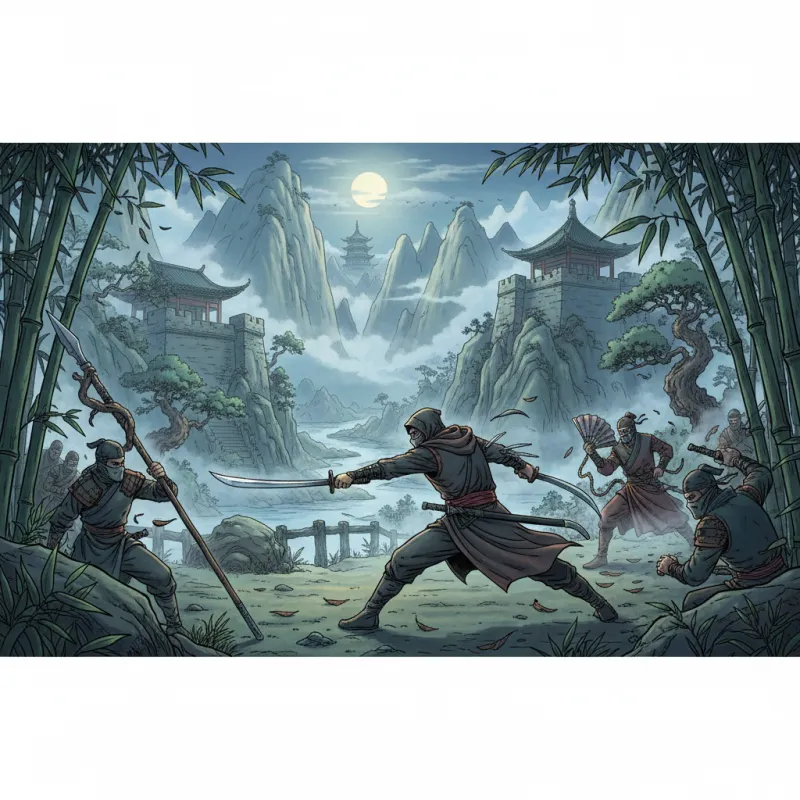
A needle slips from a sleeve. A fan snaps open to reveal razor edges. In the half-second it takes to blink, three lives end before anyone realizes a weapon was drawn. This is the art of concealed killing—where the deadliest blade is the one you never see coming.
The Philosophy of Concealment
Hidden weapons (暗器, ànqì) occupy a peculiar space in jianghu morality. Orthodox sects like Shaolin and Wudang publicly disdain them as tools of cowards, yet even the most righteous heroes keep a few throwing needles tucked away for emergencies. The truth is that concealed weapons represent something deeper than mere assassination tools—they embody the wuxia principle that true mastery means adapting to any situation. When Gu Long wrote about Li Xunhuan's flying daggers in Duoqing Jianke Wuqing Jian, he wasn't just describing a weapon; he was exploring how a gentleman could maintain his honor while using an "dishonorable" tool.
The distinction matters. A hidden weapon wielded by a righteous hero becomes an equalizer against overwhelming odds. The same weapon in an assassin's hands becomes an instrument of treachery. Jin Yong understood this duality perfectly when he created characters like Huang Yaoshi, whose jade flute could kill as easily as it could make music. The weapon itself carries no morality—only the hand that wields it does.
The Classic Arsenal
Let's talk specifics. The most iconic hidden weapon in wuxia literature is undoubtedly the flying needle (飞针, fēizhēn). Thinner than a strand of hair, nearly invisible in flight, and capable of striking acupoints with surgical precision—these are the weapons of choice for characters who value subtlety over spectacle. In The Heaven Sword and Dragon Saber, the Emei Sect's needles could seal meridians or induce paralysis depending on where they struck. The genius of needle techniques lies in their versatility: they can kill, disable, or simply send a warning.
Then there are the throwing knives (飞刀, fēidāo), which occupy the opposite end of the spectrum. Li Xunhuan's Little Li Flying Dagger never missed—not because of supernatural accuracy, but because he only threw when success was certain. That's the difference between a hidden weapon master and an amateur: knowing when not to strike. Gu Long spent an entire novel building up the legend of that single dagger, and when it finally flew, readers had been so thoroughly prepared that the moment felt inevitable.
Sleeve arrows (袖箭, xiùjiàn) deserve special mention for their mechanical ingenuity. Spring-loaded, poison-tipped, and fired with a flick of the wrist, these devices appear frequently in Tang Dynasty wuxia settings. The Tang Sect (唐门, Táng Mén) of Sichuan built their entire reputation on hidden weapons, developing hundreds of variations on the basic concept. Their poison techniques worked in tandem with their mechanical weapons, creating a synergy that made them feared throughout the jianghu.
The Art of Delivery
Here's what most people miss: the weapon itself is only half the equation. Delivery method separates masters from pretenders. Consider the difference between throwing a needle with your fingers versus using internal energy (内力, nèilì) to propel it. The latter can punch through armor; the former barely penetrates cloth. This is why hidden weapon techniques almost always appear in conjunction with advanced qigong training.
The Rainstorm Pear Blossom Needle (暴雨梨花针, Bàoyǔ Líhuā Zhēn) exemplifies this principle. This device, featured in various wuxia novels, fires dozens of needles simultaneously in a cone-shaped pattern. Sounds impressive until you realize that without proper internal energy control, the needles scatter uselessly. A true master can guide each needle to a specific target using qi manipulation—turning a shotgun blast into a precision strike.
Timing matters just as much as power. The best hidden weapon users in wuxia fiction share a common trait: they attack during moments of distraction. Mid-conversation, during a laugh, while pouring tea—these are the moments when guards drop. Ouyang Feng in The Legend of the Condor Heroes understood this instinctively. His snake staff wasn't technically a hidden weapon, but he used it with the same philosophy: strike when the opponent's mind is elsewhere.
Unconventional Implements
The most creative hidden weapons aren't weapons at all—they're everyday objects transformed into instruments of death. Jin Yong excelled at this concept. Musical instruments become particularly deadly in his novels: flutes that fire poison darts, zithers with razor-wire strings, drums that generate sonic attacks. Huang Yaoshi's jade flute could shatter internal organs with the right melody, while his wife's zither techniques could control minds.
Chess pieces, coins, flower petals, even grains of rice—in the hands of a master, anything becomes lethal. This reflects a deeper truth about martial arts philosophy: the weapon is merely an extension of the practitioner's will. When Dugu Qiubai reached the highest level of sword mastery, he could kill with a twig. Hidden weapon experts operate on the same principle, just with more emphasis on surprise.
The most disturbing hidden weapons are those concealed within the body itself. Bone needles implanted under fingernails, poison sacs hidden in false teeth, blades sewn into the lining of the stomach—these appear in darker wuxia stories, particularly those dealing with demonic sects. The Sunflower Manual's practitioners in The Smiling, Proud Wanderer took this to extremes, transforming their entire bodies into weapons through horrific self-mutilation.
Training and Mastery
Learning hidden weapons isn't like learning sword forms. There's no elegant progression of stances, no philosophical discourse about the nature of the blade. It's repetition until your muscles remember the exact angle, force, and timing required. Ten thousand throws to achieve basic competence. A hundred thousand to approach mastery. And even then, you're not guaranteed success.
The Tang Sect's training methods, as described in various novels, border on the sadistic. Students begin by throwing needles at moving targets while blindfolded, developing an almost supernatural sense of spatial awareness. They practice in darkness, in wind, in rain—any condition that might occur during actual combat. The failure rate is astronomical, but those who survive become living weapons.
Internal energy training runs parallel to physical practice. Without sufficient qi cultivation, hidden weapons remain mere projectiles. With it, they become extensions of the practitioner's will, capable of changing direction mid-flight or penetrating defenses that should be impenetrable. This is why hidden weapon masters typically come from sects with strong internal cultivation traditions—the Tang Sect, Emei, certain branches of the Beggar's Sect.
The Ethics of Assassination
Let's address the elephant in the room: hidden weapons are assassination tools. No matter how much wuxia novels romanticize them, their primary purpose is killing people who don't see it coming. This creates fascinating moral tensions in the genre. How does a righteous hero justify using weapons associated with assassins and poisoners?
Different authors handle this differently. Jin Yong tends to give his heroes visible, "honest" weapons like swords and staffs, reserving hidden weapons for morally ambiguous characters. Gu Long takes the opposite approach, arguing that the weapon doesn't define the warrior—their choices do. Li Xunhuan's flying dagger becomes a symbol of justice precisely because he uses it to protect the innocent, not to murder for profit.
The jianghu itself maintains an uneasy relationship with hidden weapons. Using them in a formal duel is considered dishonorable, but deploying them against overwhelming odds or demonic sect members is acceptable. These unwritten rules create gray areas that skilled authors exploit for dramatic tension. When does self-defense become assassination? When does pragmatism become cowardice?
Legacy and Modern Interpretation
Hidden weapons have evolved significantly in modern wuxia adaptations. Early television series portrayed them as simple throwing knives and darts. Contemporary productions, influenced by special effects capabilities and video game aesthetics, have transformed them into elaborate mechanical devices that would make Rube Goldberg proud. Whether this represents progress or departure from the genre's roots remains hotly debated among fans.
The core appeal endures: hidden weapons represent the ultimate expression of "the weak defeating the strong" (以弱胜强, yǐ ruò shèng qiáng), a fundamental wuxia theme. They prove that victory doesn't always go to the strongest or fastest, but to the most prepared and clever. In a genre obsessed with martial prowess and internal cultivation, hidden weapons remind us that sometimes the simplest solution—a well-placed needle—trumps decades of training.
The assassin's arsenal continues to fascinate because it speaks to something primal: the desire to have an ace up your sleeve, a secret advantage when all seems lost. Every reader imagines themselves as Li Xunhuan, that one perfect throw that changes everything. That's the real power of hidden weapons in wuxia—not what they do to enemies, but what they do to our imaginations.
Related Reading
- The Art of War: Exploring Weapons in Chinese Martial Arts (Wuxia) Fiction
- The Green Destiny: Most Famous Sword in Wuxia Cinema
- Martial Arts Manuals: The Most Sought-After Treasures in Wuxia
- The Heavenly Sword and Dragon Saber: Twin Weapons of Destiny
- Animal Spirits and the Path to Becoming Yaoguai
- Lingzhi: The Mushroom of Immortality from Myth to Medicine
- The World of Wuxia: Exploring Chinese Martial Arts Fiction and Jianghu Culture
Explore Chinese Culture
- Explore Jin Yong's martial arts novels
- Explore cultivation fiction and immortal heroes
- Explore the real history behind wuxia