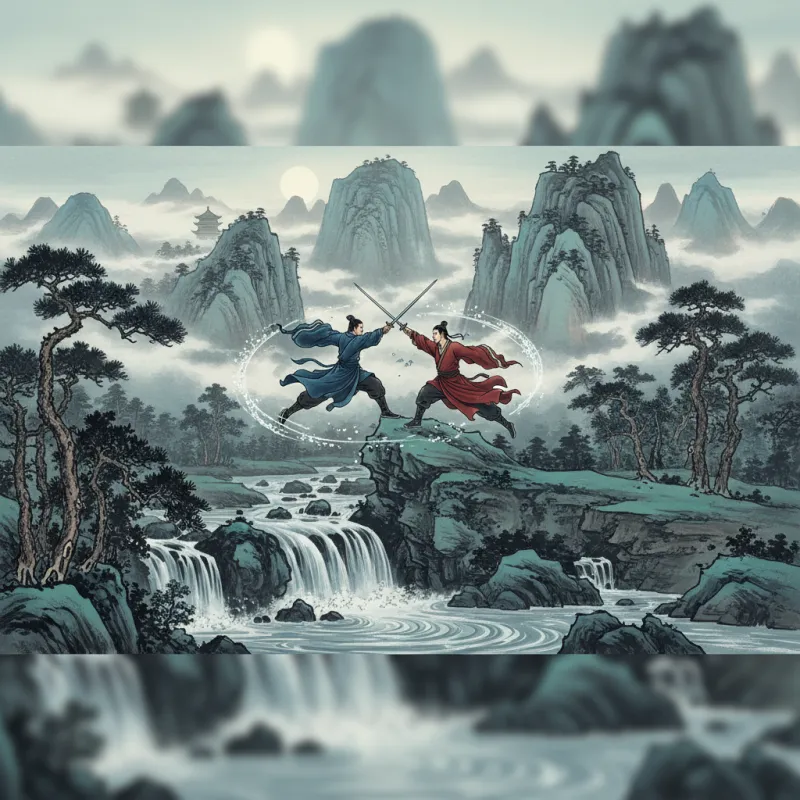
A wealthy aristocrat stands at the edge of a cliff in 423 CE, watching mist curl around distant peaks. He's just been demoted from the imperial court — a political exile disguised as a provincial appointment. Most officials would sulk in their quarters, writing bitter poems about injustice. Xie Lingyun (谢灵运 Xiè Língyùn) does something different: he invents an entire literary genre by walking into the mountains and refusing to come back.
The Man Who Walked Too Much
Xie Lingyun (385-433 CE) was born into one of the most powerful families of the Southern Dynasties. He had wealth, education, and connections. What he didn't have was political sense. After his demotion to Yongjia (modern Wenzhou), he could have played it safe. Instead, he became obsessed with mountains.
Not in a casual weekend-hiker way. Xie would disappear for days with hundreds of servants, hacking trails through virgin forest, building pavilions on remote peaks, and writing poems that described every rock formation and water source with geological precision. He invented special climbing shoes — "Xie's clogs" (谢公屐 Xiègōng jī) — with removable front and back teeth for ascending and descending steep slopes. The locals thought he was insane. The imperial court thought he was dangerous. His poetry changed Chinese literature forever.
Before Xie, Chinese poets wrote about politics, friendship, separation, and longing. They mentioned nature as backdrop. Xie made landscape the subject itself. His poems don't use mountains as metaphors for ambition or rivers as symbols of time passing. They describe actual mountains and actual rivers with the attention a portrait painter gives to a human face.
Mountain-Water: The Grammar of Landscape
The Chinese term for landscape is shanshui (山水 shānshuǐ) — literally "mountain-water." Not "scenery" or "nature" or "wilderness." The pairing is deliberate and philosophical. Mountains represent yang (阳 yáng): vertical, solid, unchanging, masculine. Water represents yin (阴 yīn): horizontal, flowing, adaptive, feminine. Together they form a complete cosmological system.
This isn't poetic decoration. It's how educated Chinese people actually perceived the physical world. When a Tang Dynasty poet looks at a landscape, he's not seeing "pretty nature." He's seeing the visible manifestation of cosmic principles — the same forces that govern human society, personal cultivation, and the movement of the Dao (道 Dào) itself.
This is why shanshui poetry matters in wuxia fiction. When a martial artist retreats to the mountains to train, they're not just finding a quiet place to practice sword forms. They're entering a space where the fundamental energies of the universe are more visible, more accessible. The concept of internal energy cultivation draws directly from this tradition — the idea that natural landscapes aren't separate from human consciousness but continuous with it.
The Political Subtext Nobody Mentions
Here's what most literary histories gloss over: shanshui poetry was invented by political exiles. Xie Lingyun was demoted. Tao Yuanming (陶渊明 Táo Yuānmíng, 365-427) quit his government post in disgust. Wang Wei (王维 Wáng Wéi, 699-759) spent years in semi-retirement after political turmoil. These weren't nature-loving hippies. They were sophisticated court officials who'd been pushed out of power.
Writing about mountains and rivers was a way to claim dignity in defeat. If you can't influence imperial policy, you can still master the art of describing morning mist on a distant peak. If political power is denied to you, you can cultivate a different kind of authority — the ability to see and articulate what others miss in the natural world.
This is why shanshui poetry has such resonance in wuxia narratives. The wandering swordsman who rejects official position to roam the jianghu (江湖 jiānghú) is following the same pattern. The philosophy of the wandering hero owes as much to exiled poets as it does to martial traditions. Both are saying: there's a kind of freedom and authenticity available outside the structures of conventional power.
What Actually Happens in These Poems
Let me be specific. Here's the opening of one of Xie Lingyun's most famous poems, "Climbing the Pond Pavilion at Yongjia":
"Hidden affairs I leave to the Creator,
Trusting to change, I follow the four seasons.
Delighting in the mountains, I let my feelings roam,
Facing the water, I rest my heart."
Notice what's happening. The first two lines establish philosophical resignation — he's given up trying to control his fate. But the second two lines reveal something else: active engagement with landscape as a form of spiritual practice. "Letting feelings roam" (畅情 chàngqíng) and "resting the heart" (息心 xīxīn) aren't passive activities. They're techniques of consciousness, ways of using landscape to transform internal states.
Later in the same poem, Xie describes specific details: "Lotus flowers bloom on the clear pond, / Fragrant grasses grow on the green shore." This isn't filler. In the context of Buddhist-influenced thought (which was spreading rapidly during Xie's lifetime), these images of natural spontaneity represent the mind's original purity before it gets tangled in desire and ambition.
The Tang Dynasty Perfects the Form
By the Tang Dynasty (618-907 CE), shanshui poetry had become one of the most prestigious literary forms. Wang Wei brought Buddhist meditation practice directly into landscape description. His poems read like verbal paintings — precise, balanced, suffused with silence:
"Empty mountains, no one in sight,
Only the sound of someone talking, echoing.
Returning light enters the deep forest,
Shining again on the green moss."
That's the complete poem "Deer Park" (鹿柴 Lùzhài). Twenty characters in Chinese. It does more with emptiness and light than most poets do with epic length.
Li Bai (李白 Lǐ Bái, 701-762) took a different approach — ecstatic, excessive, drunk on the sheer scale of mountains and rivers. His poem "Viewing the Waterfall at Mount Lu" describes water falling "three thousand feet" and compares it to the Milky Way dropping from heaven. This is shanshui poetry as cosmic spectacle, landscape as a mirror of the poet's own outsized personality.
Du Fu (杜甫 Dù Fǔ, 712-770), always more grounded than Li Bai, used landscape to frame human suffering. His poems about war-torn mountains and abandoned villages show how shanshui poetry could carry political critique without ever mentioning politics directly.
Why Wuxia Fiction Needs This Tradition
Modern wuxia novels inherit the entire shanshui tradition whether they acknowledge it or not. When Jin Yong (金庸 Jīn Yōng) describes Guo Jing and Huang Rong traveling through the landscapes of northern China in Legend of the Condor Heroes, he's working in a literary mode that's fifteen centuries old. The mountains aren't just setting. They're active participants in the characters' moral and spiritual development.
The relationship between martial arts and natural philosophy depends on this understanding. A swordsman who trains by a waterfall isn't just building arm strength. They're studying the principle of continuous flow, of power that never exhausts itself because it never resists its own nature. A hermit master living in mountain caves isn't hiding from society — they're accessing a source of wisdom that urban civilization obscures.
This is also why the best wuxia fiction includes long passages of landscape description that would seem excessive in Western adventure novels. Those passages aren't padding. They're establishing the cosmological context in which martial arts make sense as a spiritual practice rather than just a fighting technique.
The Painting Connection
You can't discuss shanshui poetry without mentioning shanshui painting (山水画 shānshuǐ huà), which developed alongside it. Both arts share the same philosophical foundation: landscape as a manifestation of cosmic principle, not just pretty scenery.
The great Song Dynasty painter Guo Xi (郭熙 Guō Xī, c. 1020-1090) wrote that mountains have three distances: high distance (looking up from the base), deep distance (looking from front mountains to back mountains), and level distance (looking from near mountains to far mountains). This isn't technical instruction. It's phenomenology — a description of how consciousness actually experiences spatial depth.
Wuxia fiction uses the same principle when describing martial arts movement. The best fight scenes aren't just choreography. They're descriptions of how a trained practitioner experiences space, distance, and timing — which is ultimately what shanshui poetry was doing with landscape all along.
What We've Lost and What Remains
Modern Chinese readers don't experience shanshui poetry the way Tang Dynasty readers did. The Buddhist and Daoist philosophical frameworks that made these poems spiritually urgent have faded into cultural background. Most people read them as beautiful descriptions of nature, missing the metaphysical stakes.
But wuxia fiction keeps something of the original alive. When a character achieves breakthrough in martial cultivation by observing natural phenomena — water flowing around rocks, wind moving through bamboo — that's the shanshui tradition in action. The landscape isn't teaching them fighting techniques. It's revealing principles of movement, adaptation, and power that apply to both physical combat and spiritual development.
This is why the genre matters beyond entertainment. It preserves a way of seeing the world that mainstream modernity has largely abandoned — the idea that mountains and rivers aren't resources to exploit or scenery to photograph, but teachers whose lessons require a lifetime to learn. Xie Lingyun, walking obsessively through the mountains of Yongjia sixteen centuries ago, would recognize the impulse immediately.
Related Reading
- Unraveling the Mystique of Wuxia: The Philosophy Behind Jianghu Culture and Kung Fu Novels
- Confucianism and Daoism in Wuxia: The Philosophical Heart of Martial Fiction
- The Philosophy of Wuxia: Why Martial Arts Fiction Is Really About Ethics
- The Dao of the Sword: Martial Arts as Philosophy in Wuxia
- Yi and Qi: The Concepts of Righteousness and Brotherhood in Wuxia
- The Wuxia Training Montage: How Heroes Are Made
- External vs. Internal Martial Arts: The Great Divide in Wuxia
- Exploring the Cultural Depth of Wuxia: The Art of Chinese Martial Arts Fiction
Explore Chinese Culture
- Explore Jin Yong's martial arts novels
- Explore cultivation fiction and immortal heroes
- Explore the real history behind wuxia