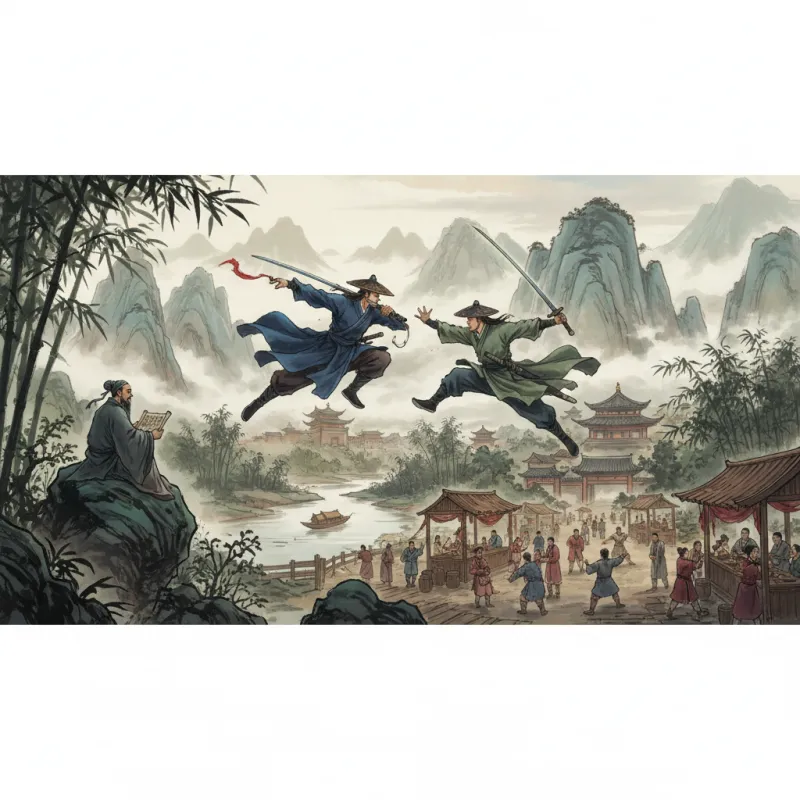
A young swordsman stands at a crossroads. The magistrate who murdered his family walks free, protected by imperial connections. The law offers no recourse. His master counsels patience. His friends urge revenge. What should he do?
This is not a plot device. This is the fundamental ethical dilemma that has driven Chinese martial arts fiction for centuries, and it's the same question that paralyzed Confucian scholars, Legalist ministers, and Daoist hermits for two millennia before the first wuxia novel was written. Strip away the flying daggers and rooftop duels, and wuxia is a sustained meditation on a single problem: when institutions fail to deliver justice, what is the moral individual to do?
The Failure of Institutional Justice
Chinese political philosophy traditionally offered three answers. Confucians insisted on working within the system—reform from inside, educate the ruler, perfect the rituals. Legalists demanded absolute obedience to state law, regardless of individual conscience. Daoists rejected the question entirely, arguing that human institutions were artificial constructs to be transcended through alignment with the Dao.
Wuxia fiction proposes a fourth path: the xia (侠, xiá) ethic. When the system fails, individuals with capability must act. Not through rebellion—the xia is not a revolutionary—but through personal intervention that restores balance without destroying the social order.
This is why Jin Yong's heroes are so often caught between competing loyalties. Guo Jing in The Legend of the Condor Heroes (1957) embodies Confucian righteousness (yi, 义) but must repeatedly act outside official channels. Yang Guo in The Return of the Condor Heroes (1959) rejects orthodox society entirely yet still serves a higher justice. These are not contradictions—they're explorations of what happens when institutional and moral authority diverge.
The Weight of Personal Power
The xia ethic rests on a dangerous premise: that personal capability creates moral obligation. If you can act, you must act. This is why martial arts mastery in wuxia is never just physical—it's always entangled with moral development.
Consider the Xiaoyao Pai (逍遥派, Xiāoyáo Pài, "Carefree Sect") in Jin Yong's Demi-Gods and Semi-Devils (1963). Their martial arts are the most sophisticated in the jianghu, yet their founder's philosophy explicitly rejects moral engagement. The result? Three generations of disciples whose immense power leads to catastrophic personal and social consequences. Wu Yazi's romantic obsession destroys his sect. Ding Chunqiu becomes a monster. Only Xu Zhu, who never sought power and doesn't want it, can wield it without corruption.
This is wuxia's central anxiety: power without moral framework is destructive, but moral framework without power is impotent. The xia must cultivate both simultaneously, and the balance is nearly impossible to maintain.
The Problem of Revenge
Nowhere is the ethical complexity more apparent than in wuxia's treatment of revenge. Confucian ethics explicitly endorses filial revenge—if your parent is murdered, you have a duty to kill the murderer. The Book of Rites states this plainly: "With the slayer of his father, a man may not live under the same heaven."
But wuxia fiction consistently demonstrates that revenge, even righteous revenge, corrupts. Gu Long's The Sentimental Swordsman (1969) follows Li Xunhuan, who has every justification for revenge but chooses not to pursue it, understanding that the act would destroy him morally even if he succeeded physically. Contrast this with the countless revenge-driven characters who achieve their goal only to find themselves hollow, their humanity consumed by their quest.
The genre's most sophisticated works don't resolve this tension—they dramatize it. In Crouching Tiger, Hidden Dragon (2000), both the film and Wang Dulu's original novels, Jen Yu's revenge against the man who killed her father is technically justified but spiritually devastating. The question isn't whether revenge is right or wrong; it's whether a person can pursue revenge without becoming the thing they're fighting against.
Justice vs. Law
Western readers often misunderstand wuxia as lawless fantasy, but the genre is obsessed with the relationship between justice (yi, 义) and law (fa, 法). The xia doesn't reject law—they operate in the space where law fails to achieve justice.
This is clearest in the jianghu's parallel legal system. Sects have rules. The wulin (武林, wǔlín, "martial forest") has codes. Sworn brotherhoods create binding obligations. These aren't alternatives to state law—they're supplements that address its inadequacies. When a corrupt official uses legal authority to commit injustice, the xia intervenes not as a criminal but as an agent of a higher law.
Gu Long understood this better than anyone. His Lu Xiaofeng series (1976-1980) features a protagonist who explicitly works between official and jianghu justice systems, solving crimes that neither can address alone. Lu Xiaofeng isn't a vigilante—he's a mediator between competing legitimate authorities, each with partial but incomplete moral claims.
The Burden of Righteousness
The xia ethic demands something almost impossible: that individuals take responsibility for systemic failures without becoming tyrants themselves. This is why so many wuxia protagonists are reluctant heroes. They understand that the moment they claim the authority to judge and execute justice, they risk becoming the very oppression they oppose.
Jin Yong's The Smiling, Proud Wanderer (1967) explores this through Linghu Chong, who repeatedly refuses positions of authority even as he acts to correct injustices. His refusal isn't weakness—it's recognition that institutional power corrupts the xia ethic. The moment the xia becomes the system, they can no longer serve as its conscience.
This connects to broader questions about the role of sects in wuxia and the meaning of jianghu as moral space. The xia must remain outside institutional power while still engaging with it—a position that's philosophically coherent but practically exhausting.
Why This Matters Now
Wuxia's ethical framework speaks to contemporary anxieties about institutional failure. When legal systems protect the powerful, when political structures serve narrow interests, when official channels offer no recourse—these are not historical problems. They're current ones.
The xia ethic doesn't offer easy answers. It doesn't say "break the law" or "trust the system." It says: individuals with capability have obligations, but exercising those obligations without becoming corrupted requires constant moral vigilance, community accountability, and recognition of one's own limitations.
This is why wuxia endures. Not because of the sword fights—though those help—but because it takes seriously a question that political philosophy often evades: what should a person do when they're right, they have power, and the system won't act? The genre's answer is complex, contradictory, and deeply humane: act, but with humility. Intervene, but don't rule. Use power, but don't trust it.
The young swordsman at the crossroads still doesn't have an easy choice. But wuxia gives him a framework for thinking through the choice, and that's more than most ethical systems offer.
Related Reading
- Confucianism and Daoism in Wuxia: The Philosophical Heart of Martial Fiction
- The Dao of the Sword: Martial Arts as Philosophy in Wuxia
- The Concept of Face (Mianzi) in the Martial World
- Daoist Poetry: Finding the Way Through Nature
- Yi and Qi: The Concepts of Righteousness and Brotherhood in Wuxia
- Shanhai Jing Creatures in Modern Video Games
- The Peaches of Immortality: The Most Famous Fruit in Chinese Mythology
- Unveiling Hidden Weapons in Wuxia: The Intrigue of Jianghu Culture
Explore Chinese Culture
- Explore Jin Yong's martial arts novels
- Explore cultivation fiction and immortal heroes
- Explore the real history behind wuxia