A butterfly dreams it's a philosopher. Or is it a philosopher dreaming he's a butterfly? Zhuangzi (庄子 Zhuāngzǐ) woke up from his nap 2,400 years ago and couldn't tell the difference — and that confusion became the foundation of an entire poetic tradition. Daoist poetry doesn't ask you to understand nature. It asks you to forget you were ever separate from it.
The Impossible Task of Writing Wu Wei
The Dao De Jing (道德经 Dào Dé Jīng) opens with a warning: "The Dao that can be spoken is not the eternal Dao." Then Laozi (老子 Lǎozǐ) proceeds to speak about it for eighty-one chapters anyway. This is the central paradox of Daoist poetry — how do you write about something that exists before language? How do you describe wu wei (无为 wú wéi), "effortless action," without turning it into effort?
The answer is you don't describe it. You enact it. Daoist poets developed a style so spare, so stripped of ornament, that the poems feel like they wrote themselves. Wang Wei (王维 Wáng Wéi), the Tang Dynasty master, could capture an entire mountain monastery in twenty characters: "Empty mountain, no one seen / But human voices heard." The poem doesn't explain emptiness. It is emptiness. The space between the words does more work than the words themselves.
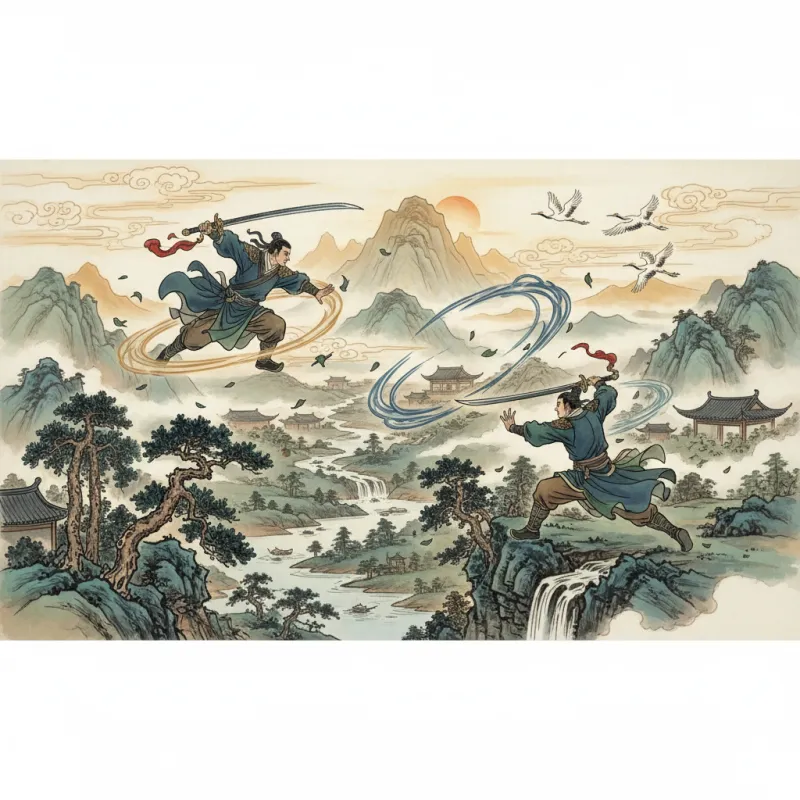
This connects directly to the martial concept of naturalness in combat — the swordsman who thinks about his technique has already lost. The poet who thinks about his metaphor has already failed. Both require a state where the self gets out of the way.
Mountains That Aren't Really Mountains
When Li Bai (李白 Lǐ Bái) writes "The birds have vanished from the sky / Now the last cloud drains away," he's not giving you a weather report. He's describing the dissolution of subject and object, the moment when the observer becomes the observed. This is shan shui (山水 shān shuǐ) poetry — "mountain-water" — but the mountains and water are never just mountains and water.
In wuxia novels, hermit masters always live on remote peaks for a reason. The mountain isn't a backdrop. It's a teacher. When Dugu Qiubai perfects his swordsmanship in the Condor Trilogy, he does it alone on a mountain, learning from wind and stone. The landscape strips away everything artificial until only the essential remains.
Daoist poets understood this centuries before Jin Yong wrote it. Tao Yuanming (陶渊明 Táo Yuānmíng) quit his government job in 405 CE, went home to his farm, and wrote: "I built my hut beside a traveled road / Yet hear no noise of passing carts and horses." How? "When the heart is distant, place becomes remote." The mountain isn't a location. It's a state of mind.
The Poetry of Uselessness
Zhuangzi tells a story about a gnarled, twisted tree so ugly and useless that no carpenter will cut it down. Because it's useless, it lives to a great old age. This is the Daoist ideal — be like the useless tree. Survive by not being good for anything.
Daoist poetry embraces this aesthetic of uselessness with almost aggressive enthusiasm. While Confucian poets were writing earnest verses about serving the emperor and maintaining social harmony, Daoist poets were getting drunk and writing about clouds. Wang Wei spent years as a Buddhist-Daoist recluse, painting bamboo and writing poems that accomplished absolutely nothing. "Sitting alone in the bamboo grove / Playing the zither, whistling long." No moral. No lesson. Just sitting.
This is the poetry equivalent of the internal martial arts — it looks like nothing is happening, but everything is happening. The useless poem that doesn't try to teach you anything teaches you everything.
Drunkenness as Spiritual Practice
Li Bai, the greatest poet of the Tang Dynasty, was allegedly drunk for most of his adult life. This wasn't recreational drinking. It was a spiritual discipline. Alcohol dissolves the boundaries between self and world, which is exactly what Daoist practice aims for. When Li Bai writes "I drink alone, no friend in sight / I raise my cup to invite the moon," he's not lonely. He's achieved the Daoist ideal — complete unity with nature, where the moon is as much a companion as any human.
The Eight Immortals of the Wine Cup (饮中八仙 Yǐn Zhōng Bā Xiān) were real Tang Dynasty poets and officials who treated drinking as a path to enlightenment. Du Fu wrote a poem about them: "Li Bai could write a hundred poems after a gallon of wine / He'd doze in a wine shop on a city street / And when the Emperor called, he wouldn't board the boat." This is wu wei in action — so natural, so effortless, that even imperial summons can't disturb the flow.
Compare this to the rigid discipline of Shaolin monks or the strict codes of jianghu sects. Daoist poets found freedom by abandoning discipline entirely. The best poem happens when you're too drunk to care about writing a good poem.
Water Knows the Way
The Dao De Jing says "The highest good is like water / Water benefits all things and does not compete." This isn't metaphor. It's instruction. Water doesn't force its way through obstacles — it flows around them. It doesn't try to be powerful — it simply is. Drop by drop, it carves through stone.
Daoist poetry moves like water. No forced rhymes, no elaborate conceits, no showing off. Wang Wei again: "After rain, empty mountain / Autumn evening, weather clear." Seven characters in Chinese. Nothing fancy. But somehow those seven characters contain an entire world — the smell of wet pine, the particular quality of autumn light, the silence after rain. The poem doesn't push. It flows.
This is why Daoist poetry translates so poorly. In English, we need verbs, subjects, articles. We need to explain. Chinese can simply present: "Rain. Mountain. Evening." The grammar itself practices wu wei. When translators add "the" and "is" and "there," they're adding effort where none existed. They're making water try to be water.
The Poet Who Wasn't There
The ultimate Daoist poem would be the one that doesn't exist. The poem so perfectly aligned with the Dao that it never needed to be written. We don't have that poem, obviously. But we have poems that come close — poems where the poet disappears so completely that only the landscape remains.
Han Shan (寒山 Hán Shān), the "Cold Mountain" poet of the Tang Dynasty, may or may not have been a real person. The poems attributed to him were found written on cliff faces and cave walls. No one knows who wrote them. This is perfect. The poems exist, but the poet doesn't. "I climb the road to Cold Mountain / The road to Cold Mountain that never ends." Is this a place or a state of mind? Is Han Shan a person or a mountain? The question dissolves.
In wuxia terms, this is the martial artist who has transcended technique entirely. Zhang Sanfeng creating Taiji Quan by watching a snake and a crane fight — the forms emerge from nature itself, not from human invention. The philosophy of spontaneity reaches its peak when there's no philosopher left, only philosophy.
Reading What Isn't Written
The best Daoist poems are the ones you don't read. They're the spaces between the characters, the silence after the last line, the moment when you look up from the page and realize you've been staring at nothing for five minutes. Wang Wei understood this: "People idle, osmanthus flowers fall / Night still, spring mountain empty." The poem is about emptiness, but more than that, the poem is emptiness. The falling flowers, the still night, the empty mountain — these aren't images. They're instructions.
Try reading a Daoist poem the way you'd read a Confucian ode or a Tang Dynasty regulated verse, and you'll miss everything. You have to read the way water flows — without trying, without grasping, without even really reading. Let the characters wash over you. Don't analyze the metaphors. Don't look for the meaning. The meaning is in the not-looking.
This is why Daoist poetry remains so influential in wuxia fiction. The wandering swordsman who sits by a stream for three days and emerges with perfect understanding — that's not mysticism. That's Daoist poetics in action. The landscape teaches what no master can. The poem writes itself in the reader's mind. The Dao that can be spoken is not the eternal Dao, but sometimes, if you're very quiet and very drunk and very lucky, you can hear it anyway.
Related Reading
- The Philosophy of Wuxia: Why Martial Arts Fiction Is Really About Ethics
- The Moon in Chinese Poetry: 50 Ways to Say 'I Miss You'
- The Concept of Face (Mianzi) in the Martial World
- Yi and Qi: The Concepts of Righteousness and Brotherhood in Wuxia
- The Dao of the Sword: Martial Arts as Philosophy in Wuxia
- Exploring Chinese Martial Arts Fiction and Jianghu Culture in Kung Fu Novels
- Exploring the Intricate World of Wuxia: Legends, Culture, and Kung Fu Novels
- Women Warriors in Wuxia: Beyond the Love Interest
Explore Chinese Culture
- Explore Jin Yong's martial arts novels
- Explore cultivation fiction and immortal heroes
- Explore the real history behind wuxia