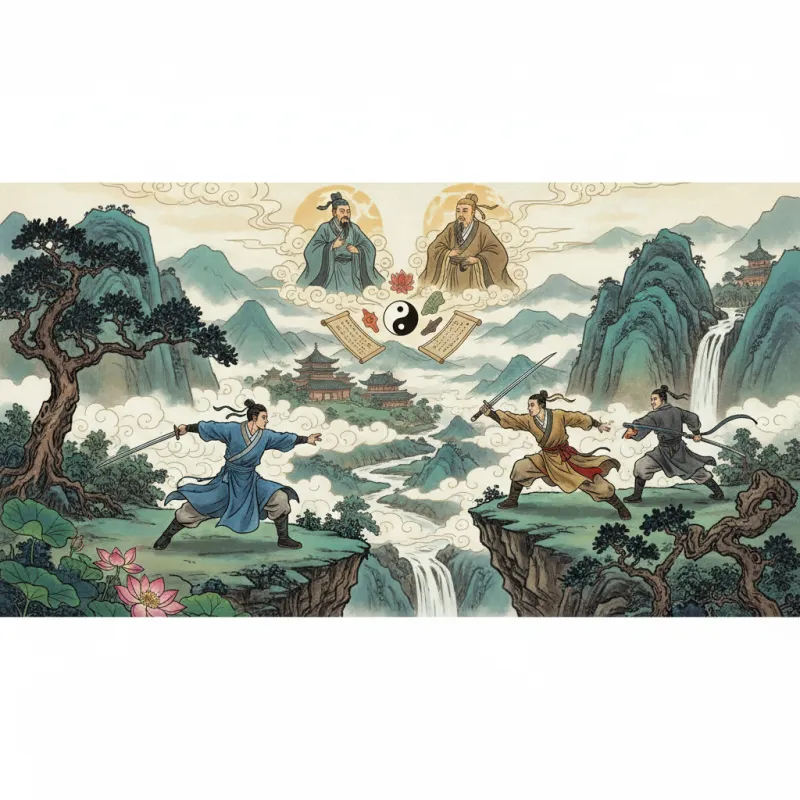
A swordsman stands at a crossroads in the jianghu. One path leads to the imperial court, where duty, hierarchy, and social order reign supreme. The other winds into the mountains, where hermits practice their arts in defiance of worldly concerns. This isn't just a plot device—it's the fundamental tension that powers every great wuxia novel ever written. And it's been there since the very beginning, encoded in the DNA of Chinese civilization itself.
The Confucian Cage: Beautiful and Suffocating
Confucianism (儒家 Rújiā) entered the jianghu with a sword in one hand and a book of rites in the other. It promises order, meaning, and a place in the grand hierarchy of heaven and earth. But that promise comes with chains.
Consider Guo Jing (郭靖) from Jin Yong's (金庸) The Legend of the Condor Heroes (射雕英雄传 Shèdiāo Yīngxióng Zhuàn). He's the Confucian ideal made flesh: loyal to his country, filial to his teachers, honest to a fault. When the Mongols invade, he doesn't hesitate. He stands on the walls of Xiangyang (襄阳) for decades, fulfilling his duty even when it means certain death. "For the country and the people" (为国为民 wèi guó wèi mín)—that's his entire philosophy in five characters.
But here's what makes Guo Jing compelling: you can see the weight crushing him. Every choice he makes is predetermined by the Confucian framework. When his daughter falls in love with Yang Guo (杨过), a Daoist-leaning rebel who refuses to bow to convention, Guo Jing can't understand it. He's trapped in his own righteousness, and Jin Yong makes sure we feel that trap closing.
The Confucian martial artist serves a master, protects the weak, upholds justice as defined by society. They practice orthodox martial arts (正派武功 zhèngpài wǔgōng) from established sects like Shaolin (少林 Shàolín) or Wudang (武当 Wǔdāng). Their kung fu is disciplined, methodical, learned through years of kowtowing and memorizing forms. There's beauty in this—the beauty of a perfectly executed ritual, a life lived in harmony with cosmic order.
But it's also suffocating. And that's where Daoism kicks down the door.
The Daoist Escape: Freedom at What Cost?
Daoism (道家 Dàojiā) in wuxia is the philosophy of the outsider, the hermit, the person who looked at Confucian society and said "no thanks." It's Laozi (老子) riding his ox into the western mountains, leaving behind only five thousand characters of cryptic wisdom. It's Zhuangzi (庄子) dreaming he's a butterfly and waking up unsure which is real.
In the jianghu, Daoism manifests as freedom—but freedom is never simple.
Yang Guo, Guo Jing's spiritual opposite, embodies Daoist principles. Orphaned, scorned, trained by unorthodox masters, he refuses every social convention. He falls in love with his teacher Xiaolongnü (小龙女), violating one of Confucianism's deepest taboos. He creates his own martial art, the Dismal Ecstasy Palm (黯然销魂掌 Ànrán Xiāohún Zhǎng), born from personal sorrow rather than inherited tradition. He wanders alone for sixteen years, answerable to no one.
And yet—Yang Guo still saves Xiangyang. He still protects the innocent. His Daoism doesn't make him selfish; it makes him free to choose righteousness on his own terms rather than having it imposed from above.
This is the genius of how wuxia handles Daoism. It's not about rejecting morality—it's about finding a morality that comes from within, from one's own nature (自然 zìrán), rather than from external rules. The Daoist martial artist practices unorthodox techniques (旁门左道 pángmén zuǒdào), often learned from eccentric hermits or discovered in ancient caves. Their kung fu is spontaneous, adaptive, sometimes bizarre. Think of the Dugu Nine Swords (独孤九剑 Dúgū Jiǔ Jiàn) from The Smiling, Proud Wanderer (笑傲江湖)—a sword style with no fixed forms, only principles.
But Daoism in wuxia also has a dark side. Taken to extremes, it becomes nihilism. Ren Woxing (任我行) from the same novel practices the Star-Absorbing Technique (吸星大法 Xīxīng Dàfǎ), absorbing others' internal energy without regard for consequences. His name literally means "Let Me Do As I Please"—Daoist freedom twisted into tyranny.
The Synthesis: When Philosophies Collide
The most interesting wuxia characters exist in the tension between these two poles. They're not purely Confucian or purely Daoist—they're struggling to reconcile both.
Linghu Chong (令狐冲), protagonist of The Smiling, Proud Wanderer, starts as a loyal disciple of the orthodox Huashan Sect (华山派 Huàshān Pài). But his natural temperament is Daoist—he loves wine, freedom, and spontaneity. When his master suspects him of learning unorthodox martial arts, Linghu Chong is expelled. The rest of the novel is his journey to understand that true righteousness (义 yì) doesn't require orthodox affiliation. He becomes a Daoist who still acts with Confucian virtue, but on his own terms.
This synthesis appears throughout Jin Yong's work because Jin Yong himself was obsessed with this question. In his later novels, especially The Deer and the Cauldron (鹿鼎记 Lùdǐng Jì), he pushes even further. Wei Xiaobao (韦小宝) is neither Confucian nor Daoist—he's a pragmatist who survives by being flexible, loyal to friends rather than principles. Some critics see this as Jin Yong's final statement: maybe the old philosophies don't work anymore in the modern world.
The Jianghu as Philosophical Laboratory
The jianghu itself—that liminal space outside government control—exists because of this philosophical tension. Confucianism creates the orthodox world of courts, laws, and hierarchies. Daoism creates the space outside it, where different rules apply.
Every jianghu conflict is ultimately about which philosophy should govern human behavior. When orthodox sects hunt down unorthodox practitioners, they're not just fighting over martial arts techniques—they're fighting over whether society's rules should extend into the wilderness. When a hero chooses between serving the emperor and wandering freely, they're choosing between Confucius and Laozi.
Gu Long (古龙), Jin Yong's great rival, approached this differently. His jianghu is darker, more existential. His heroes are often Daoist by necessity rather than choice—they're outcasts, assassins, people who can't fit into Confucian society even if they wanted to. Li Xunhuan (李寻欢) from Sentimental Swordsman, Ruthless Sword (多情剑客无情剑) gives up everything—his inheritance, his love, his place in society—out of Confucian loyalty to his sworn brother. But this act of supreme Confucian virtue leaves him wandering the jianghu as a Daoist outcast, drinking and carving wooden figurines. Gu Long seems to be saying: in the real world, you can't win. Both philosophies lead to suffering.
The Modern Question: Do These Categories Still Matter?
Contemporary wuxia and its descendants (武侠 wǔxiá and 仙侠 xiānxiá cultivation novels) still use this framework, but often unconsciously. Cultivation protagonists who defy heavenly laws and forge their own paths are Daoist. Those who protect their sects and follow proper cultivation methods are Confucian. The tension remains, even when authors don't explicitly name it.
But here's what's changed: modern readers, especially international ones, often miss the philosophical depth. They see "good sect" versus "evil sect" and think it's just fantasy tropes. They don't realize they're watching a two-thousand-year-old argument about how humans should live.
Understanding Confucianism and Daoism doesn't just help you appreciate wuxia more—it helps you understand why certain plot patterns repeat, why certain character types feel archetypal, why the genre's central conflicts feel so fundamental. These aren't arbitrary choices by authors. They're drawing from philosophical traditions that have shaped how Chinese culture thinks about duty, freedom, society, and self.
The Path Forward
The next time you read a wuxia novel, try this: identify whether each major character leans Confucian or Daoist. Watch how they interact. Notice when a character shifts from one to the other, and what causes that shift. You'll find that almost every meaningful character arc is a philosophical journey, not just a martial one.
And maybe—just maybe—you'll find yourself asking the same questions these characters face. When duty conflicts with freedom, which do you choose? When society's rules seem wrong, do you reform them from within or reject them entirely? When you gain power, do you use it to maintain order or to break free?
The jianghu has been asking these questions for centuries. It's still waiting for answers.
Related Reading
- Yi and Qi: The Concepts of Righteousness and Brotherhood in Wuxia
- The Philosophy of Wuxia: Why Martial Arts Fiction Is Really About Ethics
- Daoist Poetry: Finding the Way Through Nature
- The Dao of the Sword: Martial Arts as Philosophy in Wuxia
- The Moon in Chinese Poetry: 50 Ways to Say 'I Miss You'
- Anti-Heroes of Wuxia: The Rogues, Drunks, and Reluctant Champions
- Hua Mulan and the Wuxia Tradition of Women Warriors
- Demi-Gods and Semi-Devils: Themes of Identity and Fate
Explore Chinese Culture
- Explore Jin Yong's martial arts novels
- Explore cultivation fiction and immortal heroes
- Explore the real history behind wuxia