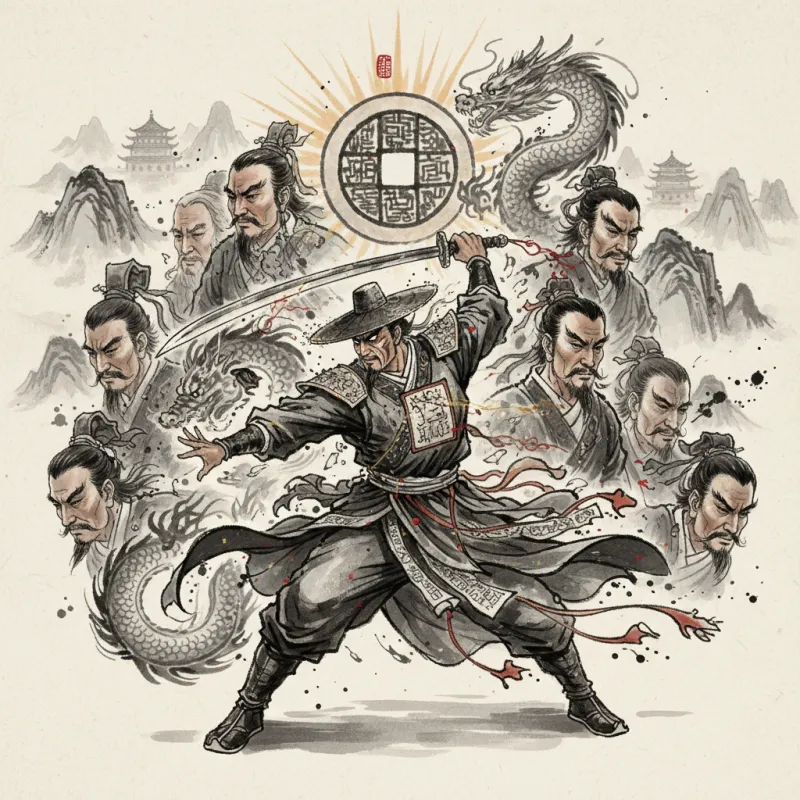
A swordsman stands at the entrance of a tavern, blocking the doorway. Another approaches. Neither speaks. Neither draws their weapon. Yet everyone in the room knows: someone is about to lose everything that matters. Not their life — their face.
This is the invisible battlefield of wuxia fiction, where 面子 (miànzi) — face — determines who lives, who dies, and who wishes they were dead. Western readers often mistake it for simple pride or reputation, but that's like calling the ocean "some water." In Jin Yong's The Legend of the Condor Heroes, Guo Jing's teacher Ke Zhen'e would rather die than admit he misjudged someone, because losing face means losing his position in the jianghu (江湖 jiānghú, the martial world). It's not stubbornness. It's survival.
The Two Currencies of Face
Chinese philosophy actually recognizes two distinct types of face, and confusing them is like mixing up gold and credit. 面子 (miànzi) is your social face — the respect others show you based on your status, achievements, and connections. It's external, performative, and can be given or taken away by others. 里子 (lǐzi), on the other hand, is your inner face — your self-respect, moral character, and personal dignity. You control 里子. The jianghu controls your 面子.
The brilliant tension in wuxia novels comes from characters forced to choose between these two. In Gu Long's The Legendary Siblings, Jiang Feng abandons his position as a respected martial artist (sacrificing 面子) to elope with a woman from an enemy sect (preserving 里子 — his authentic feelings). The jianghu never forgives him. His son spends the entire novel dealing with the consequences of that choice.
Most martial artists obsess over 面子 because it's what keeps them alive. Challenge someone above your station without proper 面子, and you're not brave — you're dead. Refuse a challenge from someone below your station, and you lose 面子, which means others will challenge you, which means you're also dead. It's a system that sounds insane until you realize it's the only law in a world without courts or police.
The Mechanics of Face Transactions
Every interaction in the jianghu is a negotiation of face. When two martial artists meet, they don't just exchange greetings — they exchange face. The junior person cups their fist and bows first, giving face to the senior. The senior acknowledges it, returning some face. If the senior ignores the greeting, they've taken face without giving any back, which is an insult that demands response.
Watch how Jin Yong handles this in Demi-Gods and Semi-Devils. Qiao Feng, leader of the Beggar Sect, enters a room full of martial artists. Everyone stands. Everyone cups their fists. Everyone waits for him to sit first. This isn't ceremony — it's the visible manifestation of his accumulated face. When he's later accused of being Khitan (and therefore an enemy of the Han Chinese), the same people refuse to stand. They're not just being rude. They're actively destroying his 面子, which destroys his ability to function in the jianghu.
The banquet scene is where face transactions become most complex. Seating arrangements matter. Toasting order matters. Who drinks first, who drinks more, who refuses a drink — every gesture is loaded with meaning. In The Smiling, Proud Wanderer, Linghu Chong constantly violates these rules because he's drunk, which should destroy his face, but his martial arts skill is so high that people tolerate it. That's the exception that proves the rule: only overwhelming personal power can override the face economy.
When Face Demands Blood
The most dangerous phrase in wuxia fiction is "给我一个面子" (gěi wǒ yī gè miànzi) — "give me face." It sounds like a request. It's actually a threat. When someone asks you to give them face, they're asking you to back down, apologize, or concede in front of witnesses. Refuse, and you've declared war.
This is why so many wuxia conflicts escalate from nothing. Two martial artists bump into each other. One demands the other apologize (give face). The other refuses (won't lose face). Now they have to fight, because if either backs down after the challenge is issued, they lose face, which means they lose status, which means they become targets for every ambitious young swordsman looking to build their own reputation.
Gu Long understood this better than anyone. His novels are full of characters trapped by face obligations they can't escape. In The Eleventh Son, the protagonist is forced into increasingly absurd situations because he can't refuse challenges without losing face, but accepting them means almost certain death. It's darkly comic and completely accurate to how the system works.
The concept of revenge cycles in wuxia is inseparable from face. When someone kills your master, you must seek revenge — not just because you loved your master, but because failing to seek revenge means you lose face. Everyone will know you're a coward. Other sects won't ally with you. Students won't join your school. The face economy demands blood payment.
Face and the Sect System
Sects (门派 ménpài) are essentially face-generating machines. A powerful sect gives its members face by association. When you introduce yourself as a disciple of Shaolin or Wudang, you're borrowing the accumulated face of centuries of martial artists. This is why sect loyalty is so intense — betraying your sect doesn't just make you a traitor, it destroys the face of everyone associated with you.
The sect hierarchy is a face hierarchy. The sect leader has the most face. The elders have significant face. The disciples have face proportional to their rank and skill. When a junior disciple defeats a senior disciple, it's not just embarrassing — it's a face crisis that threatens the entire sect's standing. This is why so many sects have rules against disciples fighting each other in public.
Inter-sect conflicts are face conflicts. In The Heaven Sword and Dragon Saber, the six major sects besiege Bright Peak not because Ming Cult is actually threatening them, but because Ming Cult's growing power threatens their face. If they don't respond, they look weak. If they look weak, they lose face. If they lose face, their sects decline. The entire war is a face transaction that costs thousands of lives.
The Face Paradox
Here's what makes 面子 fascinating: the more you care about it, the more vulnerable you become. Characters who obsess over face make stupid decisions. They fight battles they can't win. They refuse help they desperately need. They choose death over dishonor, which sounds noble until you realize they're choosing death over embarrassment.
The wisest characters in wuxia fiction understand that face is a tool, not a master. Linghu Chong drinks and jokes and violates protocol, but when it matters, he can operate within the face system perfectly. Guo Jing appears simple and face-unconscious, but he actually has tremendous face because he never tries to take it from others. The concept of wuwei in martial arts applies here — the less you grasp for face, the more you accumulate it naturally.
But most characters can't achieve this balance. They're trapped in the face economy, making increasingly desperate moves to preserve or gain face, until they destroy themselves. Yue Buqun in The Smiling, Proud Wanderer is the perfect example — his obsession with maintaining his sect's face and his own reputation as a righteous leader drives him to commit increasingly evil acts, until he becomes the villain he pretended to fight against.
Face in the Modern Reader's World
Why does this matter for readers outside Chinese culture? Because once you understand 面子, entire plot lines that seemed bizarre suddenly make sense. You understand why characters can't just apologize and move on. You understand why a minor insult leads to a death duel. You understand why sect politics are so vicious. You understand why the jianghu is so violent despite everyone claiming to follow codes of honor and righteousness.
The face economy also explains why wuxia heroes are often orphans or outcasts. Characters like Yang Guo or Linghu Chong can act freely because they have no sect face to maintain. They can befriend enemies, learn forbidden techniques, and violate social rules because they're not protecting anyone's face but their own. Their freedom comes from having nothing to lose in the face economy.
Modern Chinese society still operates on face principles, though less violently than the jianghu. Business negotiations, family gatherings, political meetings — all involve complex face transactions. Understanding 面子 in wuxia fiction gives you a lens for understanding contemporary Chinese culture, which is probably why these novels remain so popular. They exaggerate the face economy to the point of absurdity, but the underlying logic is real.
The next time you read a wuxia novel and a character makes what seems like an insane decision — refusing help, accepting an impossible challenge, choosing death over retreat — ask yourself: what face transaction is happening here? Who's giving face, who's taking it, and what are the consequences of losing it? Once you see the invisible economy, you're not just reading the story. You're reading the culture that created it.
Related Reading
- Confucianism and Daoism in Wuxia: The Philosophical Heart of Martial Fiction
- The Moon in Chinese Poetry: 50 Ways to Say 'I Miss You'
- Daoist Poetry: Finding the Way Through Nature
- Unraveling the Mystique of Wuxia: The Philosophy Behind Jianghu Culture and Kung Fu Novels
- The Dao of the Sword: Martial Arts as Philosophy in Wuxia
- Wudang Mountain: The Daoist Heart of Internal Martial Arts
- The Origins of Wuxia: From Sima Qian to Jin Yong
- The Smiling Proud Wanderer: A Story About Freedom
Explore Chinese Culture
- Explore Jin Yong's martial arts novels
- Explore cultivation fiction and immortal heroes
- Explore the real history behind wuxia