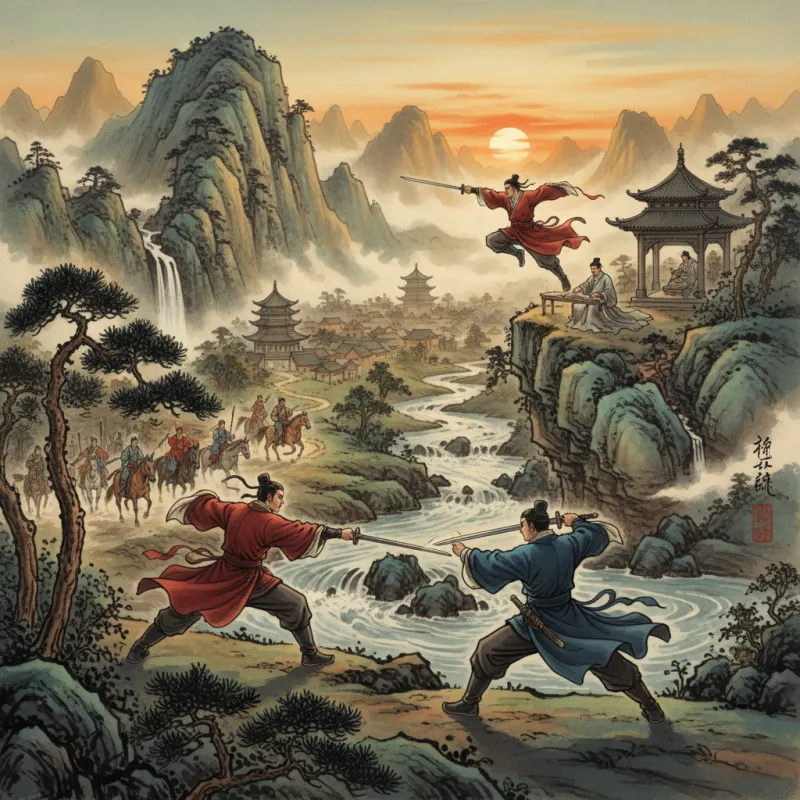
A swordsman stands at the edge of a cliff, his white robes whipping in the mountain wind. Below him, the jianghu (江湖, jiānghú) — that lawless realm of rivers and lakes — stretches endlessly. He could leap, trusting his qinggong (轻功, qīnggōng) lightness skill to carry him down. Or he could turn and face the dozen assassins behind him. This is the moment every wuxia story lives for: when personal honor collides with impossible odds, and the only way out is through.
I've spent years reading wuxia novels, from Jin Yong's classics to modern web serials, and I'm convinced that Western audiences fundamentally misunderstand what makes this genre tick. It's not just "kung fu fantasy." Wuxia is a 2,000-year-old meditation on what it means to live outside society's rules while still being bound by an even stricter code.
The Jianghu: More Than a Setting
The jianghu isn't a place you can find on a map. It's a parallel society that exists in the margins of imperial China — the teahouses where information brokers whisper secrets, the mountain temples where renegade monks practice forbidden techniques, the gambling dens where a beggar might actually be a grandmaster in disguise. When characters "enter the jianghu" (入江湖, rù jiānghú), they're not just becoming martial artists. They're stepping outside the Confucian social order entirely.
This concept crystallized during the Tang Dynasty (618-907 AD), when the imperial examination system created a class of educated men who failed to secure official positions. Some became wandering swordsmen, offering their skills for hire. Others formed secret societies. The historical reality was messy and often brutal, but it gave birth to a romantic ideal: the xiake (侠客, xiákè), the knight-errant who rights wrongs without asking for payment or recognition.
What fascinates me is how wuxia authors use the jianghu as a critique of legitimate society. In Gu Long's novels, the jianghu is explicitly more honest than the imperial court. At least in the jianghu, when someone wants you dead, they challenge you openly rather than poisoning your tea at a state banquet.
Martial Arts as Philosophy
Here's where wuxia diverges sharply from Western action fiction: the martial arts aren't just fight choreography. They're expressions of philosophical principles. When Zhang Sanfeng creates Taiji Quan (太极拳, tàijíquán) in The Heaven Sword and Dragon Saber, he's not inventing a new way to punch people. He's manifesting Daoist principles of yielding to overcome hardness, of finding stillness within motion.
The internal and external martial arts distinction matters deeply here. External styles like Shaolin kung fu emphasize physical conditioning and direct force. Internal styles like Wudang sword techniques focus on qi (气, qì) cultivation and using an opponent's energy against them. This isn't just flavor text — it reflects genuine debates in Chinese martial philosophy that date back to the Song Dynasty.
Jin Yong understood this better than anyone. In The Smiling, Proud Wanderer, the protagonist Linghu Chong learns the Dugu Nine Swords (独孤九剑, Dúgū Jiǔ Jiàn), a style with no fixed forms. It's pure adaptation, pure response to the opponent's moves. The philosophical point? True mastery means transcending technique entirely. You can't defeat Linghu Chong by studying his patterns because he has no patterns.
The Wulin: Sects, Rivalries, and Martial Codes
The wulin (武林, wǔlín) — literally "martial forest" — refers to the community of martial artists and the sects and schools they belong to. This is where wuxia gets deliciously political. Every sect has its signature techniques, its ancestral grudges, its secret manuals that everyone wants to steal. The Huashan Sect splits into Sword and Qi factions who spend decades trying to murder each other over doctrinal differences. The Beggar's Clan, despite being composed of literal beggars, is one of the most powerful organizations in the jianghu because of their information network.
What I love about the wulin structure is how it mirrors and inverts Confucian hierarchy. You have the same emphasis on master-disciple relationships, on filial piety to your sect, on face and reputation. But the values are different. A Confucian scholar serves the emperor; a wulin hero serves only their personal code of xia (侠, xiá) — righteousness, loyalty, and protecting the weak.
The tension between these codes drives the best wuxia plots. In Demi-Gods and Semi-Devils, Xiao Feng discovers he's ethnically Khitan, not Han Chinese. His entire sect turns on him despite his years of loyal service. The novel asks: what matters more, ethnic identity or personal virtue? Jin Yong, writing in 1963, was clearly commenting on contemporary Chinese nationalism, but he did it through a Song Dynasty martial arts story.
Women Warriors and Subverted Gender Roles
Wuxia has always been surprisingly progressive about women warriors. Sure, there's plenty of sexism in older works, but the genre also gave us characters like Huang Rong, who's smarter than every man around her, or Ren Yingying, who runs a spy network while her father's imprisoned. These aren't token strong female characters — they're fully realized people whose gender is relevant but not limiting.
The most interesting gender dynamic in wuxia is how martial skill creates a kind of meritocracy. A woman who's mastered the Jade Maiden Sword Technique doesn't need a man's protection. She can walk the jianghu alone, challenge sect leaders, and demand respect on her own terms. This was radical stuff in literature that often predates the 20th century.
Gu Long took this further in his novels, creating female characters who were morally complex rather than just virtuous. His women poison, manipulate, and scheme — not because they're villains, but because they're survivors in a brutal world. It's a more honest portrayal than the perfect fairy-like heroines of earlier wuxia.
The Secret Manual: Knowledge as Power
Every wuxia story eventually involves a secret martial arts manual. The Nine Yang Manual, the Sunflower Manual, the 18 Dragon-Subduing Palms — these texts contain techniques so powerful that people will massacre entire families to obtain them. On the surface, this is just a plot device. Look deeper, and it's about how knowledge circulates in Chinese culture.
In imperial China, knowledge was literally power. Pass the examinations, and you could become a government official. Fail, and you remained a peasant. The secret manual is the jianghu equivalent: a way for someone of low birth to transcend their station through learning rather than heredity. It's deeply subversive.
But wuxia also warns about the dangers of knowledge without wisdom. The Sunflower Manual in The Smiling, Proud Wanderer grants incredible power but requires self-castration. Multiple characters destroy themselves pursuing it. The message is clear: some knowledge costs more than it's worth. Technical skill without moral cultivation leads to disaster.
Modern Wuxia: Evolution and Global Reach
Contemporary wuxia has exploded beyond traditional novels into web serials, manhua, and international adaptations. Authors like Gu Long modernized the genre in the 1960s-70s, adding noir elements and psychological complexity. Today's web novelists are pushing boundaries further, blending wuxia with cultivation fiction, adding system mechanics borrowed from gaming, and creating stories that run for millions of words.
The genre's global spread has been fascinating to watch. Western readers discovering wuxia through translations often struggle with the cultural context at first — why is everyone so obsessed with face? Why do characters keep kowtowing? But once the framework clicks, they're hooked. The core appeals are universal: underdogs rising through skill and determination, complex moral codes, and the fantasy of living by your own rules in a world that demands conformity.
What worries me slightly is how commercialization might dilute wuxia's philosophical depth. When you're writing for daily updates and reader retention, it's tempting to focus on power escalation and fight scenes rather than the deeper questions about honor, loyalty, and what it means to be human. The best modern wuxia, though, still grapples with these themes while delivering the action readers crave.
Why Wuxia Endures
Wuxia has survived for centuries because it offers something that realistic fiction can't: a world where individual virtue matters more than social position, where skill and determination can overcome any obstacle, where you can literally fly if you train hard enough. It's aspirational without being naive. The heroes suffer, fail, and sometimes die. But they die on their own terms, having lived according to their principles.
In an era of increasing cynicism and institutional failure, wuxia's appeal makes perfect sense. We want to believe that personal honor still counts, that mastery is achievable through dedication, that there's a community of like-minded people out there living by a better code. The jianghu might be fictional, but the hunger for what it represents is very real.
That swordsman on the cliff? He jumps. His qinggong carries him down in a graceful arc, and he lands ready to fight another day. That's the promise of wuxia: no matter how impossible the odds, there's always another move, another technique, another way forward. You just have to be brave enough to leap.
Related Reading
- The Jade Palace of Kunlun: Home of the Queen Mother of the West
- Sacred Objects of Chinese Mythology: Seals, Mirrors, and Cauldrons
- The Hetu and Luoshu: Magical Diagrams from the Rivers
- The Beggar Sect: The Largest and Most Unlikely Martial Arts Organization
- Shanhai Jing in Modern Art: Contemporary Illustrations of Ancient Beasts
- Internal Energy (Neigong): The Hidden Power Behind Every Martial Art
Explore Chinese Culture
- Explore Jin Yong's martial arts novels
- Explore cultivation fiction and immortal heroes
- Explore the real history behind wuxia