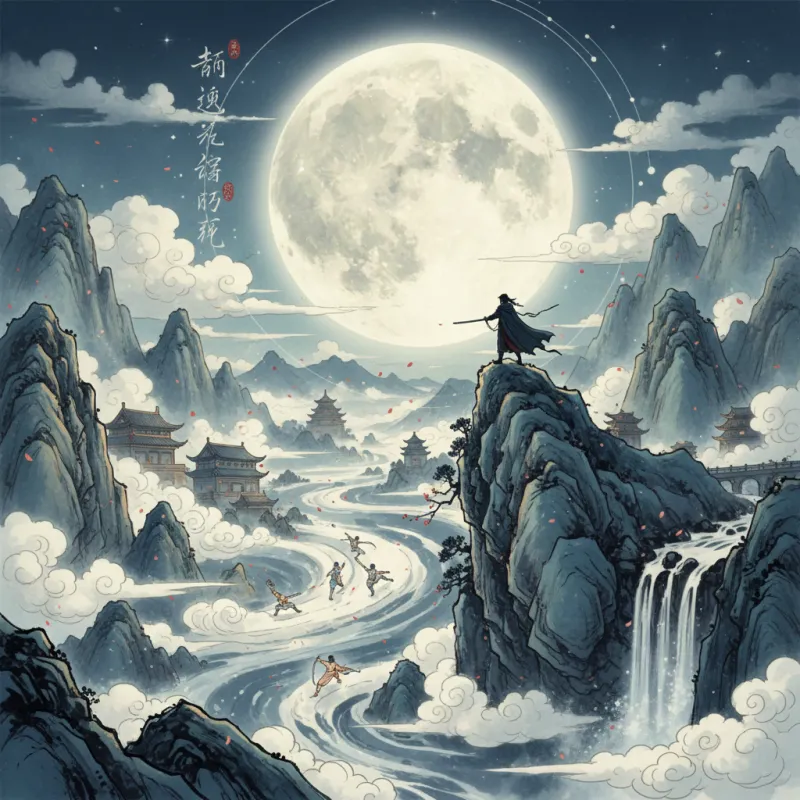
When Li Bai drowned trying to embrace the moon's reflection in the Yangtze River — or so the legend goes — he was just doing what Chinese poets had been doing for centuries: reaching for something beautiful and impossibly far away. The moon wasn't just a celestial body in classical Chinese poetry. It was a messenger, a mirror, a drinking companion, and most importantly, a way to say "I miss you" without actually saying it.
The numbers tell part of the story. In the Complete Tang Poems (全唐诗 Quán Tángshī), a collection of roughly 49,000 poems, the character 月 (yuè, moon) appears in over 10,000 of them. That's one in five poems. The moon shows up more than mountains, more than rivers, more than plum blossoms — even more than wine, though wine runs a close second. But numbers don't explain why Tang Dynasty officials stationed on the Mongolian frontier would spend their nights staring at the moon, or why a woman waiting for her husband to return from war would compose poems to it.
The Shared Screen of the Ancient World
Here's what made the moon special: in a civilization where people were constantly separated by vast distances, it was the one thing everyone could see at the same time. If you were posted to the Western Regions and your family was back in Chang'an (长安 Cháng'ān), you couldn't send a text. You couldn't video call. But you could look up at the full moon and know that your wife, your children, your aging parents were seeing the exact same thing. The moon was the ancient world's shared screen.
This wasn't just poetic fancy. The Tang Dynasty was enormous, stretching from the Korean peninsula to Central Asia. Officials were regularly posted thousands of miles from home for years at a time. Merchants traveled the Silk Road for months. Scholars went to the capital for the imperial examinations and sometimes never returned. The moon became the symbol of connection across impossible distance — and by extension, the symbol of longing itself.
The Mid-Autumn Festival (中秋节 Zhōngqiū Jié), celebrated on the fifteenth day of the eighth lunar month when the moon is fullest, became the holiday of reunion precisely because of this association. If you couldn't be with your family, at least you could look at the moon together. The festival's most famous poem, Su Shi's "Prelude to Water Melody" (水调歌头 Shuǐdiào Gētóu), written in 1076, captures this perfectly: "People have sorrow and joy, separation and reunion / The moon has darkness and light, waxing and waning / This matter has never been perfect since ancient times / I only hope that we will live long / And share the beautiful moon though a thousand miles apart."
Li Bai's Moon Obsession
No poet loved the moon more than Li Bai (李白 Lǐ Bái, 701-762). He wrote about it obsessively — in drinking songs, in poems about exile, in meditations on immortality. His most famous moon poem, "Quiet Night Thought" (静夜思 Jìng Yè Sī), is four lines that every Chinese schoolchild memorizes:
"Before my bed, the bright moonlight / I think it's frost upon the ground / I lift my head to gaze at the bright moon / I lower my head and think of home."
Twenty characters in Chinese. Five in English if you count the title. And somehow it contains everything: the shock of waking in an unfamiliar place, the moment of disorientation, the physical gesture of looking up, the weight of homesickness pulling your head back down. The moon here isn't described or praised. It's just there, bright and cold and far away, making you think of everyone you've left behind.
Li Bai wrote another poem, "Drinking Alone Under the Moon" (月下独酌 Yuè Xià Dú Zhuó), where he invites the moon and his shadow to drink with him since he has no human companions. It's funny and sad at the same time — the kind of thing you write when you're drunk and lonely and trying to make a joke out of it. The moon becomes his drinking buddy, his only friend. And then there's the legend of his death: that he drowned trying to embrace the moon's reflection in the river. It's probably not true, but it's the kind of story that gets told about someone who spent his whole life reaching for beautiful, impossible things.
Fifty Ways to Say the Same Thing
Chinese poets developed an entire vocabulary for talking about the moon, and each term carried slightly different emotional weight. 明月 (míngyuè, bright moon) was the standard term, neutral and clear. 残月 (cányuè, waning moon) suggested decline, loss, the end of something. 新月 (xīnyuè, new moon) meant beginnings, hope, the thin crescent of possibility. 孤月 (gūyuè, lonely moon) was exactly what it sounds like — the moon as a mirror of solitude.
Then there were the more elaborate terms. 玉兔 (yùtù, jade rabbit) referred to the rabbit that supposedly lived on the moon, pounding medicine in a mortar. 蟾宫 (chángōng, toad palace) came from the legend of Chang'e (嫦娥 Cháng'é), who drank the elixir of immortality and floated to the moon, where she was transformed into a toad. 广寒宫 (Guǎnghán Gōng, Palace of Expansive Cold) was Chang'e's palace on the moon — a place of immortality and unbearable loneliness.
Each term was a shorthand for a whole set of associations. When Du Fu (杜甫 Dù Fǔ) wrote about the 残月 (waning moon), he wasn't just describing the moon's phase. He was talking about the decline of the Tang Dynasty, his own aging, the sense that the best days were behind him. When a poet mentioned 玉兔 (jade rabbit), they were invoking the idea of immortality — and often questioning whether immortality was worth the price of eternal separation from loved ones.
The Moon and the Frontier
Some of the most powerful moon poems came from the frontier — the vast borderlands where Tang soldiers were stationed to defend against nomadic invasions. These poems, part of the frontier poetry tradition, used the moon to express a very specific kind of longing: not just missing home, but wondering if you'd ever see it again.
Wang Changling's (王昌龄 Wáng Chānglíng) "Out of the Frontier" (出塞 Chū Sài) begins: "In the Qin era, the bright moon; in the Han era, the frontier pass / The men who marched ten thousand miles have not yet returned." The moon here is eternal, unchanged since the Qin and Han dynasties centuries before. But the soldiers are temporary, mortal, likely to die far from home. The contrast is devastating.
The frontier moon was cold, distant, indifferent. It shone on battlefields and on the homes the soldiers had left behind, making no distinction between the living and the dead. It was a reminder that while you were freezing in a garrison on the edge of the empire, life was going on without you. Your children were growing up. Your parents were aging. Your wife was waiting, or maybe not waiting anymore.
Women and the Moon
Women poets — and women characters in poems written by men — had their own relationship with the moon. For women in traditional Chinese society, who often had limited mobility and were expected to stay within the domestic sphere, the moon was sometimes the only thing they could see that connected them to the wider world.
The palace lady poems (宫怨诗 gōngyuàn shī) are full of women looking at the moon from behind courtyard walls, thinking about the emperor who has forgotten them or the home they left behind when they entered the palace. The moon in these poems is beautiful but cold — like the emperor's favor, like the jade and silk that surround them but can't replace human warmth.
Li Bai wrote a poem called "Jade Stairs Grievance" (玉阶怨 Yù Jiē Yuàn) about a palace lady waiting for the emperor: "White dew grows on the jade stairs / At night it soaks her silk stockings / She lets down the crystal curtain / And gazes through it at the autumn moon." The emperor never comes. She stands there until the dew soaks through her clothes, looking at the moon through a curtain. The poem never says she's sad or lonely — it just shows her standing there, watching the moon, and that's enough.
The Moon in Wuxia Fiction
The moon shows up constantly in wuxia novels, and it carries all these classical associations with it. When a character stands on a mountain peak looking at the moon, readers understand they're thinking about someone far away. When two characters share a moment under the full moon, it's romantic but also tinged with the knowledge that they'll probably be separated — by duty, by fate, by the demands of the jianghu (江湖 jiānghú).
Jin Yong (金庸 Jīn Yōng) uses the moon this way throughout his novels. In The Return of the Condor Heroes (神雕侠侣 Shén Diāo Xiá Lǚ), Yang Guo and Xiao Longnü's sixteen-year separation is marked by the moon — he looks at it and thinks of her, she looks at it in her ice cave and thinks of him. The moon becomes the thread connecting them across time and distance, just like it did for Tang Dynasty poets and their loved ones.
The Mid-Autumn Festival shows up in wuxia novels as a time when the jianghu slows down, when even enemies might observe a temporary truce to look at the moon and think about home. It's one of the few moments when martial artists, who have chosen a life of wandering and violence, allow themselves to feel the weight of what they've given up. The connection to classical Chinese philosophy is direct: the moon represents the pull of home, family, and normal life that the wandering hero has rejected in favor of the martial path.
What the Moon Actually Means
After reading a few hundred moon poems, you start to realize they're all saying the same thing in different ways. The moon is beautiful. The moon is far away. The moon reminds you of someone you can't be with. The moon is the same moon they're looking at, wherever they are. The moon doesn't care about your feelings. The moon will still be there long after you're gone.
This repetition isn't a weakness. It's the point. Chinese poets weren't trying to say something new about the moon. They were trying to say the same thing in a way that would make you feel it fresh, the way you feel it when you're actually standing outside at night, looking up, thinking about someone you miss.
The moon in Chinese poetry is a cliché in the best sense — a shared language that everyone understands. When a Tang Dynasty poet wrote about the bright moon, readers knew exactly what emotional territory they were entering. When a wuxia novelist has a character gaze at the moon, readers feel the weight of a thousand years of poetry behind that gesture.
And maybe that's why the moon shows up in one out of every five Tang poems. Not because poets couldn't think of anything else to write about, but because some feelings are so universal and so persistent that you need to keep finding new ways to express them. I miss you. I wish you were here. I wonder if you're thinking of me. I hope you're safe. I hope we'll see each other again.
Fifty ways to say the same thing, and somehow it's never enough.
Related Reading
- The Philosophy of Wuxia: Why Martial Arts Fiction Is Really About Ethics
- Yi and Qi: The Concepts of Righteousness and Brotherhood in Wuxia
- The Concept of Face (Mianzi) in the Martial World
- Unraveling the Mystique of Wuxia: The Philosophy Behind Jianghu Culture and Kung Fu Novels
- The Dao of the Sword: Martial Arts as Philosophy in Wuxia
- The Best Wuxia Novels for English Readers
- The Golden Age of Hong Kong Wuxia Cinema
- Xiao Feng: The Most Tragic Hero in Wuxia
Explore Chinese Culture
- Explore Jin Yong's martial arts novels
- Explore cultivation fiction and immortal heroes
- Explore the real history behind wuxia