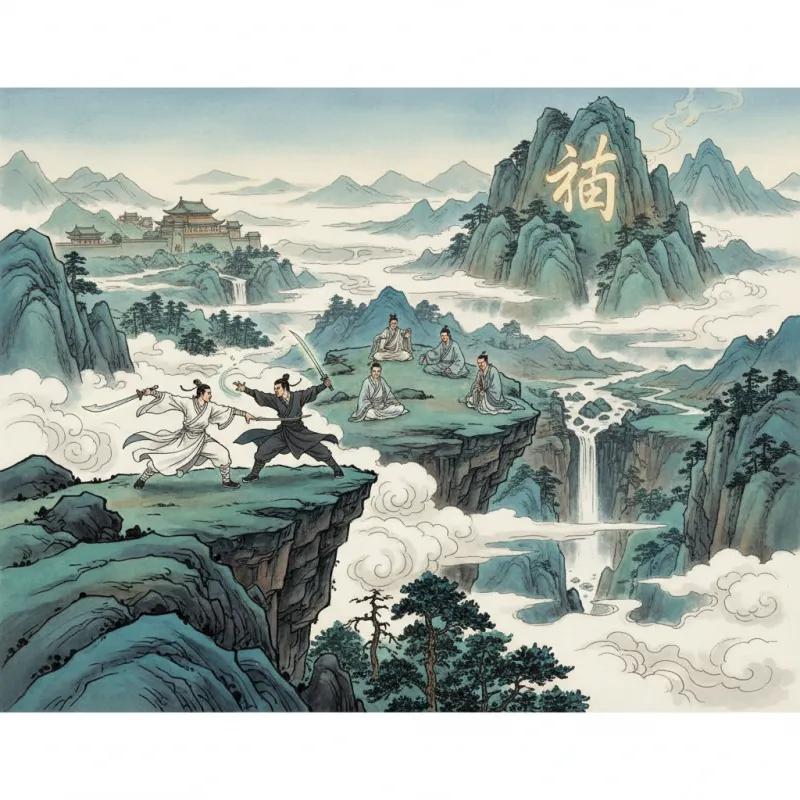
A blade flashes in moonlight. The swordsman stands motionless. His opponent collapses, blood blooming across silk robes. The question that haunts every reader: did we even see the sword move? This is the paradox at the heart of wuxia fiction — the greatest martial artists don't seem to practice martial arts at all.
The Sword That Isn't There
Dugu Qiubai (独孤求败, Dúgū Qiúbài, "Lonely Seeking Defeat") never appears alive in Jin Yong's novels, yet his philosophy dominates them. In The Return of the Condor Heroes (1959), Yang Guo discovers Dugu's cave and finds four swords, each marking a stage of mastery. The sharp sword of youth. The heavy black iron sword of middle age, inscribed with the words "重剑无锋,大巧不工" — "The heavy sword has no edge; great skill appears clumsy." Then a wooden sword. Finally, no sword at all, only the inscription: "After age forty, I no longer relied on weapons. Grass, wood, bamboo, stone — all can be swords."
This progression isn't about accumulating technique. It's about shedding it. The beginner needs a sharp blade because he relies on the weapon's edge. The master needs nothing because he has internalized the principle of the sword itself. He has become the sword, which means he no longer needs to carry one.
Western readers often mistake this for mysticism. It isn't. It's epistemology — a theory about how knowledge works and what mastery actually means.
Wu Wei and the Effortless Strike
The Daoist concept of wu wei (无为, wú wéi) literally means "non-doing" or "non-action," but every translation fails to capture its meaning. Wu wei doesn't mean doing nothing. It means acting without forcing, moving without resistance, striking without intention. Water doesn't "try" to flow downhill. It simply flows. This is wu wei.
In Demi-Gods and Semi-Devils (1963), Jin Yong's Duan Yu stumbles into mastery of the Lingbo Weibu (凌波微步, Língbō Wēibù, "Wave Striding Steps") footwork technique. He doesn't train systematically. He doesn't drill the movements. He reads the pattern once, derived from the I Ching, and his body simply knows. When assassins attack, his feet move before his mind decides. This is wu wei in action — the body responding to the situation without the interference of conscious thought.
Compare this to Guo Jing, the protagonist of The Legend of the Condor Heroes (1957). Guo Jing is famously slow-witted. He must practice each technique thousands of times. Yet by the novel's end, he has mastered the Eighteen Dragon-Subduing Palms precisely because his simple nature allows him to practice without overthinking. His lack of cleverness becomes his advantage. He achieves wu wei through a different path — not through spontaneous understanding but through practice so thorough that technique becomes nature.
The Internal vs External Cultivation debate in wuxia always circles back to this question: can you think your way to wu wei, or must you practice your way there?
The Confucian Counterpoint
But wuxia fiction doesn't simply endorse Daoist spontaneity. It's more philosophically complex than that. Confucian ethics provide the necessary counterweight — the question of what you do with your martial skill once you've achieved it.
The Xia (侠, xiá) in wuxia means "martial hero," but the character itself combines "person" and "great." A xia isn't just skilled; they're morally exemplary. They use their power to "行侠仗义" (xíng xiá zhàng yì) — "perform chivalrous deeds and uphold righteousness." This is pure Confucianism: skill without virtue is merely violence.
Qiao Feng in Demi-Gods and Semi-Devils embodies this tension. He possesses devastating martial power — his Eighteen Dragon-Subduing Palms can shatter stone. But his tragedy stems from the conflict between his martial identity and his moral obligations. Is he Khitan or Han? Does he owe loyalty to his blood or his upbringing? His martial skill cannot answer these questions. In the novel's climax, he uses his ultimate technique not to defeat an enemy but to take his own life, choosing death over betraying either people. His final act is both the perfection of martial skill (a strike no one can defend against) and its transcendence (using it to uphold righteousness rather than achieve victory).
This is why the "evil martial artist" is such a crucial figure in wuxia. Characters like Ouyang Feng or Yue Buqun achieve extraordinary skill but lack moral cultivation. They prove that martial mastery alone is insufficient — even dangerous. The Righteous vs Unorthodox Sects divide isn't really about technique; it's about whether martial arts serve the self or society.
The Buddhist Dissolution
Then Buddhism enters, complicating everything further. If Daoism teaches effortless action and Confucianism teaches righteous action, Buddhism questions whether there's anyone acting at all.
The Shaolin Temple, appearing in nearly every wuxia novel, represents this Buddhist dimension. Shaolin monks practice martial arts, but their ultimate goal is enlightenment — the realization that the self is an illusion. The famous phrase "武禅合一" (wǔ chán hé yī, "martial arts and Chan Buddhism are one") suggests that combat itself can be a form of meditation, a way to dissolve the boundary between self and other.
Sweeping Monk, the mysterious figure in Demi-Gods and Semi-Devils, demonstrates this principle. He has spent decades sweeping floors in Shaolin's scripture library, absorbing Buddhist sutras while unconsciously mastering martial arts. When he finally reveals his skill, it's almost casual — he stops deadly strikes with a wave of his hand, not through superior technique but through complete absence of ego. There's no "him" to attack. His opponents' killing intent finds nothing to strike against.
This is the deepest level of martial philosophy in wuxia: the recognition that the self you're trying to perfect through martial training is itself the obstacle. The swordsman seeking to master the sword is trapped by the duality of swordsman and sword. Only when that duality dissolves does true mastery emerge.
Why Technique Must Be Transcended
So why do wuxia novels spend hundreds of pages describing intricate techniques, only to suggest that technique doesn't matter? This seems contradictory, but it's actually the point.
You cannot transcend technique without first mastering it. The beginner who dismisses forms and drills as unnecessary hasn't achieved wu wei — he's just lazy. Dugu Qiubai didn't start with no sword; he ended there, after decades with the sharp sword, the heavy sword, the wooden sword. Each stage was necessary. Each had to be fully inhabited before it could be abandoned.
This is the pedagogical wisdom embedded in wuxia fiction: mastery is a process of accumulation followed by subtraction. You must first fill the cup before you can empty it. The martial artist who has never learned proper stance and footwork cannot suddenly fight like water flowing. But the martial artist who has drilled ten thousand strikes may one day find that the strike happens by itself, without conscious direction.
令狐冲 (Lìnghú Chōng) in The Smiling, Proud Wanderer (1967) learns the Dugu Nine Swords (独孤九剑, Dúgū Jiǔ Jiàn), a sword style with no fixed forms. It consists entirely of principles for exploiting an opponent's weaknesses. But Linghu Chong can only learn this formless style because he has already mastered the orthodox Huashan sword forms. The formless requires the formed as its foundation.
The Modern Relevance
Contemporary readers sometimes dismiss this philosophy as pre-modern mysticism, irrelevant to actual skill development. They're wrong. Modern research in motor learning, expertise acquisition, and flow states has repeatedly confirmed what wuxia novels have always known: peak performance occurs when conscious control gives way to automatic processing.
Athletes call it "being in the zone." Psychologist Mihaly Csikszentmihalyi calls it "flow." Neuroscientists observe reduced activity in the prefrontal cortex during expert performance — the conscious, deliberative part of the brain literally quiets down. The expert tennis player doesn't consciously calculate angles and velocities; her body simply knows where to be. This is wu wei, described in the language of cognitive science rather than Daoist philosophy.
The wuxia insight goes deeper, though. It's not just that experts perform automatically. It's that the self-conscious ego is the primary obstacle to expertise. The martial artist who fights to prove himself, to demonstrate his superiority, to protect his reputation — he has already lost. His ego creates tension, and tension creates hesitation, and hesitation creates openings. The truly dangerous opponent is the one who has nothing to prove, no self to defend.
The Unresolved Tension
Wuxia fiction never fully resolves the tension between these philosophical traditions. Should the martial artist cultivate spontaneity (Daoism) or discipline (Confucianism)? Should she seek to perfect the self (Confucianism) or dissolve it (Buddhism)? Should martial arts serve society or transcend it?
Different novels, different authors, different characters answer differently. That's not a weakness. It's the genre's philosophical sophistication. Wuxia fiction doesn't present a single doctrine. It stages a centuries-long conversation between competing visions of what it means to be human, what it means to have power, and what it means to use it well.
The sword is just the medium through which these questions are asked. The real subject has always been the swordsman — and what remains when the swordsman finally sets the sword down.
Related Reading
- The Philosophy of Wuxia: Why Martial Arts Fiction Is Really About Ethics
- Confucianism and Daoism in Wuxia: The Philosophical Heart of Martial Fiction
- The Moon in Chinese Poetry: 50 Ways to Say 'I Miss You'
- The Concept of Face (Mianzi) in the Martial World
- Mountain and Water Poetry (山水诗): When Landscape Becomes Literature
- The Best Wuxia Novels for English Readers
- Mythical Plants of the Shanhaijing: Trees That Grant Immortality and Flowers That Kill
- Shanhai Jing in Modern Art: Contemporary Illustrations of Ancient Beasts
Explore Chinese Culture
- Explore Jin Yong's martial arts novels
- Explore cultivation fiction and immortal heroes
- Explore the real history behind wuxia