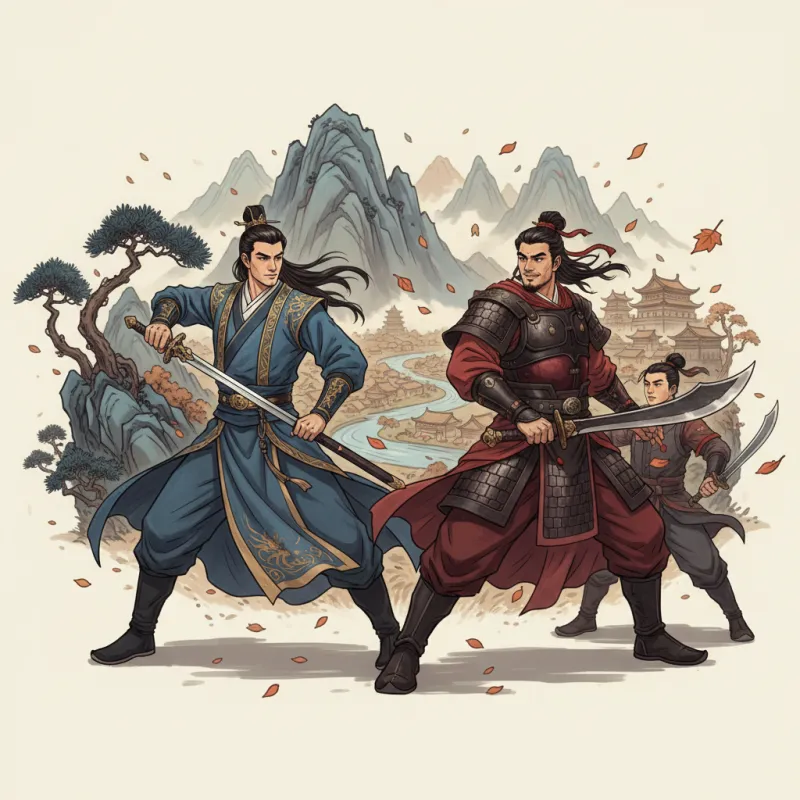
A swordsman stands at a crossroads in the rain. His sworn brother has betrayed their sect, murdered innocents, and fled into the night. The sect master demands pursuit and execution. The swordsman's hand rests on his blade. Does he choose righteousness (义 yì) — upholding justice and moral law? Or does he choose loyalty (气 qì) — honoring the blood oath sworn years ago under peach blossoms? This is the impossible choice that defines wuxia fiction, and it's encoded in two characters that every reader knows by heart: 义气 (yìqì).
The Paradox at the Heart of Jianghu
义气 (yìqì) is usually translated as "righteousness and loyalty" or "honor among brothers," but these English phrases miss the tension. In Chinese, 义 (yì) carries the weight of cosmic justice — doing what's morally right according to Confucian ethics and universal principles. 气 (qì) here doesn't mean internal energy (though it shares the character); it means spirit, backbone, the courage to act on personal bonds regardless of consequences.
The genius of wuxia is that these two values constantly collide. Jin Yong understood this better than anyone. In The Legend of the Condor Heroes (射雕英雄传 Shèdiāo Yīngxióng Zhuàn, 1957), Guo Jing embodies 义 (yì) — he's almost painfully righteous, willing to sacrifice personal relationships for the greater good of defending Song China against Mongol invasion. His sworn brother Yang Kang chooses 气 (qì) — loyalty to his adoptive father, even though that father is a Jin prince and traitor to the Han Chinese cause.
Neither choice is presented as simply wrong. That's what makes it literature instead of propaganda.
The Historical Roots: From Confucius to the Water Margin
义 (yì) enters Chinese philosophy through Confucius (551-479 BCE), who listed it as one of the five cardinal virtues alongside benevolence (仁 rén), propriety (礼 lǐ), wisdom (智 zhì), and trustworthiness (信 xìn). But Confucian 义 (yì) was primarily about social duty — a son's obligation to his father, a subject's loyalty to his emperor, a person's responsibility to maintain cosmic order.
The 气 (qì) part — the personal, emotional, almost reckless loyalty — comes from a different tradition entirely. It's the spirit of the 游侠 (yóuxiá), the wandering knights of the Warring States period (475-221 BCE) who operated outside official law. Sima Qian's Records of the Grand Historian (史记 Shǐjì, circa 94 BCE) includes a chapter on these figures, describing men who "valued commitment over life itself" and "would die for those who understood them."
The fusion happens in Water Margin (水浒传 Shuǐhǔ Zhuàn, 14th century), where 108 outlaws gather at Liangshan Marsh. They're bandits by law but heroes by 义气 (yìqì) — they rob corrupt officials, protect the weak, and maintain absolute loyalty to each other. When Song Jiang leads them to accept amnesty and serve the Song court, he's choosing 义 (yì) over 气 (qì), and it destroys them. The novel's tragedy is that righteousness and loyalty proved incompatible.
The Brotherhood Oath: Ritual and Reality
Every wuxia reader knows the scene: warriors kneel before burning incense, slash their palms, mix blood in wine, and swear "不求同年同月同日生,但求同年同月同日死" (bù qiú tóngnián tóngyuè tóngrì shēng, dàn qiú tóngnián tóngyuè tóngrì sǐ) — "We ask not to be born on the same day, but to die on the same day."
This isn't just dramatic flourish. The 结拜 (jiébài) or sworn brotherhood ceremony has real historical precedent, most famously in the Peach Garden Oath where Liu Bei, Guan Yu, and Zhang Fei swore brotherhood before founding the Shu Han kingdom (as romanticized in Romance of the Three Kingdoms). The ritual creates 义气 (yìqì) obligations that supersede blood family — your sworn brother's enemy becomes your enemy, his cause becomes your cause, his death demands your vengeance.
Gu Long weaponizes this in The Sentimental Swordsman, Ruthless Sword (多情剑客无情剑 Duōqíng Jiànkè Wúqíng Jiàn, 1969-1970). Li Xunhuan and Long Xiaoyun are sworn brothers, but Long covets Li's beloved Lin Shiyin. Li, in an act of supreme 义气 (yìqì), gives up Lin Shiyin to preserve the brotherhood. It's presented as noble, but Gu Long makes you question whether this kind of loyalty is actually self-destructive madness. Lin Shiyin never wanted Long Xiaoyun. The "righteous" choice created decades of misery for everyone involved.
When Righteousness and Loyalty Collide
The best wuxia stories don't resolve the 义 (yì) versus 气 (qì) tension — they force characters to choose and then live with the consequences.
In Jin Yong's Demi-Gods and Semi-Devils (天龙八部 Tiānlóng Bābù, 1963), Xiao Feng discovers he's ethnically Khitan, not Han Chinese. His entire life has been built on 义 (yì) — protecting the Song realm from "barbarian" invasion. But his birth parents, his blood, his people are Khitan. When he's forced to choose between ethnic loyalty (气 qì) and moral principle (义 yì), he chooses a third path: suicide. He prevents a Khitan invasion of Song (义 yì) but refuses to fight his own people (气 qì), so he removes himself from the equation entirely.
It's devastating precisely because Jin Yong doesn't present an easy answer. The novel suggests that sometimes 义气 (yìqì) creates impossible situations where honor can only be preserved through death.
Contrast this with The Smiling, Proud Wanderer (笑傲江湖 Xiào'ào Jiānghú, 1967), where Linghu Chong repeatedly chooses 气 (qì) over 义 (yì) — he remains loyal to his morally compromised master Yue Buqun long past the point where righteousness would demand rebellion. The novel ultimately vindicates him, but only barely. Jin Yong seems to be asking: how much evil can you tolerate in the name of loyalty before you become complicit?
The Female Perspective: Righteousness Without Brotherhood
Here's what's interesting: 义气 (yìqì) is coded masculine in wuxia fiction. Women can possess 义 (yì) — moral righteousness — but the 气 (qì) component, the brotherhood loyalty, is largely denied to them. They're love interests, not sworn siblings.
The exceptions prove the rule. In The Book and the Sword (书剑恩仇录 Shū Jiàn Ēnchóu Lù, 1955), the Red Flower Society includes female members, but they're always positioned as potential romantic partners first and martial siblings second. Huo Qingtong and Princess Fragrance both love Chen Jialuo; their relationship to each other is defined through him, not through direct 义气 (yìqì) bonds.
Gu Long does slightly better. His female characters like Sun Xiuqing in The Eleventh Son (萧十一郎 Xiāo Shíyī Láng, 1970) operate with their own code of 义 (yì), but they're still excluded from the male brotherhood networks that drive the plot. The jianghu's 义气 (yìqì) is a boys' club, and that's a limitation of the genre that even its best authors rarely transcend.
For more on how women navigate the martial world's power structures, see Women Warriors: Beyond the Love Interest.
Modern Interpretations: When Honor Becomes Toxic
Contemporary wuxia and its descendants (martial arts films, cultivation novels, wuxia-inspired games) are increasingly critical of 义气 (yìqì) as an absolute value. The 2002 film Hero (英雄 Yīngxióng) presents Nameless's assassination mission against the Qin Emperor as a question of competing 义 (yì) — is it more righteous to kill a tyrant or to allow him to unite China and end the Warring States period? The film's answer — that individual 义气 (yìqì) must yield to collective peace — was controversial precisely because it challenged wuxia's core assumption that personal honor trumps political calculation.
Modern cultivation novels like Grandmaster of Demonic Cultivation (魔道祖师 Módào Zǔshī, 2015) explicitly interrogate toxic 义气 (yìqì). Wei Wuxian's downfall comes partly from his absolute loyalty to the Wen remnants — he chooses 气 (qì) over 义 (yì), protecting people his society has deemed evil. The novel asks: when does loyalty become enabling? When does righteousness become self-righteousness?
These aren't questions the classic wuxia novels asked. Jin Yong and Gu Long presented 义气 (yìqì) as tragic and complicated, but ultimately noble. The new generation treats it as potentially dangerous — a value system that can justify atrocities in the name of brotherhood.
The Enduring Appeal: Why We Still Care
义气 (yìqì) endures in wuxia fiction because it addresses a fundamental human tension: the conflict between universal principles and particular loyalties. Do you save the world or save your friend? Do you uphold justice or honor your debts? Do you follow the law or follow your heart?
In the real world, we're constantly making smaller versions of these choices. Do you report a colleague's misconduct or protect them because they helped you when you were new? Do you support a family member's questionable decisions or cut them off? Do you prioritize abstract fairness or concrete relationships?
Wuxia fiction doesn't answer these questions — it dramatizes them with swords and flying techniques and blood oaths under peach trees. It takes the ethical dilemmas of ordinary life and amplifies them until they become matters of life and death, honor and shame, righteousness and loyalty.
That's why, even in 2024, readers still thrill to stories about warriors standing at crossroads in the rain, hands on their sword hilts, choosing between 义 (yì) and 气 (qì). Because we're all standing at that crossroads, every day, in smaller ways.
For more on the ethical codes that govern the martial world, see The Unwritten Rules of Jianghu and Revenge and Justice: When Personal Vendettas Meet Cosmic Order.
The swordsman at the crossroads makes his choice. He sheathes his blade and walks into the rain, following his sworn brother's trail. Not because it's right. Because it's 义气 (yìqì). And in the jianghu, sometimes that's the only answer there is.
Related Reading
- The Philosophy of Wuxia: Why Martial Arts Fiction Is Really About Ethics
- Unraveling the Mystique of Wuxia: The Philosophy Behind Jianghu Culture and Kung Fu Novels
- Daoist Poetry: Finding the Way Through Nature
- The Moon in Chinese Poetry: 50 Ways to Say 'I Miss You'
- The Concept of Face (Mianzi) in the Martial World
- The Smiling Proud Wanderer: A Story About Freedom
- Wire-Fu: The Art of Flying Swordsmen in Action Cinema
- Magical Plants of the Shanhai Jing: Trees That Grant Immortality
Explore Chinese Culture
- Explore Jin Yong's martial arts novels
- Explore cultivation fiction and immortal heroes
- Explore the real history behind wuxia