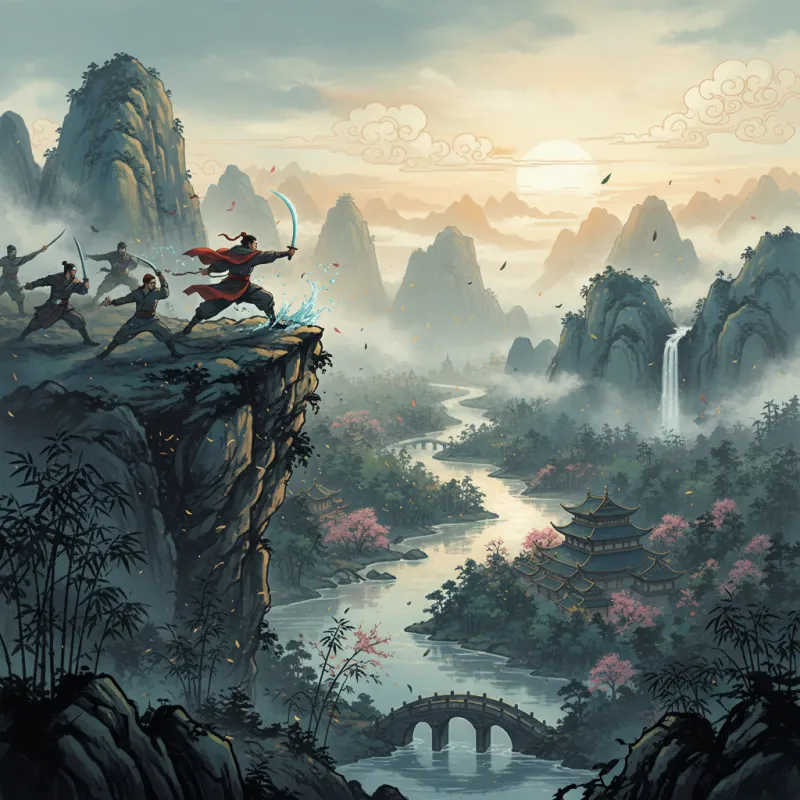
A swordsman stands at the edge of a cliff, wind whipping his robes, faced with an impossible choice: avenge his master and become the very monster he swore to destroy, or spare his enemy and betray everything the jianghu (江湖, jiānghú) stands for. This isn't just plot drama—it's the beating heart of wuxia philosophy, where every blade stroke carries the weight of cosmic justice and every decision ripples through the moral fabric of the martial world.
The Jianghu: More Than a Setting, It's a State of Mind
When Jin Yong wrote in The Legend of the Condor Heroes (1957) that "where there are people, there is jianghu," he wasn't being poetic—he was defining an entire philosophical ecosystem. Jianghu literally means "rivers and lakes," but calling it that is like calling the ocean "wet." It's the shadow society that exists parallel to imperial authority, governed not by law but by unwritten codes older than the dynasties themselves.
The jianghu operates on three pillars that would make Confucius roll in his grave while simultaneously nodding in approval. First, yi (義, yì)—righteousness that transcends legal justice. Guo Jing might be dumb as a brick in Jin Yong's novels, but his yi is so pure it becomes its own form of genius. Second, xin (信, xìn)—trustworthiness that makes a verbal promise more binding than any imperial decree. When Xiao Feng swears brotherhood in Demi-Gods and Semi-Devils, he's not making friends—he's forging chains of obligation that will drag him to tragedy. Third, qing (情, qíng)—the emotional bonds that make rational decision-making nearly impossible and stories infinitely more compelling.
Wulin Ethics: The Unwritten Constitution
The wulin (武林, wǔlín)—the martial forest where these heroes clash—has rules more complex than any legal code. You don't attack someone from behind unless they really deserve it. You don't kill someone who's already defeated unless the plot demands it. You absolutely must avenge your master, even if it takes three generations and destroys your entire family in the process.
Gu Long understood this better than anyone. His heroes in The Eleventh Son and The Legend of Lu Xiaofeng navigate a moral landscape where the "righteous" sects are often more corrupt than the "demonic" ones. The Shaolin monks preach compassion while hoarding martial arts manuals. The Wudang Taoists talk about non-action while scheming like politicians. Meanwhile, the actual demons are just honest about wanting power and revenge—there's something refreshingly straightforward about that.
This hypocrisy isn't a bug in wuxia philosophy; it's a feature. The genre emerged during periods when official morality and actual behavior diverged so wildly that people needed stories to process the cognitive dissonance. The Ming dynasty (1368-1644) gave us Water Margin, where 108 outlaws become heroes because the government was so corrupt that banditry looked like public service. The Qing dynasty (1644-1912) produced stories where Han Chinese heroes fought Manchu oppression through the metaphor of sect rivalries.
The Paradox of Power: Martial Arts as Spiritual Practice
Here's where wuxia gets philosophically interesting: the better you are at killing people, the less you should want to. The supreme martial artist in Jin Yong's universe isn't the one with the deadliest technique—it's Dugu Qiubai, who got so good he became bored and lonely, eventually fighting with a wooden sword because metal was overkill. His progression from sharp sword to heavy sword to wooden sword to no sword mirrors Buddhist enlightenment: the more you understand, the less you need.
This connects directly to Daoist concepts of wuwei (無為, wúwéi)—effortless action. The Taiji philosophy embedded in martial arts cultivation isn't about being passive; it's about being so perfectly aligned with natural flow that your actions become inevitable rather than forced. When Zhang Sanfeng creates Taijiquan in wuxia lore, he's not inventing a fighting style—he's discovering a way to move that was always there, waiting to be noticed.
But here's the tension that makes these stories work: you can't reach that enlightened state without first becoming really, really good at violence. It's like saying you can only transcend desire after you've satisfied every desire—philosophically elegant, practically impossible, dramatically perfect.
Revenge and Righteousness: The Engine of Narrative
Every wuxia story runs on revenge fuel. Your master was killed. Your sect was destroyed. Your family was massacred. Your lover was stolen. Sometimes all four in the same backstory. The question isn't whether you'll seek revenge—that's mandatory—but how that revenge will transform you.
The Count of Monte Cristo has nothing on wuxia revenge plots. In The Book and the Sword, Chen Jialuo spends the entire novel discovering that his enemy is his brother, his mission is impossible, and his love is doomed—and he still has to see it through because yi demands it. The philosophy here cuts deep: righteousness isn't about good outcomes; it's about correct action regardless of consequences.
This creates a fascinating moral framework that Western readers often find alien. In wuxia, intention matters less than obligation. You might not want to kill your sworn brother who betrayed the sect, but you have to, because the alternative is chaos. The individual conscience bows to collective harmony—very Confucian, very Chinese, very tragic.
The Master-Disciple Bond: Filial Piety with Swords
If you want to understand Chinese culture, watch how wuxia handles the shifu (師父, shīfù)—master—relationship. It's not mentorship; it's closer to parent-child dynamics with added combat training. When Linghu Chong in The Smiling, Proud Wanderer gets expelled by his master, it's not just losing a teacher—it's existential exile from the only family structure that matters in jianghu.
The master can be wrong, cruel, even evil, but the disciple's duty remains absolute. This isn't blind obedience—it's a philosophical commitment to hierarchical order as the foundation of civilization. When that order breaks down, as it does in Gu Long's darker works, the result isn't freedom but nihilism. His heroes drift through a world where traditional bonds have dissolved, and the liberation feels more like drowning.
Yet the best wuxia novels question this structure even as they uphold it. Jin Yong's later works, especially The Deer and the Cauldron, feature protagonists who succeed precisely because they ignore traditional master-disciple protocols. Wei Xiaobao learns from everyone and no one, loyal to himself first—and somehow that works. It's Jin Yong's mature philosophy: maybe the old ways need updating, but we can't just abandon them without something to replace them.
Modern Resonance: Why Jianghu Still Matters
Walk through any Chinese city today and you'll see jianghu philosophy alive in business culture, social networks, and political maneuvering. The concept of guanxi (關係, guānxì)—relationships and connections—is just jianghu networking without the swords. The emphasis on face, reputation, and unspoken obligations? That's wulin ethics in business casual.
This is why wuxia endures while other martial arts genres fade. It's not really about the fighting—it's about navigating a complex social world where official rules and actual rules diverge, where personal loyalty conflicts with abstract justice, where you must choose between competing goods rather than between good and evil. Sound familiar? That's every workplace, every family, every friend group.
The philosophy behind jianghu culture offers something contemporary life desperately needs: a framework for honor in a dishonorable world, for maintaining integrity when institutions fail, for building trust in a society of strangers. The martial arts are just the delivery mechanism for these ideas—beautiful, violent poetry that makes philosophy feel like adventure.
When that swordsman finally makes his choice at the cliff's edge, he's not just deciding his character's fate. He's demonstrating that some questions don't have right answers, only answers you can live with. That's not escapism—that's wisdom dressed in silk robes and carrying a blade.
Related Reading
- Daoist Poetry: Finding the Way Through Nature
- The Philosophy of Wuxia: Why Martial Arts Fiction Is Really About Ethics
- Confucianism and Daoism in Wuxia: The Philosophical Heart of Martial Fiction
- The Dao of the Sword: Martial Arts as Philosophy in Wuxia
- The Moon in Chinese Poetry: 50 Ways to Say 'I Miss You'
- The Real History Behind Wuxia Fiction
- Sun Wukong: The Great Sage Who Challenged Heaven
- Penglai Island: The Legendary Isle of Immortals
Explore Chinese Culture
- Explore Jin Yong's martial arts novels
- Explore cultivation fiction and immortal heroes
- Explore the real history behind wuxia