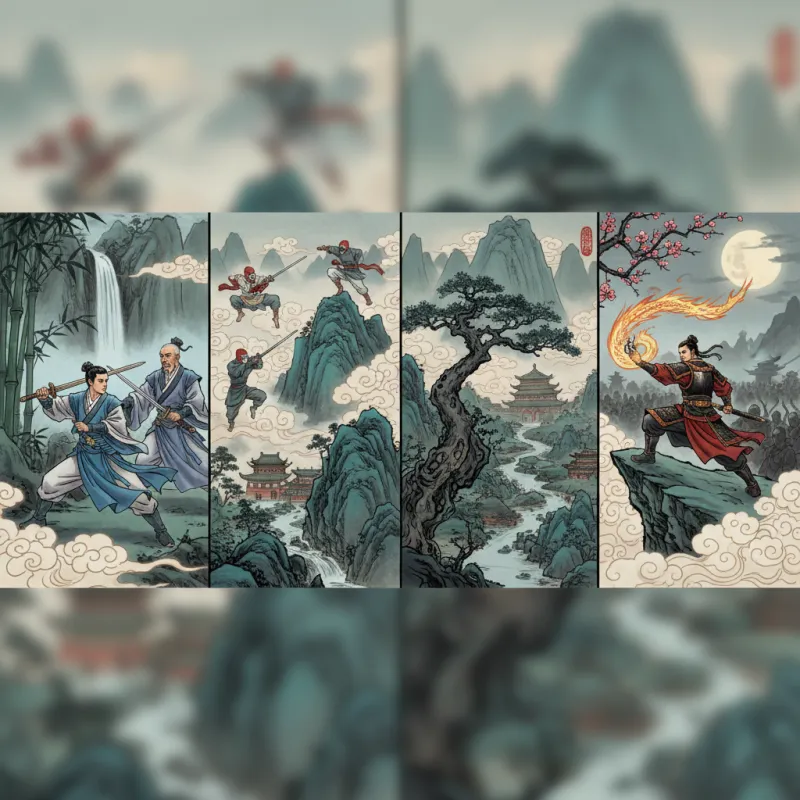
The young disciple kneels in the snow for three days straight, waiting for the master to acknowledge him. His knees are numb, his lips blue, but he doesn't move. This isn't torture—it's Tuesday. Welcome to wuxia training, where becoming a martial arts legend requires equal parts suffering, luck, and the kind of stubborn determination that makes normal people question your sanity.
Why Heroes Start as Hopeless Cases
Jin Yong (金庸 Jīn Yōng) understood something fundamental about storytelling: nobody roots for the naturally gifted. That's why Guo Jing (郭靖 Guō Jìng) from Legend of the Condor Heroes is famously dense—his teachers, the Seven Freaks of Jiangnan (江南七怪 Jiāngnán Qīguài), spend years hammering basic stances into him while more talented students breeze past. Yang Guo (杨过 Yáng Guò) has raw talent but the discipline of a caffeinated squirrel. Zhang Wuji (张无忌 Zhāng Wújì) starts The Heaven Sword and Dragon Saber as a poisoned child who can barely walk, let alone fight.
This "useless beginner" trope isn't lazy writing—it's the entire point. The training montage only works if there's genuine distance to travel. When Linghu Chong (令狐冲 Lìnghú Chōng) in The Smiling, Proud Wanderer learns the Dugu Nine Swords (独孤九剑 Dúgū Jiǔjiàn), he's already a skilled swordsman, but the technique requires him to unlearn everything he knows. Starting from zero, or worse than zero, makes the eventual mastery feel earned rather than handed down by authorial fiat.
The Three Paths to Power
Wuxia training follows predictable patterns, but each path carries different narrative weight. The first is the orthodox method: join a sect, bow to a master, and spend decades perfecting forms. This is how most martial artists in the jianghu (江湖 jiānghu) learn their craft. Guo Jing's early training with the Seven Freaks follows this model—repetitive, systematic, and agonizingly slow. The Wudang Sect (武当派 Wǔdāng Pài) and Shaolin Temple (少林寺 Shàolín Sì) both emphasize this gradual cultivation of internal energy alongside external techniques.
The second path is crisis learning: the hero stumbles into a forbidden manual, falls into a cave containing ancient techniques, or gets kidnapped by a eccentric master who teaches through psychological torture. Yang Guo learns the Jade Maiden Heart Sutra (玉女心经 Yùnǚ Xīnjīng) from Xiao Longnu (小龙女 Xiǎo Lóngnǚ) in the Ancient Tomb, a place literally designed to keep the outside world out. Zhang Wuji absorbs the Nine Yang Manual (九阳真经 Jiǔyáng Zhēnjīng) while trapped in a secret passage, his body forced to circulate qi (气 qì) just to survive the cold.
The third path is enlightenment through suffering: the hero's body becomes the training ground. Duan Yu (段誉 Duàn Yù) in Demi-Gods and Semi-Devils accidentally absorbs decades of internal energy from others, then spends the novel learning to control power he never earned. This path is controversial in-universe—it's considered cheating by orthodox sects, but it's also undeniably effective.
The Master-Student Dynamic: Abuse or Wisdom?
Let's be honest: wuxia masters are terrible teachers by modern standards. They withhold information, speak in riddles, and frequently endanger their students' lives as "tests." When Feng Qingyang (风清扬 Fēng Qīngyáng) teaches Linghu Chong the Dugu Nine Swords, he doesn't explain the underlying principles—he just attacks, expecting Linghu Chong to figure it out or get stabbed. This isn't pedagogy; it's Darwinism with swords.
But there's method in the madness. Wuxia training isn't about memorizing techniques—it's about internalizing principles until they become instinct. The master who explains everything produces students who think before they act, and in a real fight, thinking gets you killed. The cryptic master forces the student to discover truth through experience, which is why the lessons stick. When Hong Qigong (洪七公 Hóng Qīgōng) teaches Guo Jing the Eighteen Dragon-Subduing Palms (降龙十八掌 Xiángláng Shíbā Zhǎng), he demonstrates once, maybe twice, then expects Guo Jing to practice until his hands bleed.
This dynamic also serves a narrative function: it keeps the master from solving all the hero's problems. If Hong Qigong could just defeat Ouyang Feng (欧阳锋 Ōuyáng Fēng) himself, there'd be no story. The master must be absent, injured, or philosophically opposed to direct intervention, forcing the student to stand alone when it matters.
The Secret Manual: Shortcut or Death Trap?
Every wuxia reader knows the pattern: the hero finds a mysterious manual containing legendary techniques, practices in secret, and emerges transformed. But secret manuals in wuxia are double-edged swords—literally. The Sunflower Manual (葵花宝典 Kuíhuā Bǎodiǎn) in The Smiling, Proud Wanderer grants incredible speed and power, but requires self-castration to practice safely. The Evil-Resisting Sword Manual (辟邪剑谱 Bìxié Jiànpǔ), derived from the same source, drives practitioners mad with its conflicting qi flows.
Gu Long (古龙 Gǔ Lóng) took a different approach in his novels. His heroes rarely train on-page—they arrive already skilled, and their growth comes through combat experience rather than meditation. Li Xunhuan (李寻欢 Lǐ Xúnhuān) in Sentimental Swordsman, Ruthless Sword is already a master of his flying dagger technique when the story begins. The "training" happens in his mind, as he calculates angles and timing with each throw.
The most interesting secret manuals are the incomplete ones. When Zhang Wuji learns the Nine Yang Manual, he only has fragments, forcing him to improvise and develop his own interpretations. This creates a unique style rather than a carbon copy of the original master's techniques. It's a metaphor for how knowledge actually transmits across generations—imperfectly, with each student adding their own understanding.
The Montage Problem: Time and Transformation
Here's where wuxia writers face a technical challenge: how do you show years of training without boring the reader? Jin Yong's solution is to compress time ruthlessly. Guo Jing trains for years with the Seven Freaks, but we only see key moments—the first lesson, a major breakthrough, a humiliating defeat that motivates harder practice. Then suddenly he's in Mongolia, and years have passed in a paragraph.
Gu Long goes even further, often skipping training entirely. His heroes emerge fully formed, and we learn about their past through flashbacks or reputation. When we meet Chu Liuxiang (楚留香 Chǔ Liúxiāng), he's already the legendary "Bandit Commander" with skills that seem almost supernatural. The mystery of how he got so good becomes part of his mystique.
Modern wuxia novels, especially web serials, have inverted this approach. Cultivation novels (修真小说 xiūzhēn xiǎoshuō) often spend hundreds of chapters on training, breaking down internal energy cultivation into granular levels and stages. The training becomes the plot, with each breakthrough treated as a climactic event. It's a different aesthetic—less about the destination, more about the journey.
Breaking Through: The Moment of Transcendence
The best training arcs build to a breakthrough moment where everything clicks. Zhang Wuji spends months trying to master the Nine Yang Manual with no progress, his body wracked with conflicting energies from multiple martial arts. Then, in a moment of crisis, the energies suddenly harmonize, and he goes from crippled to nearly invincible in a single chapter. It's medically absurd and narratively perfect.
These breakthrough moments often come during combat, not meditation. Linghu Chong truly understands the Dugu Nine Swords only when fighting for his life against multiple opponents. The pressure forces his mind to work faster than conscious thought, and suddenly he's not remembering the techniques—he's embodying them. This is the wuxia ideal: knowledge so deep it becomes instinct, technique so refined it looks like magic.
The breakthrough also serves as a status marker in the jianghu. Before the breakthrough, the hero is a talented student. After, they're a legitimate master who can stand among the greats. It's a coming-of-age moment disguised as a power-up, and it's why readers tolerate chapters of meditation and practice—we're waiting for that transformation.
What Modern Stories Get Wrong
Contemporary wuxia adaptations often misunderstand the training montage. They show the hero practicing for thirty seconds of screen time, then cut to them defeating masters. This misses the point entirely. The training isn't filler—it's character development. We need to see Guo Jing fail repeatedly to appreciate his eventual success. We need to watch Yang Guo's arrogance slowly transform into genuine skill.
The other mistake is making training too easy. Video game logic has infected modern storytelling: defeat enemies, gain experience points, level up. But wuxia training is supposed to be grueling, unfair, and often pointless. The hero practices the same stance ten thousand times, and nine thousand nine hundred of those repetitions seem to accomplish nothing. Then, suddenly, the body remembers, and the stance becomes effortless.
The best wuxia training arcs understand that mastery isn't linear. It's plateaus and breakthroughs, dead ends and sudden insights, suffering that seems meaningless until it isn't. When Guo Jing finally masters the Eighteen Dragon-Subduing Palms, it's not because he's talented—it's because he's too stubborn to quit. That's the real lesson of the wuxia training montage: persistence beats genius, every time.
Related Reading
- Wuxia Training Montages: How Heroes Are Made
- Exploring Chinese Martial Arts Fiction: Training and Tradition in Wuxia Novels
- Internal Energy (Neigong): The Hidden Power Behind Every Martial Art
- The Poison Arts: Wuxia Fiction's Most Feared Discipline
- How Wuxia Heroes Train: From Waterfall Meditation to Iron Palm
- The Heavenly Sword and Dragon Saber: Twin Weapons of Destiny
- Sun Wukong: The Great Sage Who Challenged Heaven
- Women Warriors in Wuxia: Beyond the Love Interest
Explore Chinese Culture
- Explore Jin Yong's martial arts novels
- Explore cultivation fiction and immortal heroes
- Explore the real history behind wuxia