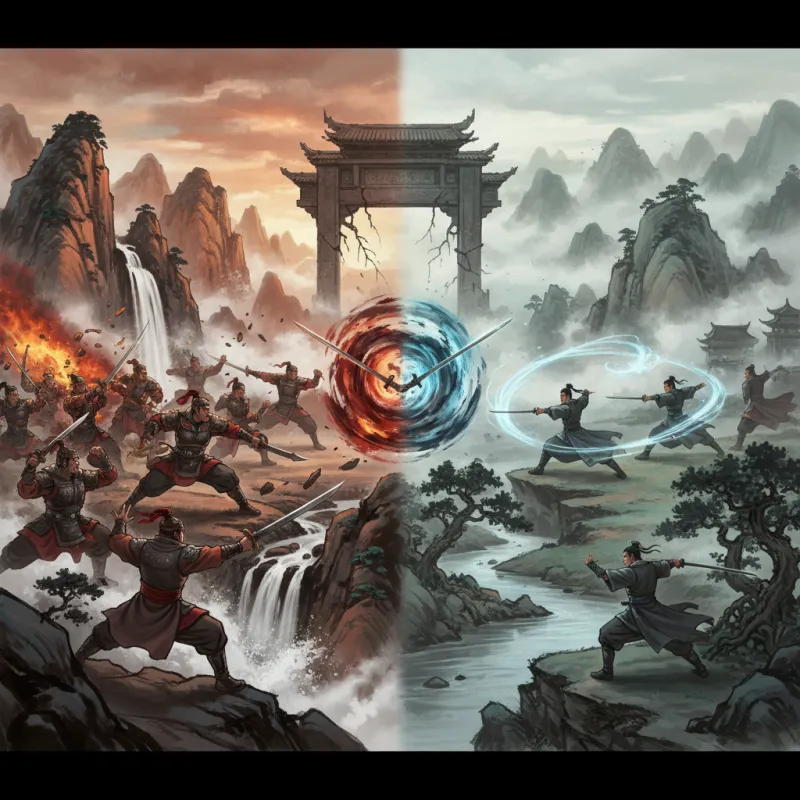
A young Shaolin monk spends fifteen years perfecting the Iron Palm technique. His hands can shatter bricks, split wood, and deflect blade strikes. He descends the mountain confident in his abilities. Three days later, he meets an elderly Wudang priest who's never thrown a serious punch in his life. The fight lasts exactly one exchange — the priest's seemingly gentle palm strike sends the monk flying backward, internal organs ruptured, meridians in chaos. The monk survives, barely, and spends the next decade wondering what the hell just happened.
This scenario plays out in countless wuxia novels because it illustrates the genre's most fundamental power dynamic: the supremacy of internal cultivation over external technique. It's not just a plot device. It's the philosophical backbone that separates wuxia from every other martial arts tradition in fiction.
The External Path: Muscle, Bone, and Ten Thousand Repetitions
External martial arts (外功 wàigōng) are exactly what they sound like — training that focuses on the physical body. Strength conditioning, speed drills, weapon forms, striking techniques, defensive postures. This is the martial arts most people recognize: the Shaolin monk breaking stone slabs, the spearman practicing thrusts until his arms shake, the swordsman running through forms at dawn.
In wuxia novels, external practitioners are everywhere. They're the rank-and-file disciples of major sects, the bodyguards and soldiers, the bandits and enforcers. They're competent, often dangerous, but they hit a ceiling. No amount of external training alone will elevate someone to the top tier of the jianghu (江湖 jiānghú).
The Shaolin Temple is the archetypal external school, though this is a simplification — Shaolin actually has internal methods too, but its public reputation rests on external feats. The 72 Shaolin Arts (少林七十二艺 Shàolín Qīshí'èr Yì) are mostly external: Iron Head, Iron Shirt, Iron Palm, Finger Strength, Leg Strength. These techniques produce visible, measurable results. A monk with Iron Shirt can take sword strikes to the torso. Someone who's mastered Finger Strength can poke holes through wooden planks.
But here's the problem: external cultivation is linear. You get stronger, faster, tougher — but the gains diminish over time. After a certain point, you're just maintaining what you've built. There's no exponential leap, no sudden breakthrough that transforms you into something beyond human.
The Internal Path: Qi, Meridians, and the Cultivation Bottleneck
Internal martial arts (内功 nèigōng) operate on completely different principles. Instead of conditioning the body, you're cultivating qi (气 qì) — vital energy that flows through meridians (经脉 jīngmài) in the body. This isn't metaphorical. In wuxia, qi is real, measurable, and the source of all superhuman abilities.
Internal cultivation is what allows a martial artist to perform lightness kung fu (轻功 qīnggōng), leap across rooftops, fight for hours without tiring, heal from injuries at accelerated rates, and project force without physical contact. It's the difference between hitting someone with your fist and hitting them with your qi.
The classic internal schools are Wudang (武当 Wǔdāng), Emei (峨眉 Éméi), and the various Taoist sects. Their training methods look deceptively simple from the outside — meditation, breathing exercises, slow-motion forms like Taiji. But internally, practitioners are doing something far more complex: opening meridians, circulating qi through specific pathways, building and refining their internal energy reserves.
Jin Yong's novels are obsessed with this process. In The Legend of the Condor Heroes (射雕英雄传 Shèdiāo Yīngxióng Zhuàn), Guo Jing spends years learning the Nine Yin Manual's (九阴真经 Jiǔyīn Zhēnjīng) internal cultivation methods. The results aren't immediate — internal training is slow, requires patience, and has multiple bottlenecks where progress stalls completely. But once Guo Jing breaks through, his power level jumps dramatically. He goes from competent fighter to someone who can stand against the Five Greats.
Why Internal Always Wins (Eventually)
The wuxia genre has a clear hierarchy: pure external practitioners lose to hybrid practitioners, who lose to pure internal masters. This isn't about fairness or balance. It's about the exponential nature of internal cultivation versus the linear nature of external training.
Consider Zhang Wuji from The Heaven Sword and Dragon Saber (倚天屠龙记 Yǐtiān Túlóng Jì). He learns the Nine Yang Divine Skill (九阳神功 Jiǔyáng Shéngōng), one of the most powerful internal cultivation methods in Jin Yong's universe. Within a few years, he's functionally invincible. His internal energy is so deep that he can learn any martial art instantly, heal from near-fatal injuries, and overpower opponents with decades more experience.
This is the internal cultivation fantasy: the idea that there's a hidden dimension of power that most people never access, and once you do, the normal rules stop applying. It's why wuxia protagonists almost always follow the internal path, or at least combine internal and external training.
The external-only fighter, no matter how skilled, is playing a different game. They're bound by physical limitations — stamina, strength, speed. The internal master transcends those limitations. They can fight for days without rest, take hits that would kill a normal person, and deliver strikes that bypass physical defenses entirely.
The Hybrid Approach: Best of Both Worlds?
Most elite martial artists in wuxia don't choose one path exclusively. They combine external technique with internal cultivation, creating a synergy that's more powerful than either approach alone.
Shaolin's highest-level arts, like the Yijin Jing (易筋经 Yìjīn Jīng) or Marrow Cleansing Classic (洗髓经 Xǐsuǐ Jīng), are actually internal methods that enhance external training. A monk who masters these can perform external feats that would be impossible otherwise — not because their muscles are stronger, but because qi is reinforcing and amplifying their physical movements.
The Eighteen Dragon-Subduing Palms (降龙十八掌 Jiàng Lóng Shíbā Zhǎng) is a perfect example of this hybrid approach. The technique itself is external — specific palm strikes with defined forms. But it requires massive internal energy to execute properly. Without deep internal cultivation, the moves are just fancy hand gestures. With it, each palm strike carries enough force to shatter stone and send opponents flying.
This is why the beggar sect's (丐帮 Gàibāng) martial arts are so respected. They're not purely internal like Wudang, but they've perfected the integration of internal and external methods. Hong Qigong, the sect's leader in Condor Heroes, is a grandmaster precisely because he's mastered both dimensions.
The Philosophical Divide: Daoist vs. Buddhist Roots
The internal-external split isn't just mechanical — it reflects deeper philosophical differences between Daoist and Buddhist approaches to cultivation.
Daoist internal arts emphasize wu wei (无为 wúwéi), effortless action. The goal is to align yourself with natural energy flows, to cultivate without forcing. Wudang's Taiji principles embody this: soft overcomes hard, yielding defeats aggression, minimal effort produces maximum effect. A true internal master doesn't need to exert themselves because they're working with qi, not against it.
Buddhist external arts, particularly Shaolin's tradition, emphasize discipline, repetition, and the transformation of the physical body through rigorous practice. There's a monastic quality to it — the idea that enlightenment (or martial mastery) comes through dedicated, systematic effort. You build your foundation brick by brick, form by form, until the body itself becomes a weapon.
Neither approach is wrong, but wuxia novels consistently favor the Daoist model. Internal cultivation is portrayed as more sophisticated, more powerful, and ultimately more aligned with the genre's core fantasy: that hidden knowledge and patient cultivation can elevate you beyond normal human limits.
The Great Reversal: When External Becomes Internal
Here's where things get interesting: at the highest levels, the distinction between internal and external starts to blur.
In Gu Long's novels, particularly the Chu Liuxiang (楚留香 Chǔ Liúxiāng) series, some characters achieve such mastery of external technique that it becomes indistinguishable from internal cultivation. Their movements are so refined, so perfectly efficient, that they seem to transcend physical limitations. This is the "return to simplicity" (返璞归真 fǎnpú guīzhēn) concept — when you've mastered something so completely that it becomes effortless again.
The Dugu Nine Swords (独孤九剑 Dúgū Jiǔ Jiàn) from The Smiling, Proud Wanderer (笑傲江湖 Xiào'ào Jiānghú) represents this principle. It's technically a sword technique — external by definition. But it requires such deep understanding of martial principles, such perfect timing and perception, that it functions like an internal art. Linghu Chong doesn't need massive qi reserves to use it effectively because the technique itself is so refined that it bypasses the normal power requirements.
This is the ultimate wuxia paradox: the highest external mastery looks like internal cultivation, and the highest internal cultivation manifests through external technique. The divide that seems so absolute at lower levels dissolves at the peak.
Why This Matters for Reading Wuxia
Understanding the internal-external divide changes how you read wuxia novels. When a character starts learning a new martial art, the first question should be: is this internal or external? That tells you their power trajectory, their potential ceiling, and how they'll match up against future opponents.
It also explains why wuxia protagonists spend so much time meditating, recovering from injuries, or having their meridians manipulated by masters. They're not resting — they're cultivating. Every moment of internal training is an investment that pays exponential returns later.
The external-internal split is also why wuxia has such dramatic power scaling. In most martial arts fiction, fighters get incrementally better. In wuxia, they have breakthroughs. A character can be struggling against mid-tier opponents, then suddenly unlock a new level of internal cultivation and start dominating people who were previously untouchable. This isn't plot armor — it's the logical outcome of how internal energy cultivation works in the genre's framework.
The next time you see an elderly master defeat a younger, stronger opponent with minimal effort, you'll know exactly what's happening: internal cultivation trumping external prowess, qi overwhelming muscle, decades of patient meditation paying off in a single exchange. That's not just a fight scene. That's the entire philosophy of wuxia martial arts playing out in real time.
Related Reading
- Acupoint Striking (Dianxue): The Deadly Art of Pressure Points
- The Greatest Palm Techniques in Wuxia Fiction, Ranked
- Wudang vs Shaolin: Two Philosophies of Combat
- Martial Arts Systems in Wuxia: Internal vs External, Orthodox vs Unorthodox
- Exploring the Intricate World of Wuxia: Legends, Culture, and Kung Fu Novels
- Exploring the Evolution of Wuxia: Modern Influences on Chinese Martial Arts Fiction
- Sun Wukong: The Great Sage Who Challenged Heaven
- Exploring the Cultural Depth of Wuxia: The Art of Chinese Martial Arts Fiction
Explore Chinese Culture
- Explore Jin Yong's martial arts novels
- Explore cultivation fiction and immortal heroes
- Explore the real history behind wuxia