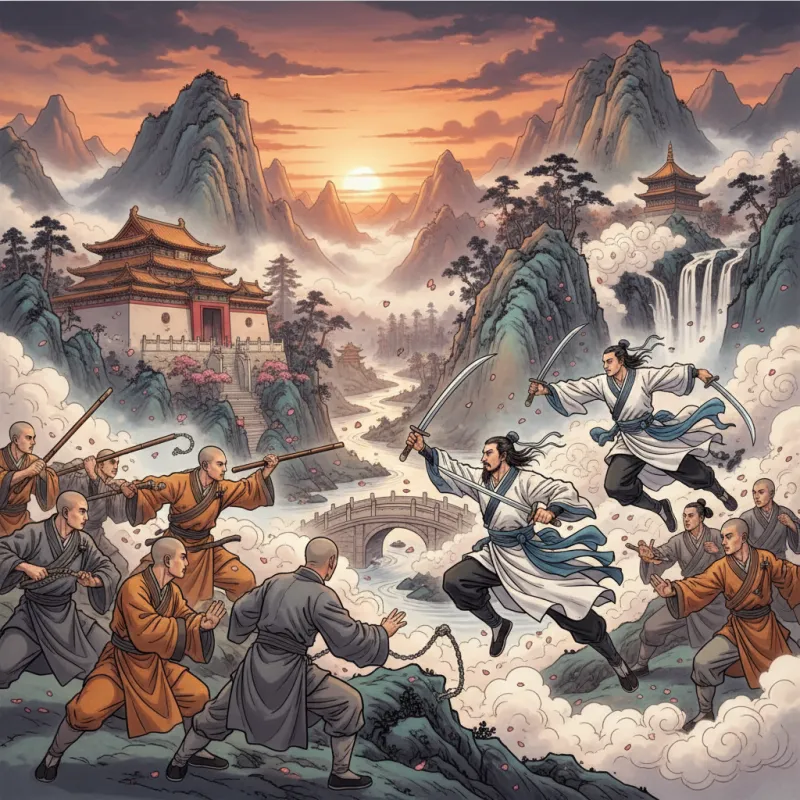
Ask any wuxia fan which school would win in a fight — Shaolin or Wudang — and watch them launch into a passionate defense of internal versus external cultivation, Buddhist discipline versus Daoist philosophy, staff techniques versus sword forms. The debate has raged for centuries in teahouses, on film sets, and across internet forums. But here's the uncomfortable truth: this legendary rivalry, the one that's shaped countless novels and films, is largely a literary invention. And that invention tells us more about Chinese culture than any "real" history ever could.
The Two Sacred Mountains
Shaolin Temple (少林寺 Shàolín Sì) perches on Song Mountain (嵩山 Sōngshān) in Henan Province, its gray walls weathered by fifteen centuries of history. Founded in 495 CE during the Northern Wei Dynasty, it started as a simple Buddhist monastery. The martial arts came later — much later than most people think. The famous story about Bodhidharma (达摩 Dámó) teaching kung fu to weak monks? That's a Ming Dynasty addition to a much older legend. The real Shaolin martial tradition probably emerged during the Tang Dynasty, when monks helped the emperor fight bandits and earned imperial favor.
Wudang Mountain (武当山 Wǔdāng Shān) rises in Hubei Province, its seventy-two peaks shrouded in mist and Daoist mysticism. Unlike Shaolin's ancient roots, Wudang's martial reputation is surprisingly recent. The complex of temples we see today was built during the Ming Dynasty (1368-1644), when the Yongle Emperor poured massive resources into creating a Daoist counterweight to Buddhist influence. The martial arts associated with Wudang — particularly taijiquan (太极拳 tàijíquán) — didn't become linked to the mountain until even later, mostly through 19th and 20th century marketing.
So when did these two schools become rivals? Not in the Tang Dynasty. Not in the Song. The rivalry as we know it crystallized in Ming Dynasty fiction and exploded in Qing Dynasty popular culture.
The Literary Birth of a Rivalry
The real architect of the Shaolin-Wudang rivalry wasn't a martial artist — it was novelists and storytellers who needed a compelling framework for their tales. The dichotomy was too perfect to resist: Buddhist monks versus Daoist priests, external power versus internal cultivation, northern styles versus southern influence, rigid discipline versus flowing adaptability.
Jin Yong (金庸 Jīn Yōng), the grandmaster of modern wuxia, understood this perfectly. In The Heaven Sword and Dragon Saber (倚天屠龙记 Yǐtiān Túlóng Jì), he doesn't just mention the rivalry — he makes it the engine of the plot. Zhang Sanfeng (张三丰 Zhāng Sānfēng), the legendary founder of Wudang martial arts, is portrayed as a former Shaolin disciple who created an entirely new system to counter Shaolin's techniques. The novel's climactic moments revolve around whether Wudang's internal methods can overcome Shaolin's external power.
But Jin Yong was building on centuries of popular tradition. Qing Dynasty novels and operas had already established the basic framework: Shaolin represented orthodox, establishment power, while Wudang embodied a more flexible, philosophical approach. This wasn't really about martial arts — it was about competing visions of Chinese identity and values.
External vs Internal: The Great Divide
The supposed technical difference between Shaolin and Wudang styles has become martial arts gospel: Shaolin practices external methods (外家 wàijiā) focused on physical conditioning, strength, and hard techniques, while Wudang cultivates internal methods (内家 nèijiā) emphasizing qi circulation, softness, and yielding force.
This distinction is philosophically appealing but historically questionable. Real martial arts don't divide so neatly. Shaolin monks absolutely practiced breathing exercises and meditation — they were Buddhists, after all. And Wudang practitioners needed strong bodies and practical fighting skills, not just philosophical musings about yin and yang.
The internal-external split probably originated with 17th century martial artist Huang Zongxi (黄宗羲 Huáng Zōngxī), who wrote about "internal school" boxing to distinguish certain styles from Shaolin's methods. Later writers expanded this into a full-blown philosophical system, mapping it onto the Buddhist-Daoist divide. By the time Republican-era martial artists were trying to systematize Chinese kung fu, the internal-external framework had become unquestioned dogma.
In wuxia fiction, this divide becomes even more pronounced. Characters who practice Shaolin methods are often portrayed as powerful but rigid, while Wudang practitioners are flexible and strategic. Think of how internal cultivation techniques are depicted as the "higher" path in many novels — it's not subtle.
The Weapons Tell the Story
If you want to understand the Shaolin-Wudang rivalry, look at their signature weapons. Shaolin's icon is the staff (棍 gùn) — simple, direct, devastatingly effective in trained hands. The staff represents Buddhist simplicity and the practical needs of monks who couldn't carry bladed weapons. Shaolin staff techniques emphasize powerful strikes, sweeps, and blocks. It's the weapon of someone who's spent years conditioning their body to deliver maximum force.
Wudang's signature weapon is the sword (剑 jiàn) — elegant, precise, requiring years of subtle training to master. The sword represents Daoist refinement and scholarly martial arts. Wudang sword techniques emphasize flowing movements, deceptive angles, and the principle of using minimal force for maximum effect. It's the weapon of someone who's spent years understanding leverage and timing.
This weapon symbolism runs deep in wuxia fiction. When Jin Yong's Zhang Wuji learns both Shaolin and Wudang techniques in The Heaven Sword and Dragon Saber, his ability to synthesize them represents a transcendence of the rivalry itself. The message is clear: the division is artificial, and true mastery requires understanding both approaches.
Why the Rivalry Persists
So if the Shaolin-Wudang rivalry is largely fictional, why does it remain so powerful? Because it serves as a perfect vehicle for exploring fundamental tensions in Chinese culture.
The Buddhist-Daoist divide represents different approaches to life: engagement versus withdrawal, discipline versus spontaneity, community versus individuality. Shaolin monks live in a strict hierarchy, following rules and schedules. Daoist practitioners on Wudang Mountain supposedly cultivate personal enlightenment through solitary practice. These are archetypal life paths, and the martial arts rivalry lets fiction explore them through action rather than philosophy.
The rivalry also reflects regional and class tensions. Shaolin, with its imperial connections and institutional power, represents the establishment. Wudang, with its mountain mysticism and individual masters, represents the alternative path. In many wuxia novels, heroes learn Wudang techniques to challenge corrupt Shaolin abbots — it's a story about resisting institutional power, not really about martial arts styles.
Modern martial arts schools have embraced and perpetuated the rivalry because it's great marketing. If you're teaching taijiquan, claiming lineage to Wudang Mountain adds mystique and authority. If you're running a Shaolin kung fu school, you're selling centuries of proven tradition. The rivalry creates brand differentiation in a crowded market.
The Reality Behind the Legend
Here's what we actually know: Shaolin Temple did develop significant martial traditions, particularly during the Ming and Qing Dynasties. Monks really did practice staff fighting and hand-to-hand combat. The temple was attacked and burned multiple times, most famously in 1928, which scattered monks and their knowledge across China and eventually the world.
Wudang Mountain has been a center of Daoist practice for centuries, and Daoist priests did practice martial arts. But the specific styles now associated with Wudang — taijiquan, baguazhang (八卦掌 bāguàzhǎng), xingyiquan (形意拳 xíngyìquán) — have complex histories that don't neatly trace back to the mountain. Zhang Sanfeng, the legendary founder of Wudang martial arts, probably didn't exist as described in fiction. The historical Zhang Sanfeng (if he existed) was a Daoist priest, but the martial arts attributed to him were likely developed by many people over centuries.
The real story is messier and more interesting than the legend. Chinese martial arts developed through countless individual teachers, family traditions, military training, and cross-pollination between styles. The idea that everything divides neatly into two schools is a simplification — but a useful one for storytelling.
Living With the Myth
I've trained in both "Shaolin" and "Wudang" styles, and I can tell you the rivalry feels real when you're learning the techniques. The different training philosophies produce different results. Shaolin-style conditioning builds explosive power and pain tolerance. Taijiquan practice develops sensitivity and relaxation under pressure. These are real differences, even if the historical rivalry is exaggerated.
The best martial artists I've met don't worry about the rivalry. They study what works, regardless of lineage claims. They understand that traditional martial arts evolved through practical testing, not philosophical purity. The Shaolin-Wudang framework is useful for organizing knowledge, but it shouldn't become a cage.
In wuxia fiction, the rivalry will continue because it's dramatically irresistible. Readers want to see Zhang Wuji synthesize Shaolin and Wudang techniques into something greater. We want to debate whether Shaolin's Vajra Palm can overcome Wudang's Taiji Sword. These arguments are fun precisely because they're not really about martial arts — they're about different ways of being in the world.
The rivalry that shaped Chinese martial arts is a beautiful lie. But sometimes the lies we tell reveal deeper truths than facts ever could. Shaolin and Wudang represent eternal tensions: hard versus soft, external versus internal, institution versus individual. As long as those tensions exist in human life, the rivalry will continue to captivate us.
And honestly? That's exactly as it should be.
Related Reading
- Qinggong: The Art of Lightness in Wuxia Fiction
- Internal vs External Martial Arts: The Great Debate
- Iron Palm Training: Hardening the Body Through Discipline
- Exploring Wuxia Fiction: The Art and Culture of Chinese Martial Arts Novels
- Wudang Sword Techniques: The Art of Taoist Swordsmanship
- The Code of Jianghu: Unwritten Rules of the Martial World
- Hidden Weapons in Wuxia: The Deadly Art of Surprise
- Shaolin Temple: The Sacred Mountain of Martial Arts
Explore Chinese Culture
- Explore Jin Yong's martial arts novels
- Explore cultivation fiction and immortal heroes
- Explore the real history behind wuxia