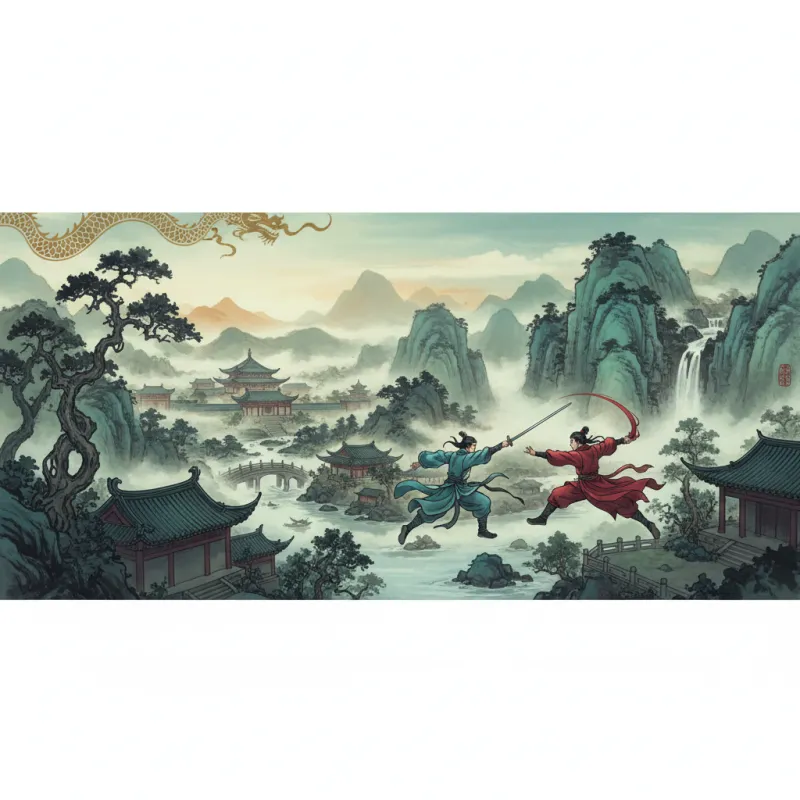
A warrior steps onto a bamboo leaf. The leaf bends—but doesn't break. He takes another step, then another, crossing a pond by walking from leaf to leaf, each one dipping just enough to kiss the water's surface before springing back. This is qinggong (轻功 qīnggōng), the "lightness skill" that separates wuxia heroes from ordinary martial artists, and it's the reason the genre's fight scenes happen everywhere except solid ground.
Qinggong isn't just a martial art—it's the visual language of wuxia itself. When Zhang Yimou filmed Crouching Tiger, Hidden Dragon, he wasn't inventing something new. He was translating to screen what readers had been imagining since the Ming Dynasty, when novels like Water Margin first described bandits leaping over walls "as if they had wings." The technique represents the genre's central promise: that through discipline and cultivation, humans can transcend their physical limitations without abandoning their humanity entirely.
The Physics of Controlled Impossibility
Here's what qinggong isn't: flying. That matters more than you'd think. In traditional wuxia, there's a careful distinction between lightness skill and actual flight, which typically requires either demonic cultivation or immortal status. Qinggong practitioners are still bound by gravity—they've just negotiated better terms.
The classical explanation involves internal energy (内力 nèilì) manipulation. By circulating qi through specific meridians, a master can temporarily reduce their body's effective weight while simultaneously enhancing muscular power. The result looks like flight but functions more like controlled falling with style. You're not defying physics so much as exploiting every loophole it offers.
Jin Yong's The Legend of the Condor Heroes demonstrates this distinction beautifully. When Guo Jing first learns qinggong from the Seven Freaks of Jiangnan, he can manage respectable leaps—maybe three zhang (about 30 feet) with a running start. But when Zhou Botong teaches him the genuine internal cultivation methods, suddenly he's bounding across rooftops in the Mongolian steppes, each step covering distances that would make an Olympic long jumper weep. The difference isn't supernatural power; it's the depth of his internal cultivation combined with proper technique.
The Taxonomy of Lightness
Not all qinggong is created equal. The genre recognizes several distinct categories, each with its own logic and limitations.
Vertical qinggong focuses on height. This is your classic wall-running, tree-climbing skill set. Linghu Chong's ability to scale Mount Hua's cliffs in The Smiling, Proud Wanderer exemplifies this category. The key principle is generating enough upward force with each step to overcome gravity before it reasserts control. Masters can run straight up walls for dozens of feet, though even they eventually need to find a handhold or push off to change direction.
Horizontal qinggong emphasizes distance and speed. This is where you get the iconic rooftop chases and the ability to cross rivers by skipping across the surface. The Wudang Sect's "Cloud Ladder" (梯云纵 tī yún zōng) technique, frequently mentioned in Jin Yong's works, belongs here. Practitioners don't actually walk on water—they move fast enough and step lightly enough that surface tension supports them for the split second their foot makes contact.
Sustained qinggong is the rarest and most demanding form. This is the ability to maintain lightness for extended periods, like Duan Yu's "Lingbo Weibu" (凌波微步) from Demi-Gods and Semi-Devils. Based on the hexagrams of the I Ching, this technique allows him to glide across battlefields in seemingly random patterns, making him nearly impossible to strike. It's less about spectacular leaps and more about perfect efficiency—every movement conserves energy while maintaining the lightness state.
The Training Regimen Nobody Wants
Qinggong training in traditional wuxia novels is brutally unglamorous. Forget mystical meditation on mountaintops—we're talking about years of wearing weighted leg bands while doing basic footwork drills.
The classic training method involves progressively lighter surfaces. Students begin by running across wooden planks, then move to paper stretched over frames, then to rice paper, then finally to leaves floating on water. The goal isn't to weigh less—it's to distribute your weight so perfectly across time and space that even fragile surfaces can support you momentarily. One of my favorite details from Gu Long's novels is that qinggong students often develop distinctive calluses on their toes from the constant practice of weight distribution.
The Wudang Sect supposedly had students practice by jumping while holding lit incense sticks. The goal was to land so softly that the incense wouldn't go out. Shaolin's approach was characteristically more direct: monks would jump from progressively higher platforms into sand pits, training their legs to absorb impact without injury. Only after mastering the landing could they work on the leaping.
Internal cultivation runs parallel to physical training. Students learn to sense and direct their qi, typically starting with basic meditation and breathing exercises. The Yijin Jing (易筋经), or "Muscle-Tendon Change Classic," attributed to Bodhidharma, is frequently cited as foundational text. Whether it actually teaches qinggong is debatable—the historical text focuses more on general health cultivation—but in wuxia fiction, it's treated as essential reading for anyone serious about lightness skills.
When Qinggong Goes Wrong
The genre's best writers understand that qinggong has costs and limitations. Jin Yong is particularly good at this. In The Heaven Sword and Dragon Saber, Zhang Wuji's qinggong is formidable, but when he's poisoned and his internal energy is compromised, he can barely manage a normal jump. The skill isn't a superpower you can toggle on and off—it's a technique that demands constant energy expenditure.
Gu Long takes a different approach in his works. His characters often have spectacular qinggong but use it sparingly because it's exhausting. Li Xunhuan in The Sentimental Swordsman can cross incredible distances when necessary, but he's usually too drunk or too melancholic to bother. The limitation isn't physical—it's psychological and practical. Why waste energy flying across rooftops when walking works fine?
The most interesting limitation is environmental. Qinggong works best in specific contexts. Rooftops with regular spacing? Perfect. Open fields? Manageable. Dense forest with unpredictable branch placement? Suddenly much harder. Swamps? Nearly impossible—there's nothing solid to push against, and the suction works against the lightness principle. This is why the Miao people's territory in southern China, with its mountainous jungle terrain, is so dangerous for northern martial artists in many wuxia stories. Their qinggong techniques evolved for different environments.
The Cultural Roots of Lightness
Qinggong didn't emerge from nowhere. Its fictional depiction draws on several real Chinese martial arts concepts and practices, even if the exaggerated results are pure fantasy.
Historical martial arts manuals do discuss "lightness work" (轻功), though their version is considerably more modest. The Bubishi, an Okinawan martial arts text with Chinese origins, describes training methods for improving jumping ability and reducing landing impact. Shaolin texts mention exercises for strengthening legs and improving balance. None of them promise you'll run across water, but they do suggest that dedicated training can produce seemingly superhuman agility.
The philosophical foundation comes from Daoist internal alchemy (内丹 nèidān). The idea that circulating qi through the body can produce physical transformations is central to Daoist practice, even if traditional practitioners aimed for longevity and spiritual enlightenment rather than rooftop parkour. Wuxia fiction simply asks: what if you directed that cultivated energy toward martial purposes instead?
There's also a theatrical tradition. Chinese opera has long featured acrobatic performances where actors leap, flip, and balance in ways that suggest supernatural ability. The stylized movement vocabulary of Beijing Opera, with its emphasis on precise footwork and dramatic leaps, provided a visual template for how qinggong might look in action. When wuxia films emerged in the 1960s, directors borrowed heavily from opera choreography.
Qinggong in the Modern Genre
Contemporary wuxia has complicated relationship with qinggong. Some authors have dialed it back, aiming for more "realistic" martial arts. Others have cranked it up to eleven, with characters essentially flying for all practical purposes.
The xianxia (仙侠) subgenre, which blends wuxia with fantasy cultivation, has largely abandoned the pretense that qinggong isn't flight. Characters in novels like Coiling Dragon or I Shall Seal the Heavens progress from basic lightness skills to literal sword-flying to teleportation. The careful distinction between enhanced jumping and actual flight has dissolved. Whether this is evolution or dilution depends on your perspective.
Meanwhile, some modern writers have found interesting ways to refresh the concept. Priest's Faraway Wanderers (the novel behind Word of Honor) treats qinggong almost casually—characters use it constantly for mundane purposes, not just dramatic fight scenes. Zhou Zishu uses lightness skills to eavesdrop from rooftops and avoid annoying conversations as much as he does for combat. It's a martial art fully integrated into daily life rather than reserved for special occasions.
The film and television adaptations face their own challenges. Wire work can only do so much, and CGI qinggong often looks weightless in the wrong way—characters float rather than leap. The best adaptations, like Zhang Yimou's Hero or the 2003 The Twins Effect, find a middle ground where the movement feels both impossible and grounded, maintaining that crucial sense that gravity still exists even if it's being temporarily negotiated with.
Why Lightness Matters
Qinggong endures because it's the perfect metaphor for what wuxia fiction promises: transcendence through discipline. The heroes aren't born with superpowers or chosen by prophecy (usually). They train, they cultivate, they practice until they can do the impossible. The fact that they still can't actually fly—that they're still fundamentally human, just operating at the absolute peak of human potential—makes their achievements meaningful.
It's also just incredibly cool to watch. There's a reason every wuxia adaptation, no matter how grounded it tries to be, includes at least one scene of someone leaping across rooftops or fighting on bamboo poles. Qinggong is the genre's signature move, its visual promise that this world operates by different rules. Rules that can be learned, if you're willing to put in the work.
For readers and viewers, qinggong represents possibility. Not the possibility of literal flight, but the possibility that dedicated practice can transform you into something more than you were. That's the real lightness skill—not making your body lighter, but making your limitations feel less heavy.
Related Reading
- Iron Palm Training: Hardening the Body Through Discipline
- Neigong: The Art of Internal Energy in Wuxia
- Dianxue: The Deadly Art of Pressure Point Strikes
- Internal vs External Martial Arts: The Great Debate
- The Complete Guide to Wuxia: China's Martial Arts Fiction Tradition
- Legend of the Condor Heroes: A Complete Reading Guide
- The Four Seas and the Shape of the Ancient Chinese World
- The Greatest Palm Techniques in Wuxia Fiction, Ranked
Explore Chinese Culture
- Explore Jin Yong's martial arts novels
- Explore cultivation fiction and immortal heroes
- Explore the real history behind wuxia