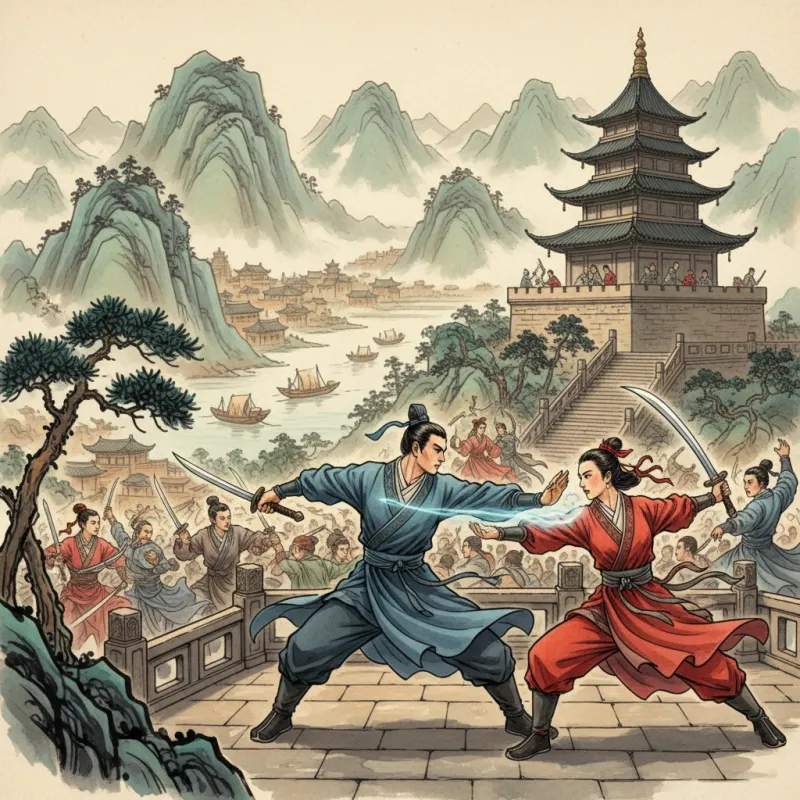
A single finger pressed against the hollow of your throat. You try to speak, but nothing comes out. You try to move, but your limbs refuse to obey. Your opponent hasn't drawn a weapon, hasn't even broken a sweat — just touched you, almost gently, and now you're frozen like a statue. This is dianxue (点穴 diǎnxué), the art of pressure point strikes, and in the world of wuxia fiction, it's the ultimate expression of martial supremacy: defeating an enemy without appearing to fight at all.
The Medical Foundation: Where Healing Meets Harm
Dianxue literally translates as "dotting the acupoints," which sounds almost therapeutic until you realize that the same knowledge used to heal can be weaponized with devastating efficiency. The foundation lies in traditional Chinese medicine's understanding of the body as a network of meridians (经络 jīngluò) — invisible channels through which qi (气 qì), or vital energy, flows. Along these meridians sit hundreds of acupoints (穴位 xuéwèi), specific locations where qi can be manipulated.
An acupuncturist inserts needles to restore balance and promote healing. A dianxue master? They strike these same points to disrupt, paralyze, or kill. The theory is identical; only the intention differs. This duality makes dianxue particularly fascinating in wuxia literature — it requires deep medical knowledge, the kind typically associated with healers and physicians, yet it's employed as a combat technique. The greatest dianxue practitioners often double as doctors, understanding that to harm effectively, you must first understand how to heal.
The most commonly targeted points in fiction include the Jianjing (肩井 jiāngjǐng) at the shoulder, which can cause immediate arm paralysis; the Quchi (曲池 qūchí) at the elbow crease, affecting the entire arm; and the dreaded Yamen (哑门 yǎmén) at the base of the skull, which can cause instant death or permanent muteness. Jin Yong's novels frequently reference the Tanzhong (膻中 tánzhōng) point at the center of the chest — strike it correctly, and you can stop someone's heart.
The Mechanics: Timing, Precision, and Internal Power
Here's what separates dianxue from simply poking someone: it requires the convergence of three elements that most martial artists spend decades trying to master. First, anatomical precision — you need to hit the exact point, often no larger than a grain of rice. Miss by even a centimeter, and nothing happens. Second, timing — acupoints are believed to be more vulnerable at specific times of day, following the traditional Chinese medicine concept of the "organ clock" where qi flows more strongly through certain meridians during certain hours. Third, and most crucially, you need profound internal power (内力 nèilì) to project qi through your fingertip into the target's meridian system.
This last requirement is why dianxue is almost exclusively the domain of internal martial arts practitioners. You can learn the locations of every acupoint, memorize the entire organ clock, and still fail utterly if you lack the internal cultivation to make your strikes effective. It's not about physical force — you're not trying to bruise or break tissue. You're attempting to disrupt the flow of qi itself, which requires your own qi to be both abundant and controllable. This is why characters who practice Internal vs External Martial Arts: The Great Debate often have such different capabilities when it comes to dianxue.
The finger techniques themselves vary. Some practitioners use the index and middle fingers together (剑指 jiànzhǐ, "sword fingers"), others prefer a single finger strike, and some advanced masters can allegedly project their qi without physical contact at all — the so-called "empty force" (空劲 kōngjìn) that remains controversial even within wuxia fiction's generous physics.
The Seal and the Release: Temporary vs Permanent
One of dianxue's most narratively useful features is its reversibility — or lack thereof. When a master seals your acupoints, they can choose whether it's temporary or permanent, and whether you'll need their specific technique to unlock it or if it will release on its own after a set period. This creates endless plot possibilities.
The temporary seal is the most common in wuxia novels. Your acupoints are struck, you're paralyzed for anywhere from a few minutes to several hours, and then the effect naturally dissipates as your qi circulation gradually restores itself. Jin Yong loved this device — how many times does Linghu Chong in The Smiling, Proud Wanderer (笑傲江湖 Xiào Ào Jiānghú) wake up to find himself sealed and helpless? The temporary seal serves as a non-lethal way to neutralize opponents, capture prisoners, or simply humiliate rivals without killing them.
More sinister is the permanent seal, which requires another dianxue expert to release — and preferably the same person who applied it. This creates hostage situations without hostages: "Do as I say, or you'll never use your arms again." Gu Long's novels feature this frequently, with characters spending entire story arcs searching for the one person who can unlock their sealed meridians. The medical implications are grim: if qi cannot flow properly through your meridians, you'll gradually weaken, sicken, and eventually die, making the permanent seal a slow-acting death sentence.
Then there's the delayed-effect seal, a favorite of cunning villains. Your acupoints are struck, but you don't realize it immediately. Hours or days later, at a predetermined time or under specific conditions, the seal activates. Imagine discovering mid-battle that your opponent sealed your acupoints three days ago, and they're only now taking effect. The psychological warfare aspect is delicious.
Famous Practitioners: From Physicians to Demons
The Peach Blossom Island's Huang Yaoshi (黄药师 Huáng Yàoshī) from Jin Yong's The Legend of the Condor Heroes (射雕英雄传 Shè Diāo Yīngxióng Zhuàn) represents the scholarly approach to dianxue. He's a polymath who understands medicine, music, mathematics, and martial arts as interconnected disciplines. His dianxue technique is precise, almost surgical, reflecting his intellectual mastery. When he seals someone's acupoints, it's with the casual efficiency of a doctor performing a routine procedure.
Contrast this with Qiu Qianren (裘千仞 Qiū Qiānrèn), whose Iron Palm technique incorporates dianxue strikes that are brutal and unsubtle. He's not interested in the elegant theory; he wants results. His approach is more "strike hard enough that it doesn't matter if you're off by a few millimeters" — overwhelming force compensating for lack of finesse.
But the most terrifying dianxue practitioner in wuxia fiction might be Ding Chunqiu (丁春秋 Dīng Chūnqiū) from Demi-Gods and Semi-Devils (天龙八部 Tiānlóng Bābù). His Chemical Skill (化功大法 Huàgōng Dàfǎ) doesn't just seal acupoints — it corrodes them, permanently destroying a person's martial arts cultivation. He combines dianxue with poison, creating a hybrid technique that represents the dark side of medical knowledge. When Ding Chunqiu touches you, he's not just disrupting your qi flow; he's chemically altering your meridian system itself.
The Countermeasures: Defense and Reversal
If dianxue were unstoppable, every wuxia novel would be very short. Fortunately, several defensive approaches exist, each with its own logic and limitations.
The most straightforward defense is superior internal power. If your qi is abundant and your meridians are robust, an opponent's dianxue strike might simply fail to penetrate. This is why characters with profound internal cultivation like Zhang Sanfeng (张三丰 Zhāng Sānfēng), founder of Wudang Sect: Taoist Martial Philosophy, are often described as immune to ordinary dianxue techniques. Their qi is too strong to be easily disrupted.
Another approach is the "chaotic meridian" defense, where you deliberately circulate your qi in irregular patterns, making it difficult for an opponent to predict where your qi will be at any given moment. This is risky — circulating qi chaotically can damage your own meridians — but it's effective against dianxue masters who rely on precise timing.
Some martial arts specifically train resistance to dianxue. The Golden Bell Shield (金钟罩 Jīnzhōng Zhào) and Iron Shirt (铁布衫 Tiěbùshān) techniques, typically associated with Shaolin's external training, create a kind of qi armor that makes acupoints harder to access. The practitioner's meridians are so reinforced that they're less vulnerable to disruption.
Then there's the nuclear option: self-sealing. If you know an opponent is about to strike your acupoints, you can seal them yourself first, using a different pattern. This prevents the enemy's technique from working, though it also temporarily limits your own abilities. It's the martial arts equivalent of cutting power to your house to prevent someone from electrocuting you — effective, but inconvenient.
The Reality Check: Does Dianxue Actually Exist?
Here's where we need to separate wuxia fiction from historical martial arts. Did ancient Chinese martial artists study pressure points? Absolutely. Do modern martial arts like Dim Mak (点脉 diǎnmài, "touch the pulse") claim to use pressure point strikes? Yes. Can you actually paralyze someone with a single finger tap to the shoulder? The evidence is... let's say "contested."
Traditional Chinese medicine's acupoint system is real and well-documented, with thousands of years of clinical use. Acupuncture demonstrably affects the nervous system, though whether this happens through "qi meridians" or through more conventional neurological mechanisms remains debated. What's less clear is whether striking these points can produce the dramatic effects described in wuxia novels.
Some pressure points do correspond to vulnerable anatomical structures. Strike the carotid sinus correctly, and you can cause a sudden drop in blood pressure leading to unconsciousness. Hit certain nerve clusters, and you can cause temporary paralysis or intense pain. But these effects require significant force and aren't as precise or controllable as fiction suggests. You're not "sealing qi flow" — you're causing neurological trauma or vascular disruption.
The "delayed effect" seal is particularly dubious from a medical standpoint. How would striking an acupoint today cause paralysis three days from now? The proposed mechanism — that you're creating a "qi blockage" that gradually worsens — doesn't align with how the nervous system actually works. Nerve damage is typically immediate, not delayed.
That said, the psychological component shouldn't be dismissed. If someone believes their acupoints have been sealed, the nocebo effect (the evil twin of the placebo effect) can produce real symptoms. Expectation shapes experience, and in a culture where dianxue is accepted as real, the belief itself might be enough to cause temporary dysfunction.
The Narrative Power: Why Dianxue Endures
Regardless of its real-world validity, dianxue remains one of wuxia fiction's most compelling devices because it embodies several key themes. First, it represents knowledge as power — the idea that understanding the human body's secrets grants you control over life and death. This appeals to the scholarly tradition in Chinese culture, where education and wisdom are highly valued.
Second, dianxue is the ultimate expression of efficiency. Why swing a sword when a finger tap will do? It's elegant, economical, and demonstrates such profound skill that it borders on the supernatural. In a genre obsessed with martial supremacy, dianxue represents the pinnacle: defeating opponents without apparent effort.
Third, it creates interesting moral ambiguities. A sword wound is clearly violent, but a dianxue strike can appear almost gentle. The victim might not even realize they've been attacked until they try to move. This allows for subtle villainy and creates situations where characters must prove they've been harmed when there's no visible injury.
Finally, dianxue's reversibility makes it narratively flexible. Characters can be neutralized without being killed, creating tension without permanent consequences. The search for someone to unlock sealed acupoints can drive entire plot arcs. And the threat of permanent sealing provides villains with leverage that's more interesting than simple death threats.
In the end, dianxue persists in wuxia fiction not because it's realistic, but because it's useful. It's a narrative tool that allows authors to explore themes of knowledge, power, medicine, and martial arts philosophy while creating compelling plot complications. And really, isn't that what matters? We don't read wuxia novels for medical accuracy — we read them for the thrill of imagining a world where a touch can be more deadly than a blade, and where true mastery means understanding the body so completely that you can control it with a fingertip.
Related Reading
- Exploring Wuxia Fiction: The Art and Culture of Chinese Martial Arts Novels
- Iron Palm Training: Hardening the Body Through Discipline
- Qinggong: The Art of Lightness in Wuxia Fiction
- Neigong: The Art of Internal Energy in Wuxia
- Shaolin vs Wudang: The Rivalry That Shaped Chinese Martial Arts
- Sleeve Arrows and Mechanical Weapons in Wuxia Fiction
- Tea Houses and Wine Shops: The Social Hubs of the Martial World
- Wuxia Training Montages: How Heroes Are Made
Explore Chinese Culture
- Explore Jin Yong's martial arts novels
- Explore cultivation fiction and immortal heroes
- Explore the real history behind wuxia