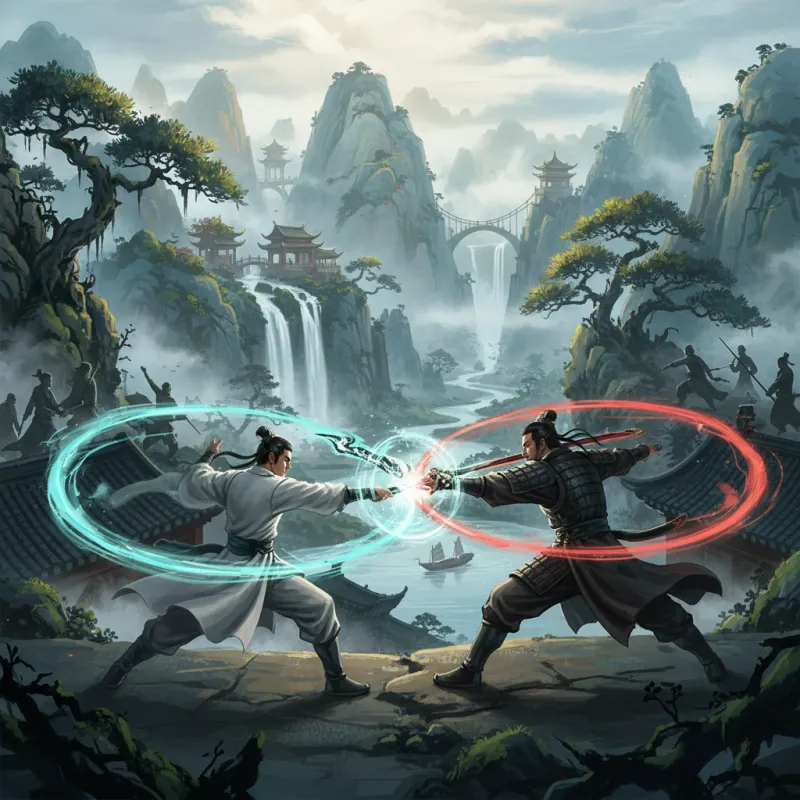
Every master in wuxia fiction shares one secret: they can kill you without moving. A flick of the sleeve sends an opponent flying. A palm pressed to the chest stops a heart three beats later. A whisper of breath extinguishes candles across the room. This isn't magic—it's neigong (内功 nèigōng), the cultivation of internal energy that separates legends from corpses.
What Neigong Actually Does
Neigong transforms the human body into something more than flesh and bone. It's the difference between Zhang Wuji's ability to withstand the combined assault of six major sect leaders in The Heaven Sword and Dragon Saber and an ordinary martial artist who'd be paste after the first exchange. The practice involves circulating qi (气 qì)—vital energy—through specific pathways in the body called meridians (经络 jīngluò), gradually strengthening organs, bones, and tissues from the inside out.
Think of it as internal architecture. External martial arts like Shaolin kung fu build the facade—impressive forms, devastating strikes, acrobatic kicks. Neigong builds the foundation and frame. Without it, even the most spectacular sword techniques are just dangerous dancing. With it, a simple palm strike can shatter stone or heal a dying man, depending on the practitioner's intent and skill level.
The dantian (丹田 dāntián), located roughly three finger-widths below the navel, serves as the primary reservoir for cultivated qi. Ancient Daoist texts describe it as the "field of elixir," where raw energy is refined into usable power. Beginners spend years just learning to sense this area, let alone fill it with qi. Masters like Dugu Qiubai reportedly cultivated their dantian to such depths that their internal energy became self-replenishing—a perpetual motion machine of martial power.
The Cultivation Process: Slower Than Watching Bamboo Grow
Here's the part that wuxia novels gloss over with convenient time skips: neigong cultivation is brutally slow. The orthodox method involves sitting meditation, breathing exercises, and visualization techniques practiced daily for decades. Zhang Sanfeng, founder of Wudang, allegedly spent thirty years in seclusion perfecting his internal arts before emerging to revolutionize martial philosophy.
The process follows a general progression. First, you learn to sense qi—most people never get past this stage. Then you learn to guide it through the twelve primary meridians using breath control and mental focus. Next comes opening the eight extraordinary meridians, particularly the Governing Vessel (督脉 dūmài) running up the spine and the Conception Vessel (任脉 rènmài) running down the front. When these two connect in what's called the "Small Heavenly Circuit" (小周天 xiǎo zhōutiān), you've achieved the first major milestone.
But that's just the foundation. Advanced practitioners work toward the "Great Heavenly Circuit" (大周天 dà zhōutiān), where qi flows freely through all meridians simultaneously. At this level, internal energy can be projected outside the body—the famous "palm wind" that knocks opponents back without physical contact. Duan Yu's Six Meridians Divine Sword in Demi-Gods and Semi-Devils represents an extreme application: converting internal energy into invisible sword qi that strikes from a distance.
Orthodox vs. Unorthodox: The Cultivation Divide
The martial world splits neigong methods into orthodox (正派 zhèngpài) and unorthodox (邪派 xiépài) schools, though the distinction is more political than practical. Orthodox methods emphasize gradual, balanced cultivation that strengthens the body without damaging it. The Shaolin's Yi Jin Jing (易筋经 Yì Jīn Jīng, "Muscle-Tendon Change Classic") exemplifies this approach—slow, safe, and requiring monastic discipline.
Unorthodox methods trade safety for speed. The Star-Absorbing Great Technique (吸星大法 Xīxīng Dàfǎ) from The Smiling, Proud Wanderer lets practitioners steal others' internal energy directly, achieving in months what might take decades through orthodox training. The catch? Absorbed qi from different sources conflicts within the body, eventually driving the practitioner insane unless they possess extraordinary mental discipline or a method to harmonize the chaotic energies.
Then there's the truly demonic stuff. The Beiming Divine Art (北冥神功 Běimíng Shéngōng) that Duan Yu stumbles into works similarly to the Star-Absorbing technique but with better quality control—it automatically refines absorbed energy. The Sunflower Manual (葵花宝典 Kuíhuā Bǎodiǎn) offers godlike speed and power but demands self-castration first, operating on the theory that eliminating yang energy allows pure yin cultivation. Dongfang Bubai's transformation into an androgynous, nearly invincible fighter proves the method works, even if the price is steep.
Internal Energy in Combat: More Than Hitting Harder
Raw power is just the beginning. Skilled practitioners use neigong for applications that seem like sorcery to the uninitiated. Protective qi (护体罡气 hùtǐ gāngqì) creates an invisible barrier around the body—this is why masters can stand in blizzards wearing silk robes or deflect arrows without moving. Guo Jing's "Eighteen Dragon-Subduing Palms" wouldn't be legendary without the massive internal energy he channels through each strike.
Healing represents another major application. The "Nine Yang Divine Skill" (九阳神功 Jiǔyáng Shéngōng) generates such pure yang energy that it automatically expels poisons and heals injuries. Zhang Wuji uses it to cure himself of multiple deadly toxins that should have killed him three times over. Other masters can transfer their qi to heal others, though this depletes their own reserves and can be dangerous if the recipient's meridians can't handle the influx.
Lightness skills (轻功 qīnggōng) depend entirely on internal energy. The ability to run across water, leap onto rooftops, or stand on swaying bamboo branches isn't about being physically light—it's about using qi to reduce your effective weight and enhance explosive power. Without substantial neigong, qinggong is just jumping with style.
The Bottleneck Problem: Why Most People Plateau
Neigong cultivation hits walls. The first major bottleneck comes when trying to open the Governing and Conception Vessels. Many practitioners spend entire lifetimes stuck here, their internal energy circulating through the twelve primary meridians but never achieving the Small Heavenly Circuit. Forcing the breakthrough can cripple or kill you—qi deviation (走火入魔 zǒuhuǒ rùmó) occurs when energy flows into wrong pathways, damaging meridians and organs.
The second bottleneck separates masters from legends. After achieving the Great Heavenly Circuit, further progress requires either decades more cultivation or a fortuitous encounter—consuming a rare spiritual herb, absorbing a dying master's lifetime of cultivation, or discovering an ancient manual. This is why wuxia protagonists constantly stumble into caves containing century-old martial arts secrets. Without these narrative shortcuts, they'd be middle-aged before becoming relevant.
Age matters too. Starting young means flexible meridians that open more easily. Starting after thirty means fighting against a body that's already set in its ways. This is why sects recruit children and why older characters who suddenly begin cultivation rarely achieve greatness. The exceptions—like Linghu Chong learning the Star-Absorbing technique in his twenties—usually involve unorthodox methods that bypass normal limitations.
Neigong's Real-World Roots
The fictional version exaggerates, but neigong exists outside novels. Traditional Chinese martial arts include internal cultivation practices derived from Daoist meditation and breathing exercises. Taijiquan, Baguazhang, and Xingyiquan—the three major internal martial arts—all emphasize qi cultivation alongside physical technique. Practitioners report improved health, mental clarity, and yes, enhanced martial ability, though nobody's shooting sword qi from their fingers.
The concept traces back to the Warring States period (475-221 BCE), appearing in texts like the Zhuangzi and medical classics like the Huangdi Neijing. These sources describe qi as the fundamental substance of the universe, with human health depending on its smooth circulation through the body. Martial artists adapted these health practices into combat applications over centuries, creating the foundation that wuxia fiction would later amplify into supernatural territory.
Modern practitioners distinguish between "hard" qigong (硬气功 yìng qìgōng)—conditioning the body to withstand strikes—and "soft" qigong (软气功 ruǎn qìgōng)—cultivating internal energy for health and martial application. The Iron Shirt training that lets Shaolin monks take staff strikes to the body without injury is real, documented, and impressive. The part where they project qi to knock someone over from ten feet away remains... let's say disputed.
Why Neigong Matters to the Genre
Every wuxia power system is ultimately a neigong variant. The "internal strength" that lets characters fight for hours without tiring? Neigong. The ability to neutralize poisons, survive falls that should be fatal, or sense enemies approaching from behind? All neigong applications. Even purely external fighters need basic internal cultivation to compete at high levels—otherwise their bodies would break under the stress of their own techniques.
The genius of neigong as a narrative device is that it's simultaneously concrete and flexible. It follows rules—meridians, dantian, circulation methods—that create consistent power scaling. But it's also mysterious enough to justify almost any ability the plot requires. Need your protagonist to survive a deadly poison? Their neigong is special. Need them to learn a technique impossibly fast? Their meridians are naturally suited to it. The system provides structure without constraining creativity.
Understanding neigong transforms how you read wuxia fiction. When令狐冲 (Linghu Chong) struggles to master the Dugu Nine Swords despite his talent, it's because his internal energy foundation is weak. When 郭靖 (Guo Jing) defeats more technically skilled opponents, it's because his neigong is deeper. The invisible architecture of internal energy underlies every fight scene, every power-up, every moment of martial excellence. Master this concept, and the entire genre opens up.
Related Reading
- Dianxue: The Deadly Art of Pressure Point Strikes
- Iron Palm Training: Hardening the Body Through Discipline
- Internal vs External Martial Arts: The Great Debate
- Exploring Wuxia Fiction: The Art and Culture of Chinese Martial Arts Novels
- Shanhai Jing Creatures in Modern Video Games
- External vs. Internal Martial Arts: The Great Divide in Wuxia
- The Green Destiny: Most Famous Sword in Wuxia Cinema
Explore Chinese Culture
- Explore Jin Yong's martial arts novels
- Explore cultivation fiction and immortal heroes
- Explore the real history behind wuxia