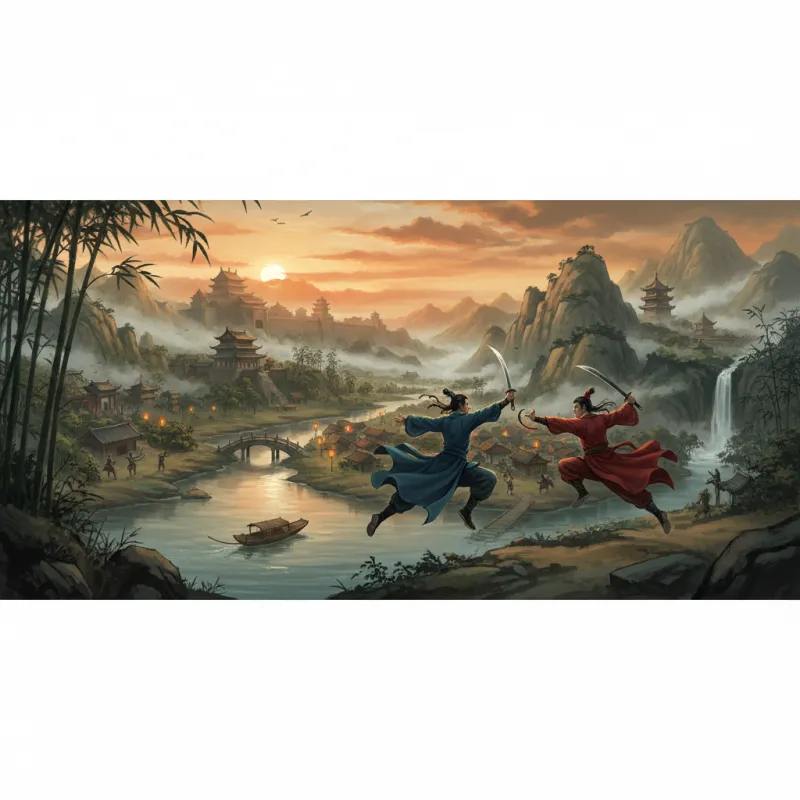
A lone swordsman stands at the edge of a cliff, his white robes whipping in the mountain wind. Below him, a hundred soldiers wait with drawn blades. He doesn't run. He doesn't negotiate. He simply steps off the edge — and the moment his foot leaves solid ground, you know you're watching wuxia. That impossible leap, that defiance of physics and fate alike, captures everything essential about China's martial arts fiction tradition: the elevation of human will over natural law, the romance of the wandering hero, and the belief that mastery of martial arts can transform an ordinary person into something transcendent.
Wuxia (武侠, wǔxiá) — literally "martial heroes" — represents more than a genre. It's a cultural mythology that has shaped Chinese popular imagination for over two millennia, from the historical chronicles of Sima Qian to the blockbuster novels of Jin Yong. Unlike Western fantasy with its dragons and magic systems, wuxia operates in a heightened version of historical China where the impossible becomes possible through discipline, training, and the mysterious force called internal energy. It's the difference between Gandalf casting a spell and a Shaolin monk shattering stone with his bare hands — one is supernatural, the other is human potential pushed to its absolute limit.
The Roots: From Historical Records to Popular Romance
The first wuxia heroes weren't fictional at all. They appear in Sima Qian's Records of the Grand Historian (史记, Shǐjì), written around 100 BCE, in a chapter titled "Biographies of Assassin-Retainers" (刺客列传, Cìkè Lièzhuàn). These were real people — or at least, people Sima Qian believed were real — like Jing Ke, who attempted to assassinate the First Emperor of Qin in 227 BCE, or Nie Zheng, who killed a corrupt minister and then mutilated his own face to protect his family from retribution.
What made these figures proto-wuxia wasn't just their martial skill but their adherence to yi (义, yì) — righteousness, loyalty, the willingness to sacrifice everything for a cause or a friend. This concept would become the moral backbone of every wuxia story written afterward. The historical assassins operated in the shadows of power, serving nobles and kings, but they embodied a code that transcended politics: keep your word, repay your debts, protect the weak, avenge the wronged.
By the Tang Dynasty (618-907 CE), these historical accounts had evolved into chuanqi (传奇, chuánqí) — "tales of the strange" — short stories that blended history with supernatural elements. Heroes could now leap over walls, fight multiple opponents simultaneously, and possess secret techniques passed down through mysterious masters. The line between possible and impossible began to blur, creating the aesthetic space where wuxia would flourish.
The true explosion came during the Ming (1368-1644) and Qing (1644-1912) dynasties with the rise of vernacular novels. Water Margin (水浒传, Shuǐhǔ Zhuàn), written in the 14th century, gave us 108 outlaw heroes, each with distinct personalities and fighting styles, united against corrupt officials. This wasn't just entertainment — it was social commentary disguised as adventure, a pattern that would define wuxia for centuries. When the government is corrupt, when the law serves the powerful rather than the just, the martial hero steps outside the system entirely and creates his own justice in the jianghu.
The Jianghu: A World Apart
Understanding wuxia requires understanding jianghu (江湖, jiānghú), perhaps the most important concept in the entire tradition. Literally "rivers and lakes," jianghu refers to the martial arts underworld — a parallel society existing alongside but separate from official government and conventional civilian life. It's where martial artists, wanderers, outlaws, and heroes operate according to their own rules and hierarchies.
The jianghu isn't a physical place you can point to on a map. It's more like a social network, a subculture, a state of mind. When a character "enters the jianghu" (闯荡江湖, chuǎngdàng jiānghú), they're leaving behind the safety and constraints of normal society. They might be seeking revenge, fleeing persecution, searching for a legendary master, or simply pursuing martial excellence. But once you're in, you're bound by jianghu rules: honor your sect, respect your elders, settle disputes through combat, and never — ever — betray a sworn brother.
The jianghu has its own geography of famous locations: Mount Hua where swordsmen gather for tournaments, the Shaolin Temple where Buddhist monks practice the most orthodox martial arts, the peaks of Wudang where Taoist priests develop internal cultivation techniques. These aren't just backdrops but characters in their own right, each associated with specific martial traditions and philosophical approaches. The rivalry between Shaolin (Buddhist, external, hard) and Wudang (Taoist, internal, soft) structures countless wuxia plots, representing not just different fighting styles but different approaches to life itself.
What makes the jianghu compelling is its moral ambiguity. Unlike the clear good-versus-evil of many Western adventure stories, the jianghu operates in shades of gray. The "righteous sects" (正派, zhèngpài) claim to uphold justice but often prove hypocritical and rigid. The "unorthodox sects" (邪派, xiépài) may use forbidden techniques and operate outside conventional morality, but they sometimes show more genuine loyalty and courage than their supposedly righteous counterparts. The best wuxia stories explore this tension, forcing heroes to question whether the established order deserves their allegiance.
The Golden Age: Jin Yong and the Modern Masters
If you read only one wuxia author, make it Jin Yong (金庸, Jīn Yōng), pen name of Louis Cha (1924-2018). Between 1955 and 1972, Jin Yong wrote fifteen novels that essentially defined modern wuxia. His work combines the adventure and romance of classical wuxia with psychological depth, historical accuracy, and philosophical sophistication that elevated the genre from pulp entertainment to serious literature.
Take The Legend of the Condor Heroes (射雕英雄传, Shèdiāo Yīngxióng Zhuàn), published serially from 1957-1959. The protagonist Guo Jing is almost comically simple-minded — loyal, honest, hardworking, but not particularly bright. In most stories, he'd be a supporting character. But Jin Yong makes him the hero precisely because of these qualities, contrasting his straightforward righteousness with the clever, morally compromised characters around him. By the end, Guo Jing becomes one of the greatest martial artists of his generation not through genius but through persistence, proper teaching, and unwavering moral character. It's a deeply Confucian message wrapped in thrilling action sequences.
Or consider The Smiling, Proud Wanderer (笑傲江湖, Xiào'ào Jiānghú), published 1967-1969, which deconstructs the entire righteous-versus-unorthodox dichotomy. The protagonist Linghu Chong learns techniques from both sides, befriends outcasts and demons, and ultimately rejects the hypocrisy of the orthodox sects. The novel's central conflict isn't about defeating an evil villain but about maintaining personal integrity in a world where every faction claims moral authority while pursuing power.
Jin Yong's contemporary Gu Long (古龙, Gǔ Lóng, 1938-1985) took wuxia in a completely different direction. Where Jin Yong wrote sprawling historical epics with detailed martial arts systems, Gu Long wrote noir-influenced mysteries with sparse, poetic prose. His heroes are often lonely, alcoholic, world-weary — more Sam Spade than Robin Hood. The Legendary Siblings (绝代双骄, Juédài Shuāngjiāo) and The Eleventh Son (萧十一郎, Xiāo Shíyī Láng) read like existentialist westerns transplanted to ancient China, full of betrayal, moral ambiguity, and characters who fight not for justice but simply to survive.
The third pillar of modern wuxia is Liang Yusheng (梁羽生, Liáng Yǔshēng, 1924-2009), who actually wrote the first modern wuxia serial in 1954, predating Jin Yong by a year. Liang's work is more traditionally structured, emphasizing historical accuracy and classical Chinese culture. His heroes tend to be scholars as much as fighters, equally skilled with brush and sword. While less internationally famous than Jin Yong or Gu Long, Liang established many conventions that his successors would build upon.
Martial Arts Systems: The Physics of the Impossible
What separates wuxia from realistic martial arts fiction is qinggong (轻功, qīnggōng) — literally "lightness skill" — the ability to leap impossible distances, run up walls, and balance on bamboo stalks. This isn't magic. Characters train for years to achieve these abilities, often through specific exercises and breathing techniques. The logic is that by mastering qi (气, qì) — internal energy — a martial artist can temporarily overcome physical limitations.
This leads to one of wuxia's most distinctive features: elaborate martial arts systems with poetic names and specific philosophies. The Eighteen Dragon-Subduing Palms from Jin Yong's Condor trilogy represents the pinnacle of external, yang-based martial arts — powerful, straightforward, requiring immense internal energy. Each of the eighteen moves has a name drawn from the I Ching, like "The Dragon Soars in the Sky" or "The Dragon Battles in the Wilderness," and each can be used in specific tactical situations.
Contrast this with the Nine Yin Manual, a legendary text containing the most profound yin-based techniques. Where the Dragon-Subduing Palms emphasize overwhelming force, the Nine Yin techniques focus on flexibility, redirection, and using an opponent's strength against them. The manual also contains methods for internal cultivation, healing, and even psychological manipulation. Possessing this text makes you a target for every ambitious martial artist in the jianghu — it's the One Ring of wuxia, a source of power that corrupts as much as it empowers.
The best wuxia authors use these martial arts systems to reveal character. A hero who practices Buddhist techniques from Shaolin will fight differently — and think differently — than one trained in Taoist methods from Wudang. The choice of weapons matters too: a sword suggests refinement and scholarship, a saber implies directness and military background, while fighting barehanded often indicates either supreme confidence or Buddhist principles against taking life.
Internal energy cultivation adds another layer. Characters don't just learn techniques; they spend years building up their neigong (内功, nèigōng) — internal power — through meditation, breathing exercises, and sometimes absorbing energy from natural sources or even other people. This creates a hierarchy where an elderly master with decades of cultivation can defeat younger, faster opponents through sheer depth of internal energy. It's a system that rewards patience and discipline over raw talent, very much in line with traditional Chinese values.
Themes and Philosophy: More Than Just Fighting
Strip away the sword fights and rooftop chases, and wuxia is fundamentally about how to live righteously in an unjust world. The central tension in almost every wuxia story is between personal desires and moral obligations, between individual freedom and social responsibility.
The concept of xia (侠, xiá) — the "hero" in wuxia — carries specific connotations. A xia isn't just someone who fights well. They're someone who uses their martial abilities to help others, particularly the powerless. The famous phrase "yi bo yun tian" (义薄云天, yì bó yún tiān) — "righteousness as high as the clouds" — captures this ideal. A true xia will sacrifice wealth, status, even life itself to uphold justice and protect the innocent.
But wuxia also recognizes that this ideal is nearly impossible to achieve. Heroes constantly face impossible choices: Do you avenge your murdered master even if it means killing someone who showed you kindness? Do you remain loyal to your sect when you discover they're corrupt? Do you save your loved one or fulfill your duty to the jianghu? The best wuxia stories don't offer easy answers. They show heroes struggling, failing, compromising, and living with the consequences.
Revenge is perhaps the most common wuxia plot driver, but it's treated with surprising complexity. Yes, characters seek vengeance for murdered families and betrayed masters — that's expected, even required by the code of the jianghu. But the stories often question whether revenge actually brings peace or just perpetuates cycles of violence. In Jin Yong's Demi-Gods and Semi-Devils (天龙八部, Tiānlóng Bābù), multiple characters discover that their enemies aren't who they thought, that the "truth" they've built their lives around is false, that revenge would mean killing someone innocent. The novel asks: What do you do when your entire identity is built on a lie?
Romance in wuxia tends toward the tragic. The wandering nature of jianghu life makes stable relationships difficult. Heroes fall in love with women from rival sects, or with the daughters of their enemies, or with fellow martial artists whose paths diverge. The most memorable wuxia romances — Guo Jing and Huang Rong, Yang Guo and Xiao Longnü, Linghu Chong and Ren Yingying — work because the lovers support each other's growth as martial artists and moral beings. They're partnerships of equals, not damsels waiting to be rescued.
Legacy and Evolution: From Page to Screen to Game
Wuxia's influence extends far beyond novels. Hong Kong cinema of the 1960s-90s brought wuxia to global audiences through directors like King Hu, Chang Cheh, and later Tsui Hark. Films like Come Drink with Me (1966), A Touch of Zen (1971), and Once Upon a Time in China (1991) established the visual language of wuxia: wire-work for impossible leaps, rapid editing for lightning-fast combat, and elaborate choreography that treats fighting as dance.
Ang Lee's Crouching Tiger, Hidden Dragon (2000) introduced wuxia to mainstream Western audiences, though purists debate whether its art-house sensibility captures the genre's essence. More recently, Zhang Yimou's Hero (2002) and House of Flying Daggers (2004) emphasized visual spectacle over narrative complexity, creating something beautiful but arguably less authentically wuxia.
Television adaptations of Jin Yong's novels have been produced dozens of times, each generation reinterpreting the classics for contemporary audiences. The 1983 TVB version of The Legend of the Condor Heroes remains definitive for many fans, while newer adaptations experiment with darker tones and more complex characterization.
Video games have become wuxia's newest frontier. Sword and Fairy (仙剑奇侠传, Xiānjiàn Qíxiá Zhuàn) blends wuxia with Chinese mythology, while Jade Empire brought wuxia aesthetics to Western RPG mechanics. More recently, Black Myth: Wukong demonstrates how wuxia's emphasis on martial mastery and moral choice translates naturally to interactive media.
The genre continues to evolve. Contemporary web novels experiment with wuxia conventions, often blending them with cultivation fantasy (修真, xiūzhēn) where characters pursue literal immortality through martial arts. Some purists object to these innovations, arguing they dilute wuxia's essential humanism. Others see them as natural evolution, keeping the tradition alive for new generations.
Why Wuxia Matters: The Appeal of the Wandering Hero
In an age of superheroes and space operas, why does wuxia still resonate? Perhaps because its heroes are fundamentally human. They train for years to achieve their abilities. They make mistakes, hold grudges, fall in love unwisely, and struggle with moral ambiguity. They're not chosen ones or genetic anomalies — they're people who decided to pursue excellence and righteousness, whatever the cost.
The jianghu offers something increasingly rare in modern fiction: a world where individual action matters, where a single person with sufficient skill and moral courage can make a difference. It's a fantasy, certainly, but a deeply appealing one. In the jianghu, you're judged by your abilities and character, not your birth or wealth. You can reinvent yourself, learn from masters, form sworn brotherhoods with strangers who become closer than family.
Wuxia also preserves something essential about Chinese culture — not the official Confucian hierarchy of emperors and bureaucrats, but the alternative tradition of wanderers and rebels, of people who chose freedom over security and righteousness over law. Every dynasty tried to suppress this tradition, and every dynasty failed. The martial hero, standing alone against injustice, remains one of Chinese culture's most enduring archetypes.
For readers outside China, wuxia offers a window into a different set of cultural values and storytelling traditions. The emphasis on loyalty, the complexity of master-student relationships, the belief that moral cultivation and martial cultivation are inseparable — these aren't just exotic flavors but genuine alternatives to Western narrative conventions. Reading wuxia challenges assumptions about what heroism means, what justice requires, and how stories should be structured.
The wandering swordsman at the cliff's edge, stepping into empty air with absolute confidence — that image captures something universal about human aspiration. We all want to believe that with enough discipline, enough dedication, enough righteousness, we could transcend our limitations and achieve the impossible. Wuxia tells us that maybe, just maybe, we can. Not through magic or divine intervention, but through the cultivation of our own human potential. That's a fantasy worth believing in.
Related Reading
- Qinggong: The Art of Lightness in Wuxia Fiction
- Iron Palm Training: Hardening the Body Through Discipline
- Internal vs External Martial Arts: The Great Debate
- Wudang Sword Techniques: The Art of Taoist Swordsmanship
- Dianxue: The Deadly Art of Pressure Point Strikes
- The Mountain Gods: Nature Deities in the Daoist Pantheon
- External vs. Internal Martial Arts: The Great Divide in Wuxia
- The Real History Behind Wuxia: Knight-Errants of Ancient China
Explore Chinese Culture
- Explore Jin Yong's martial arts novels
- Explore cultivation fiction and immortal heroes
- Explore the real history behind wuxia