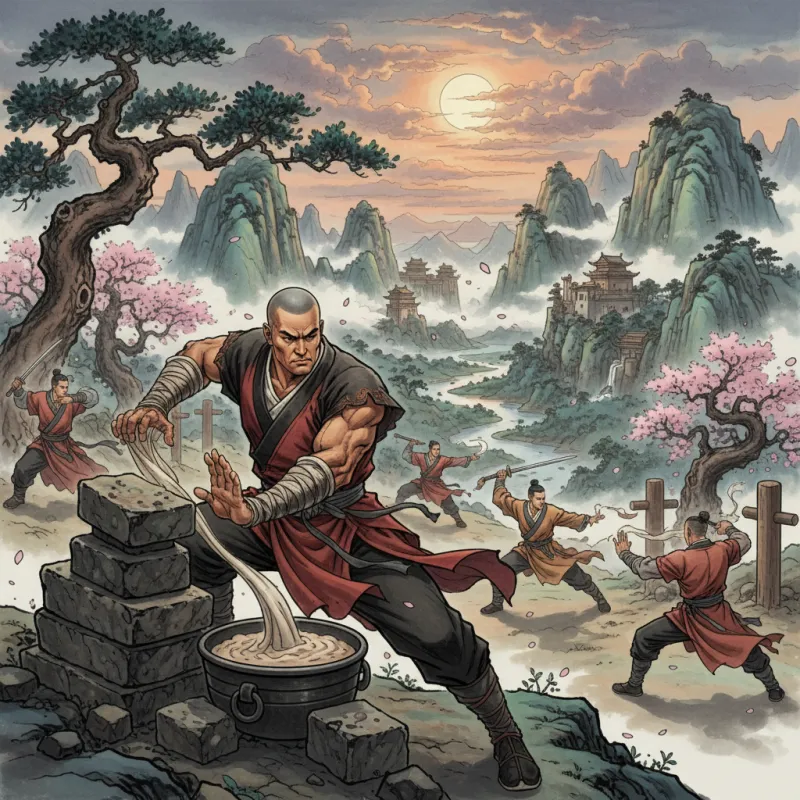
The first time you see it in a wuxia novel, it seems almost absurd: a weathered master casually shattering a stone tablet with his bare palm, or worse, leaving a handprint seared into an opponent's chest that kills them three days later. Yet Iron Palm training—Tie Zhang (铁掌)—is no mere fiction. It's one of the most demanding and dangerous conditioning methods in Chinese martial arts, a practice that transforms human hands into weapons through years of calculated trauma and herbal medicine.
The Reality Behind the Legend
Iron Palm isn't a single technique but a family of training methods that emerged across different martial arts schools during the Ming and Qing dynasties. The most famous lineage traces back to the Iron Palm Sect (铁掌帮, Tie Zhang Bang) of the Jiangnan region, though historical records suggest similar practices existed in Shaolin Temple and among wandering martial artists centuries earlier. What separates Iron Palm from basic hand conditioning is its systematic approach: practitioners don't just toughen their skin—they restructure bone density, callus formation, and even pain tolerance through progressive resistance training.
The training typically begins with striking bags filled with mung beans, then progresses to sand, gravel, iron filings, and eventually solid surfaces like wood or stone. But here's what most wuxia novels get wrong: real Iron Palm training takes 10-15 years of daily practice, not the three-month montage you see in films. The Qing dynasty martial artist Gu Ruzhang (顾汝章), one of the few documented Iron Palm masters, reportedly trained for over two decades before he could break bricks reliably. His hands, according to photographs from the 1920s, looked surprisingly normal—no grotesque deformities, just slightly thickened knuckles and palms.
The Three Pillars of Training
Traditional Iron Palm training rests on three interconnected practices: striking (击打, ji da), herbal medicine (药洗, yao xi), and internal cultivation (内功, nei gong). Remove any one pillar, and the entire structure collapses—often literally, in the form of arthritis, nerve damage, or shattered bones.
The striking regimen follows a brutal but logical progression. Beginners strike canvas bags filled with mung beans 300-500 times per session, twice daily. The beans provide resistance while absorbing impact, preventing the microfractures that would occur from hitting harder surfaces too soon. After six months to a year, practitioners graduate to sand, which offers less cushioning and forces the hand to adapt. The iron filing stage, reached after 3-5 years, is where many students quit—the filings are unforgiving, and improper technique results in torn skin and damaged joints. Masters eventually strike iron plates or stone slabs, but only after their hands have undergone fundamental structural changes.
The herbal medicine component is what separates Iron Palm from simple self-mutilation. After each training session, practitioners soak their hands in dit da jow (跌打酒, "fall and hit wine"), a liniment made from dozens of herbs including myrrh, frankincense, dragon's blood resin, and various roots. These formulas, closely guarded secrets passed from master to student, serve multiple purposes: they reduce inflammation, promote bone density, improve circulation, and supposedly prevent the stagnation of qi that leads to arthritis in old age. Modern analysis has confirmed that many traditional dit da jow ingredients contain compounds with genuine anti-inflammatory and bone-strengthening properties, though the exact mechanisms remain debated.
The Internal Dimension
Here's where Iron Palm training diverges sharply from Western strength conditioning: the emphasis on internal energy cultivation. Practitioners spend as much time on standing meditation (站桩, zhan zhuang) and breathing exercises as they do striking bags. The theory, rooted in traditional Chinese medicine, holds that external conditioning without internal cultivation produces "dead strength"—power that damages the user as much as the target.
The Iron Shirt training practiced by some schools shares this philosophy, but focuses on receiving strikes rather than delivering them. Iron Palm masters claim that proper nei gong allows them to project force through targets rather than merely impacting the surface. Whether you interpret this as biomechanical efficiency, psychological conditioning, or genuine qi manipulation depends on your worldview, but the practical results are documented: skilled practitioners can break multiple boards with a palm strike that looks almost gentle, while beginners using pure muscular force often fail to break a single board despite hitting harder.
The Dark Side of Iron Hands
Wuxia novels love to romanticize Iron Palm training, but they rarely show the failures. For every master who successfully completes the training, dozens suffer permanent damage. Without proper herbal treatment, repeated trauma causes arthritis, nerve damage, and reduced fine motor control. Some practitioners develop hands so calloused and stiff they can barely hold chopsticks. Others experience chronic pain that worsens with age.
The most disturbing aspect, rarely discussed in polite martial arts circles, is the psychological toll. Iron Palm training requires practitioners to override their body's natural pain responses daily for years. Some masters report a troubling emotional numbness that extends beyond physical sensation—a hardening of the heart that mirrors the hardening of the palm. The Qing dynasty martial arts manual "Secrets of Shaolin" warns that Iron Palm practitioners must cultivate compassion deliberately, lest they become "weapons without conscience."
There's also the question of practical utility. In an era of firearms and legal consequences, what purpose does Iron Palm serve? Modern practitioners often frame it as character development rather than combat preparation—a test of dedication and pain tolerance rather than a practical fighting skill. This shift has probably saved countless hands from unnecessary damage.
Iron Palm in Wuxia Literature
Jin Yong's novels feature several memorable Iron Palm practitioners, most notably Qiu Qianren (裘千仞) from "The Legend of the Condor Heroes," whose Iron Palm technique could allegedly kill with a single strike. But Jin Yong, ever the realist beneath his fantasy, portrayed Qiu as a fraud who relied more on reputation than actual skill—a subtle commentary on the gap between martial arts mythology and reality.
Gu Long took a different approach in his novels, depicting Iron Palm as one technique among many, neither superior nor inferior to other methods. His characters who used Iron Palm were often tragic figures, their hardened hands symbolizing emotional barriers they'd built against the world. This psychological dimension adds depth often missing from pure action-oriented wuxia.
The most realistic portrayal might be in "The Smiling, Proud Wanderer," where Shaolin Temple's seventy-two arts include Iron Palm as one option among many. The novel acknowledges that mastering even one of these arts requires a lifetime of dedication—you can't collect them like trading cards, despite what video game adaptations suggest.
Modern Practice and Preservation
Today, authentic Iron Palm training exists in a strange limbo. Some traditional schools still teach complete systems, herbal formulas and all, but they're increasingly rare. More common are modified versions that emphasize conditioning without the extreme progression to stone and iron. These "lite" versions produce tougher hands suitable for full-contact sparring without the decade-plus commitment or injury risk.
The herbal medicine component faces particular challenges. Many traditional dit da jow ingredients are now restricted or banned due to conservation concerns (looking at you, pangolin scales and tiger bone). Modern practitioners substitute legal alternatives, but whether these formulas work as well as the originals remains hotly debated. Some masters claim the old formulas were superior; others suggest this is nostalgia talking, and that modern sports medicine offers better solutions.
Perhaps the most interesting development is the application of Iron Palm principles to other areas. Rock climbers use similar progressive conditioning for their fingers. Pianists and surgeons study the balance between toughness and sensitivity that Iron Palm masters achieve. The underlying principle—that the human body can adapt to extraordinary demands through patient, systematic training—transcends martial arts.
The Verdict: Discipline Over Destruction
If you're considering Iron Palm training, ask yourself why. If you want to break bricks at parties, there are easier ways to impress people. If you're seeking practical self-defense, modern combat sports offer faster results with less risk. But if you're drawn to the challenge itself—the idea of transforming your body through years of disciplined practice, of proving to yourself that you can endure discomfort in pursuit of mastery—then Iron Palm might offer something valuable.
Just find a qualified teacher who emphasizes herbal medicine and internal cultivation alongside striking practice. Your sixty-year-old hands will thank you. And remember: the real iron isn't in your palm—it's in your commitment to show up and train even when progress seems invisible, even when your hands ache, even when the rational part of your brain asks why you're hitting a bag of sand for the thousandth time. That's the discipline that wuxia novels celebrate, and it's far more impressive than any shattered stone tablet.
Related Reading
- Neigong: The Art of Internal Energy in Wuxia
- Exploring Wuxia Fiction: The Art and Culture of Chinese Martial Arts Novels
- The Complete Guide to Wuxia: China's Martial Arts Fiction Tradition
- Shaolin vs Wudang: The Rivalry That Shaped Chinese Martial Arts
- Qinggong: The Art of Lightness in Wuxia Fiction
- Poison and Medicine in Wuxia: Two Sides of the Same Coin
- Hidden Weapons: The Dark Arts of Wuxia Combat
- Unraveling the Mystique of Wuxia: Horror Elements in Chinese Martial Arts Fiction
Explore Chinese Culture
- Explore Jin Yong's martial arts novels
- Explore cultivation fiction and immortal heroes
- Explore the real history behind wuxia