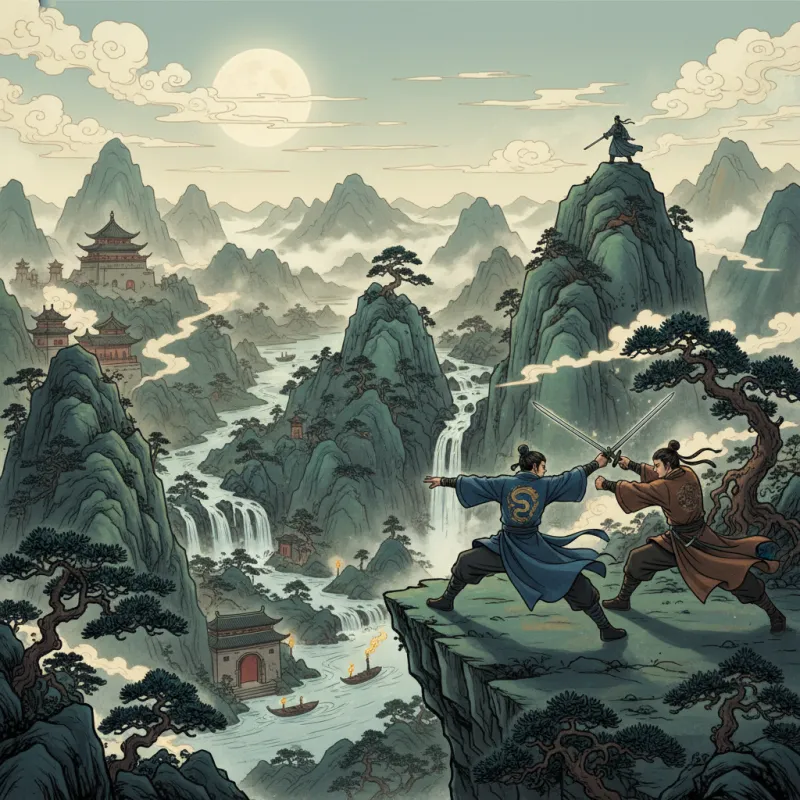
A swordsman walks into a teahouse in Luoyang. Three men are already seated—strangers to him, but he recognizes the calluses on their hands, the way they've positioned themselves to watch the door. One nods. The swordsman nods back. No words are exchanged, but a contract has been signed. If bandits attack this teahouse tonight, these four men will fight together. Tomorrow, they might be enemies. Tonight, they follow the code.
This is the jianghu (江湖 jiānghú), and it runs on rules that were never written down.
The Three Unbreakable Laws
Every wuxia novel has its own flavor of martial world politics, but three rules appear so consistently across the genre that breaking them marks a character as either a villain or a revolutionary. Jin Yong understood this. Gu Long built entire plots around characters who violated these laws and paid the price.
First: Repay your debts. Not financial debts—those are trivial. We're talking about renqing (人情), the web of favors and obligations that holds the jianghu together. If someone saves your life, you owe them a life debt. If a master teaches you a technique, you owe them loyalty. In The Legend of the Condor Heroes, Guo Jing's entire character arc revolves around honoring the debts his father left behind. He's not being noble—he's following the code. To ignore a debt is to declare yourself outside the system, and the jianghu has ways of dealing with outlaws.
Second: Respect the hierarchy. The martial world isn't democratic. Masters outrank disciples. Sect leaders outrank wandering swordsmen. The older generation outranks the younger, always, even if the young hotshot could win in a fair fight. This isn't about power—it's about mianzi (面子), face. When Linghu Chong in The Smiling, Proud Wanderer refuses to kowtow to certain elders, he's not being rebellious for fun. He's making a calculated statement about which hierarchies he recognizes and which he rejects. Every character in that novel understands exactly what he's doing.
Third: Keep your word. In a world without contracts or courts, your reputation is your only currency. If you say you'll meet someone at the Sword Pavilion at noon, you show up or you die trying. If you promise not to reveal a technique, you take it to your grave. The entire plot of Demi-Gods and Semi-Devils hinges on characters trapped by promises they made decades ago. Xiao Feng's tragedy isn't just that he's caught between two nations—it's that he gave his word to both sides, and the code offers no escape clause for impossible situations.
The Duel Protocol
Here's something most wuxia adaptations get wrong: formal duels have rules. Lots of them. And everyone in the jianghu knows them, even if the author never bothers to explain them to the reader.
You don't just challenge someone to a fight. You send a zhangtie (战帖), a written challenge, delivered by a neutral third party. The challenge specifies the time, place, and sometimes the weapons. The challenged party has the right to refuse—but refusing costs face, and in the jianghu, face is everything. If you accept, you show up alone. Bringing backup is the mark of a coward or a villain. The fight ends at first blood, surrender, or death, depending on what was specified in the challenge.
Watch how Jin Yong handles the duel between Qiao Feng and Murong Fu in Demi-Gods and Semi-Devils. They don't just start punching. There's a whole dance of formality first—witnesses are gathered, terms are stated, respect is paid to the location. Even though both men are furious, even though one of them is probably going to die, they follow the protocol. Because that's what separates the jianghu from common street violence.
The code even covers what happens after the duel. If you lose, you acknowledge defeat publicly. If you win, you don't gloat—that's xiaoren (小人) behavior, the mark of a petty person. And if your opponent dies, you're responsible for their burial and for informing their sect or family. Failure to do this marks you as wuyi (无义), without righteousness, and that reputation will follow you everywhere.
Sect Politics and the Unspoken Hierarchy
The jianghu isn't anarchic. It has structure, just not the kind imposed by imperial decree. At the top sit the da pai (大派), the great sects—Shaolin, Wudang, Emei, Kunlun. Below them, a constellation of smaller schools, family clans, and regional organizations. At the bottom, the wandering swordsmen who answer to no one.
But here's the trick: this hierarchy is maintained entirely through reputation and consensus. Shaolin doesn't have an army. They can't arrest you. Their power comes from the fact that everyone agrees they're powerful. It's a collective hallucination that becomes real through shared belief. When Gu Long writes about the decline of the great sects in his later novels, he's not describing military defeat—he's describing a loss of weiyan (威严), that untranslatable combination of prestige and authority that makes people bow without being forced.
The code governs how sects interact with each other. You don't poach another sect's disciples. You don't teach their secret techniques to outsiders. You don't interfere in their internal affairs unless invited. When these rules break down—as they do spectacularly in The Heaven Sword and Dragon Saber—the entire martial world descends into chaos. The six major sects besieging Bright Peak aren't just fighting the Ming Cult. They're trying to restore the old order, the old agreements about who gets to do what.
And then there are the xiejiao (邪教), the heterodox sects that explicitly reject the code. The Ming Cult, the Sun Moon Holy Cult, the various demon sects that pop up in wuxia fiction—they're not evil because they practice dark kung fu. They're evil because they refuse to play by the rules. They don't respect the hierarchy. They don't honor debts the way orthodox sects define them. They've opted out of the system, which makes them existential threats to everyone who remains inside it.
The Guest-Host Dynamic
One of the most frequently invoked rules in wuxia fiction is also one of the least explained: the sacred relationship between guest and host. Once you've accepted someone's hospitality—eaten their food, slept under their roof—you're bound by obligation. You can't attack them. You can't steal from them. You can't even speak ill of them until you've left their territory.
This is why so many wuxia plots involve elaborate schemes to get enemies to accept hospitality. Once you've drunk tea in someone's hall, your hands are tied. The code is explicit: keqi (客气) isn't just politeness, it's a binding contract. Break it, and you're marked as wuxin (无信), without trustworthiness.
Gu Long plays with this constantly. In The Eleventh Son, characters are forever maneuvering to avoid accepting hospitality from people they might need to fight later. The tension isn't about combat skill—it's about social obligation. Can you refuse tea without giving offense? Can you leave before the meal is served? These aren't trivial questions. In the jianghu, they can mean the difference between life and death.
The flip side is equally important: hosts have obligations too. If someone seeks shelter, you provide it. If someone asks for directions, you give them. If someone is injured on your doorstep, you treat their wounds first and ask questions later. The Mountain Manor tradition in wuxia—those isolated estates where wandering heroes always seem to find refuge—exists because of this rule. Turning away a traveler in need is buren (不仁), without benevolence, and that stain never washes off.
When the Code Breaks Down
The most interesting wuxia stories aren't about heroes who follow the code—they're about what happens when the code fails. When two rules contradict each other. When following one principle means violating another. When the system that's supposed to create order instead creates tragedy.
Xiao Feng's story in Demi-Gods and Semi-Devils is the definitive example. He owes loyalty to his Khitan heritage and to his Chinese brotherhood. The code demands he honor both debts. But history has made those debts incompatible. There's no right answer, no clever solution. The code, which is supposed to provide clarity, instead guarantees his destruction. Jin Yong isn't criticizing Xiao Feng—he's revealing the limitations of any rigid moral system when confronted with genuine complexity.
Or consider Linghu Chong in The Smiling, Proud Wanderer. He's expelled from his sect but refuses to stop calling his master "master." He befriends members of the demonic cult but won't join them. He learns the forbidden techniques of the Sunflower Manual but won't use them for personal gain. He's constantly violating the letter of the code while desperately trying to honor its spirit. The novel asks: when the rules themselves become corrupt, is following them still righteous?
This is what separates great wuxia from mediocre wuxia. Bad wuxia treats the code as a simple checklist—follow these rules, be a hero. Good wuxia understands that the code is a language for talking about impossible choices. It's not a solution. It's a framework for understanding why there is no solution.
The Modern Jianghu
Here's the uncomfortable truth: the code of jianghu is dying in contemporary wuxia fiction, and maybe that's appropriate. The world that created these rules—imperial China, isolated communities, a society where reputation mattered more than law—doesn't exist anymore. Modern wuxia writers face a choice: preserve the code as a historical artifact, or adapt it to contemporary sensibilities.
Some writers, like Jin Yong in his later revisions, tried to have it both ways. They kept the formal structure of the code while questioning its assumptions. Others, like Gu Long, deconstructed it entirely, showing how the rules could be weaponized by the powerful against the weak. The "righteous sects" in Gu Long's novels are often the real villains, hiding behind the code while committing atrocities.
And then there are the writers who simply ignore it. Modern web novels set in xianxia or xuanhuan worlds often feature characters who act like video game protagonists, accumulating power without regard for social obligation. They're not bound by debts or hierarchies or promises. They're free agents in a way that would be unthinkable in classical wuxia. Whether this represents evolution or loss depends on what you think the genre is for.
But here's what hasn't changed: the best wuxia stories still understand that rules matter. Not because following them makes you good, but because the choice to follow or break them reveals character. The code of jianghu isn't a moral system—it's a pressure test. It shows us who people are when the stakes are high and the right answer isn't clear.
That teahouse in Luoyang? Those four swordsmen who nodded at each other? They're not following the code because it's written down somewhere. They're following it because everyone in that room understands that without these unwritten rules, the jianghu would collapse into pure chaos. The code is the difference between a martial world and a war zone. It's the difference between heroes and villains, between a society and a slaughterhouse.
And that's why, even in 2024, even in stories set in fantasy worlds that never existed, writers keep coming back to these rules. Because the question the code asks—how do you create order without law, justice without courts, honor without enforcement—is still the most interesting question in the genre.
Related Reading
- Wulin Alliance: Politics of the Martial World
- Poison and Medicine in Wuxia: Two Sides of the Same Coin
- Wuxia in Modern Culture: From Novels to Netflix
- Tea Houses and Wine Shops: The Social Hubs of the Martial World
- Wuxia Culture: How Martial Arts Fiction Shaped Modern Chinese Society
- The Concealed Weapon Arsenal: Every Hidden Weapon in the Jianghu
- Sects and Clans in Wuxia: The Organizations That Rule the Martial World
- The Greatest Palm Techniques in Wuxia Fiction, Ranked
Explore Chinese Culture
- Explore Jin Yong's martial arts novels
- Explore cultivation fiction and immortal heroes
- Explore the real history behind wuxia