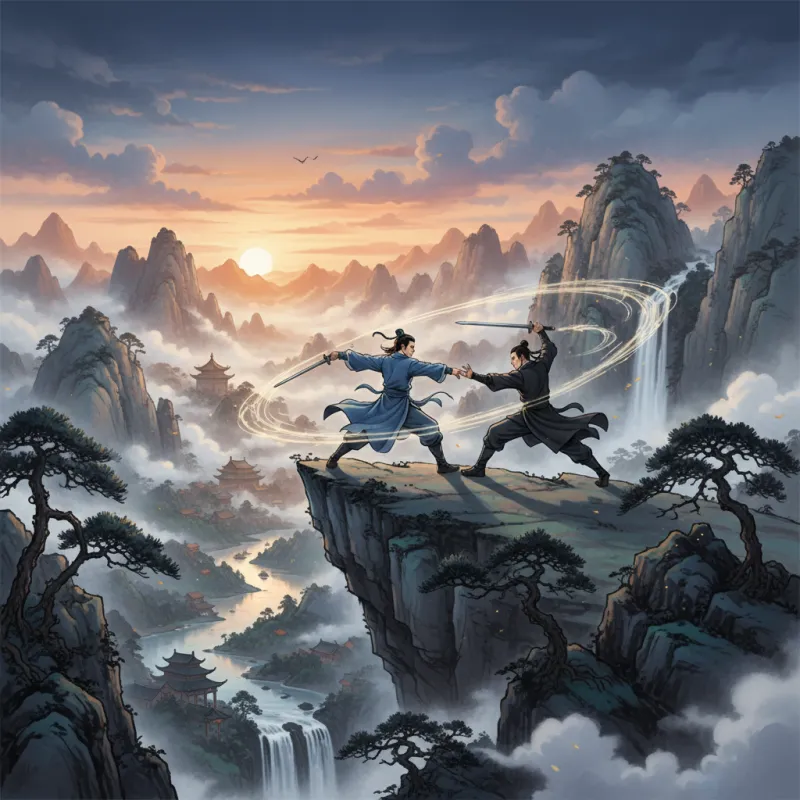
The old Taoist priest moved like water flowing uphill. His sword—a simple jian with a worn leather grip—traced patterns in the morning mist that seemed to defy the very laws of motion. One moment the blade hung motionless, the next it had already completed its arc, as if time itself bent around the weapon. This wasn't the flashy acrobatics you see in modern wuxia films. This was Wudang sword technique (武当剑法, Wǔdāng jiànfǎ), and watching it felt less like observing combat training and more like witnessing a conversation between the swordsman and the universe itself.
The Mountain That Birthed a Legend
Wudang Mountain in Hubei Province didn't become the cradle of Taoist swordsmanship by accident. According to tradition, the legendary Zhang Sanfeng (张三丰, Zhāng Sānfēng)—a semi-mythical figure who supposedly lived through multiple dynasties—created the Wudang martial arts system during the Song or Yuan Dynasty, depending on which historical account you trust. The truth is murkier than most wuxia novels admit. Zhang Sanfeng might have been a real person, or an amalgamation of several Taoist masters, or pure legend. What matters is that by the Ming Dynasty, Wudang had established itself as the philosophical counterweight to the Shaolin Temple's Buddhist martial tradition.
The mountain itself shaped the art. Wudang's peaks rise in sudden, dramatic formations, shrouded in fog that can descend without warning. Training grounds perch on narrow ledges where a misstep means a fatal fall. This environment demanded a martial art built on balance, precision, and an almost supernatural awareness of space. You can't muscle your way through a sword form when you're practicing on a stone platform barely wider than your shoulders, suspended above a thousand-foot drop. The internal energy cultivation required for Wudang techniques wasn't just spiritual philosophy—it was survival.
Softness That Cuts Steel
The core principle of Wudang swordsmanship is "using softness to overcome hardness" (以柔克刚, yǐ róu kè gāng). This sounds like fortune cookie wisdom until you see it in action. Where Shaolin sword techniques might meet an opponent's blade with force, deflecting through superior strength, Wudang practitioners let the opponent's energy flow past them like water around a stone. The Wudang sword doesn't block—it redirects, guides, and then strikes from an angle the opponent never anticipated.
Take the signature technique "Immortal Points the Way" (仙人指路, xiānrén zhǐ lù). The swordsman extends the blade in what appears to be a simple thrust, but the real action happens in the subtle rotation of the wrist and the precise shifting of weight. The blade doesn't travel in a straight line—it spirals, creating a vortex of steel that can slip past defenses or bind an opponent's weapon in a way that feels almost magnetic. Jin Yong understood this perfectly when he wrote Zhang Sanfeng's character in "The Heaven Sword and Dragon Saber" (倚天屠龙记). The old master's swordsmanship wasn't about speed or power; it was about being in the right place at the right moment, as if he could see three moves ahead.
The famous "Wudang Taiji Sword" (武当太极剑, Wǔdāng tàijí jiàn) form exemplifies this philosophy. Its 54 movements flow into each other without pause, each position simultaneously defensive and offensive. The practitioner appears to be performing a slow, meditative dance, but every gesture contains multiple applications. A rising block becomes a disarm; a retreating step sets up a devastating counter-thrust. Modern practitioners often perform it too slowly, turning it into mere exercise, but the old texts describe it being executed at full combat speed—still fluid, still graceful, but fast enough that the blade seems to multiply into a dozen phantom swords.
The Jian: More Than Just a Weapon
Wudang swordsmanship specifically uses the jian (剑, jiàn)—the straight, double-edged sword that Westerners often call a "Chinese longsword." This isn't the heavy saber (dao) favored by cavalry or the flexible whip-sword of exotic wuxia tales. The jian is a scholar's weapon, a gentleman's weapon, and in Taoist hands, a philosopher's weapon. Its balance point sits just above the guard, making it incredibly responsive to subtle wrist movements. A skilled practitioner can change the blade's direction mid-thrust with nothing more than a finger's pressure.
The relationship between swordsman and jian in Wudang tradition goes beyond the practical. Taoist philosophy teaches that all things contain qi (气, qì)—vital energy—and the sword is no exception. A Wudang practitioner doesn't just wield the sword; they extend their qi through it, making the weapon an extension of their body and will. This sounds mystical, and it is, but it also has a practical component. When you train with the same sword for years, you develop an intuitive understanding of its weight, balance, and reach that operates below conscious thought. Your nervous system literally incorporates the weapon into its body map.
This is why in wuxia novels, a master's sword often has a name and history. It's not just romantic flourish—it reflects the genuine bond between practitioner and weapon. The legendary swords of wuxia fiction exaggerate this relationship, but they're rooted in real martial arts culture where a swordsman might spend decades with a single blade, repairing and maintaining it until the weapon becomes irreplaceable.
Forms, Footwork, and the Dance of Combat
Wudang sword forms (套路, tàolù) serve as both training method and encyclopedia of techniques. The "Wudang Xuanmen Sword" (武当玄门剑, Wǔdāng xuánmén jiàn) contains 72 movements that cover every fundamental principle of the art. But here's what most people miss: these forms aren't meant to be memorized and repeated mindlessly. They're templates for improvisation, frameworks within which the practitioner develops their own expression of the principles.
The footwork deserves special attention because it's where Wudang swordsmanship truly distinguishes itself. The "Eight Trigram Step" (八卦步, bāguà bù) allows the swordsman to circle an opponent while maintaining perfect balance and positioning. Combined with the "Seven Star Step" (七星步, qīxīng bù), which creates unpredictable angles of attack, a Wudang practitioner can seem to be in multiple places at once. This isn't supernatural—it's geometry and psychology working together. The opponent's brain struggles to track the circular movement while simultaneously processing the threat of the blade.
Watch any decent wuxia film and you'll see echoes of these patterns, though usually exaggerated into wire-fu acrobatics. Tsui Hark's "Swordsman" series captures some of the flavor, particularly in the way the Wudang practitioners seem to glide rather than step. The reality is less visually spectacular but more impressive in its efficiency. A real Wudang sword master doesn't need to leap twenty feet in the air—they're already behind you before you realize they've moved.
The Internal Alchemy Connection
You can't separate Wudang swordsmanship from Taoist internal alchemy (内丹, nèidān). The same breathing techniques, meditation practices, and energy cultivation methods that Taoist monks use for spiritual development also form the foundation of combat training. This isn't coincidental—it's the entire point. In Taoist philosophy, there's no distinction between spiritual cultivation and martial practice. Both are paths to understanding the Tao (道, Dào), the fundamental nature of reality.
The "Three Treasures" (三宝, sānbǎo)—jing (essence), qi (energy), and shen (spirit)—must be cultivated and harmonized for true mastery. A swordsman with perfect technique but no internal cultivation is just going through motions. The power of Wudang swordsmanship comes from the integration of physical movement with internal energy flow. When Zhang Wuji learns the Wudang sword techniques in Jin Yong's novels, he struggles until he combines them with his profound internal energy cultivation. That's not just plot convenience—it reflects genuine martial arts philosophy.
This is why traditional Wudang training takes decades. You're not just learning to move a sword around—you're restructuring your entire being. The breathing must synchronize with the footwork. The mind must remain calm while the body moves at combat speed. The qi must flow smoothly through the meridians, unblocked by tension or fear. Modern martial arts schools often skip this internal work, teaching only the external forms. The result looks similar but lacks the depth and power of authentic practice.
Living Tradition in a Modern World
Today, Wudang Mountain still hosts martial arts schools where students train in traditional methods, though the reality is complicated by tourism and commercialization. Some schools maintain genuine lineages stretching back centuries; others are essentially performance troupes teaching simplified forms for beginners. The challenge for serious practitioners is distinguishing authentic transmission from modern invention.
The good news is that the principles of Wudang swordsmanship remain valid regardless of whether you're training for actual combat or personal development. The emphasis on balance, efficiency, and internal cultivation translates well to modern life. You probably won't need to defend yourself with a jian against bandits in the jianghu (江湖, jiānghú)—the martial arts world of wuxia fiction—but the mental discipline and physical awareness developed through practice have universal applications.
What makes Wudang swordsmanship enduringly fascinating is its refusal to separate the practical from the philosophical. Every technique contains a lesson about Taoist principles; every form is a meditation on the nature of change and adaptation. When you practice "Cloud Hands Holding the Moon" (云手抱月, yúnshǒu bào yuè), you're not just learning a defensive technique—you're embodying the Taoist concept of wu wei (无为, wúwéi), effortless action that achieves its goal by working with natural forces rather than against them.
The Path Forward
For those drawn to Wudang swordsmanship, whether through wuxia novels, films, or genuine martial interest, the path requires patience and humility. This isn't an art you can master through weekend seminars or YouTube tutorials. It demands consistent practice, qualified instruction, and a willingness to embrace both the physical and philosophical dimensions of the training.
Start with the basics: find a qualified instructor who understands both the external forms and internal cultivation. Study Taoist philosophy not as abstract theory but as practical guidance for training. Practice the fundamental stances and footwork until they become second nature. Only then will the sword techniques begin to reveal their deeper layers.
The beauty of Wudang swordsmanship lies in its infinite depth. A beginner sees a simple thrust; an intermediate practitioner recognizes the footwork and body mechanics; an advanced student perceives the energy flow and strategic implications; a master sees the Tao itself expressed through steel and motion. Each level of understanding opens new dimensions of practice, ensuring that the art remains fresh and challenging regardless of how many years you dedicate to it.
In the end, Wudang sword techniques offer something rare in modern martial arts: a complete system that addresses body, mind, and spirit simultaneously. Whether you approach it as combat training, moving meditation, or cultural exploration, the art rewards sincere effort with insights that extend far beyond the practice hall. The old Taoist masters knew something we're only beginning to rediscover—that the sword, properly understood, is not a weapon but a teacher, and every practice session is an opportunity to learn something new about ourselves and the world we inhabit.
Related Reading
- Neigong: The Art of Internal Energy in Wuxia
- Exploring Wuxia Fiction: The Art and Culture of Chinese Martial Arts Novels
- Qinggong: The Art of Lightness in Wuxia Fiction
- The Complete Guide to Wuxia: China's Martial Arts Fiction Tradition
- Internal vs External Martial Arts: The Great Debate
- Exploring Chinese Martial Arts Fiction and the Mythical Jianghu Culture
- Exploring Chinese Martial Arts Fiction and Jianghu Culture in Kung Fu Novels
- Unraveling the Mystique of Wuxia: A Dive into Jianghu Culture and Kung Fu Novels
Explore Chinese Culture
- Explore Jin Yong's martial arts novels
- Explore cultivation fiction and immortal heroes
- Explore the real history behind wuxia