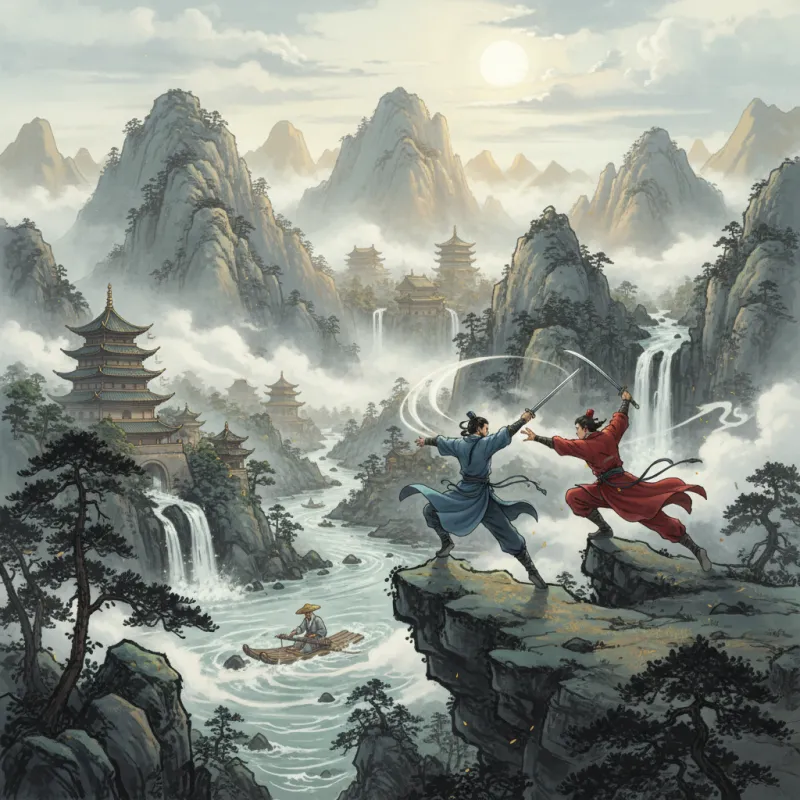
A swordsman leaps from a rooftop, his blade singing through moonlight as he pursues a shadow across the tiled roofs of Chang'an. Below, the city sleeps, unaware of the deadly dance unfolding above. This is jianghu (江湖, literally "rivers and lakes")—the parallel world where martial artists settle scores beyond the reach of imperial law. For over a century, wuxia fiction has transported millions of readers into this realm where a single sword technique can topple dynasties and personal honor matters more than life itself.
The Roots Run Deeper Than You Think
Most people credit the 1920s as wuxia's golden age, but that's like saying rock and roll started with Elvis—technically true for the modern form, but wildly incomplete. The DNA of wuxia stretches back to the Tang Dynasty (618-907 CE), when tales of xiake (侠客, knight-errants) first appeared in written form. The Youxia Liezhuan (游侠列传, Biographies of Wandering Knights) from Sima Qian's Records of the Grand Historian documented real martial artists who lived by their own code centuries before the first wuxia novel hit the printing press.
What changed in the early 20th century wasn't the existence of martial arts stories—it was their democratization. When Xiang Kairan published Jianghu Qixia Zhuan (江湖奇侠传, Strange Knights of Jianghu) in 1923, he wasn't inventing a genre; he was adapting oral storytelling traditions for a newly literate urban audience hungry for escapism during China's tumultuous Republican era. The serialized format, borrowed from Western pulp fiction, proved perfect for the episodic nature of martial arts adventures.
The Architecture of a Wuxia World
Every wuxia novel operates on a foundation of shared conventions that readers instinctively recognize. The jianghu exists as a shadow society with its own rules, hierarchies, and geography. Martial arts sects function as surrogate families, each with distinctive fighting styles and philosophical approaches. The Shaolin Temple emphasizes Buddhist compassion and external martial arts; Wudang Mountain follows Taoist principles and internal energy cultivation.
This isn't just window dressing. Jin Yong (Louis Cha), arguably the greatest wuxia novelist, built entire plots around the tension between different martial philosophies. In The Heaven Sword and Dragon Saber, the conflict between the orthodox sects and the Ming Cult drives the narrative, but the real question is whether rigid adherence to tradition serves justice better than pragmatic adaptation. The martial arts become metaphors for competing worldviews.
The concept of wulin (武林, martial forest) adds another layer—it's the collective term for all martial artists and their interconnected relationships. Reputation in the wulin matters more than gold. A master's word can elevate an unknown fighter to legendary status or condemn a hero to pariah status. This social dimension transforms simple revenge plots into complex explorations of honor, loyalty, and the weight of reputation.
The Language of Combat
Wuxia's most distinctive feature is qinggong (轻功, lightness skill)—the ability to leap impossible distances, run across water, or perch on bamboo tips. Western readers often stumble here, dismissing it as fantasy, but that misses the point entirely. Qinggong represents the transcendence of physical limitations through dedicated cultivation, a concept deeply rooted in Daoist and Buddhist practices.
The same applies to neigong (内功, internal energy cultivation). When Guo Jing in The Legend of the Condor Heroes spends years mastering the Eighteen Dragon-Subduing Palms, he's not just learning to punch harder—he's cultivating qi (气, vital energy) through meditation, breathing exercises, and moral development. The martial arts in wuxia are inseparable from spiritual cultivation. A villain might possess superior technique, but their corrupted qi ensures eventual defeat.
Weapon choice reveals character. The jian (剑, straight double-edged sword) belongs to scholars and nobles—elegant, refined, requiring years of study. The dao (刀, single-edged saber) suits soldiers and pragmatists—direct, powerful, efficient. When Linghu Chong in The Smiling, Proud Wanderer masters the Dugu Nine Swords, a technique that abandons fixed forms for pure adaptability, it reflects his journey from rigid orthodoxy to philosophical freedom.
The New School Revolution
The 1950s brought a seismic shift when Jin Yong, Gu Long, and Liang Yusheng redefined wuxia for modern audiences. Jin Yong grounded his stories in actual Chinese history—The Deer and the Cauldron unfolds during the Kangxi Emperor's reign, weaving fictional characters into real events with such skill that readers sometimes confuse the two. His protagonists grow and change; Guo Jing transforms from a simple-minded boy into a principled general defending Xiangyang against the Mongols.
Gu Long took the opposite approach, stripping away historical context to focus on pure character and atmosphere. His novels read like noir thrillers transplanted to ancient China. Li Xunhuan in The Sentimental Swordsman embodies existential loneliness—a master whose throwing daggers never miss, yet who cannot escape his own melancholy. Gu Long's prose is sparse, almost poetic, favoring suggestion over description. Where Jin Yong might spend pages detailing a sword technique, Gu Long writes: "The blade moved. The enemy fell."
This stylistic divide created two camps among readers that persist today. Jin Yong fans appreciate the epic scope, historical depth, and detailed martial arts systems. Gu Long devotees prefer the psychological complexity, moral ambiguity, and cinematic pacing. Both approaches influenced countless writers and filmmakers, establishing templates that modern wuxia adaptations still follow.
The Moral Universe
Western fantasy often presents clear good-versus-evil conflicts, but wuxia operates in murkier territory. The concept of yi (义, righteousness or loyalty) drives characters more than abstract morality. A hero might commit murder to avenge a master, and readers accept this because yi demands it. The tension between personal loyalty and broader justice creates the genre's most compelling dilemmas.
Consider the recurring trope of the shifu (师父, master) who forbids their student from seeking revenge, knowing it will lead to destruction. The student faces an impossible choice: obey the master (filial piety) or avenge them (loyalty). There's no right answer, only the one the character can live with. This reflects Confucian ethics, where competing obligations create genuine moral complexity.
The jianghu code also includes en (恩, debt of gratitude) and chou (仇, enmity)—social debts that must be repaid. When someone saves your life, you owe them a life debt. When someone kills your master, you inherit the obligation of revenge. These debts can span generations, creating cycles of violence that only exceptional characters can break. The greatest wuxia heroes aren't those who fight best, but those who find ways to resolve conflicts without perpetuating bloodshed.
Women Warriors and Gender Dynamics
Wuxia fiction has always featured formidable female martial artists, though their portrayal evolved significantly over time. Early novels often relegated women to supporting roles—the beautiful maiden who needs rescuing or the vengeful widow seeking justice. But writers like Jin Yong gradually developed more complex female characters who drive their own narratives.
Huang Rong in The Legend of the Condor Heroes combines martial skill with strategic brilliance, often outsmarting opponents rather than overpowering them. Ren Yingying in The Smiling, Proud Wanderer leads a martial arts sect and makes political decisions that shape the story's outcome. These characters aren't just "strong female characters" in the modern sense—they're fully realized individuals whose gender informs but doesn't limit their roles.
The concept of xia (侠, chivalry or knight-errantry) theoretically applies equally to men and women, though practice often fell short. Female martial artists faced additional scrutiny regarding their virtue and propriety, reflecting real historical constraints. The most interesting wuxia novels acknowledge these double standards while allowing female characters to transcend them through exceptional skill or unconventional choices.
Why Wuxia Still Matters
In an age of superhero blockbusters and fantasy epics, wuxia might seem like a regional curiosity. But its influence extends far beyond Chinese-speaking audiences. The Matrix's bullet-time sequences borrowed directly from Hong Kong wuxia films. Crouching Tiger, Hidden Dragon introduced Western audiences to wirework and qinggong. Video games from Jade Empire to Sekiro adapt wuxia conventions for interactive media.
More importantly, wuxia offers something increasingly rare in modern fiction—a coherent moral universe where actions have weight and consequences ripple through communities. The jianghu isn't just a setting; it's a functioning society with its own logic and values. Characters can't simply punch their way to victory; they must navigate complex social networks, honor ancient obligations, and consider how their choices affect their reputation and their sect's standing.
The best wuxia novels also grapple with timeless questions about power, justice, and identity. What does it mean to be a hero when the government is corrupt? How do you maintain personal integrity in a world that rewards ruthlessness? Can violence ever truly solve problems, or does it only create new ones? These questions resonated in 1920s China, and they resonate today.
Reading wuxia fiction means entering a world where a single sword technique contains philosophical truth, where loyalty matters more than law, and where the greatest battles happen as much in the heart as on the battlefield. It's a genre that rewards patience and cultural curiosity, but for those willing to make the leap, it offers adventures unlike anything else in world literature. The rooftops of jianghu await.
Related Reading
- Iron Palm Training: Hardening the Body Through Discipline
- Dianxue: The Deadly Art of Pressure Point Strikes
- Qinggong: The Art of Lightness in Wuxia Fiction
- The Complete Guide to Wuxia: China's Martial Arts Fiction Tradition
- Shaolin vs Wudang: The Rivalry That Shaped Chinese Martial Arts
- The World of Wuxia: Exploring Chinese Martial Arts Fiction and Jianghu Culture
- The Enigma of Jianghu: Discovering the Roots of Chinese Wuxia Literature
- Jianghu Terminology Glossary: Essential Martial World Vocabulary
Explore Chinese Culture
- Explore Jin Yong's martial arts novels
- Explore cultivation fiction and immortal heroes
- Explore the real history behind wuxia