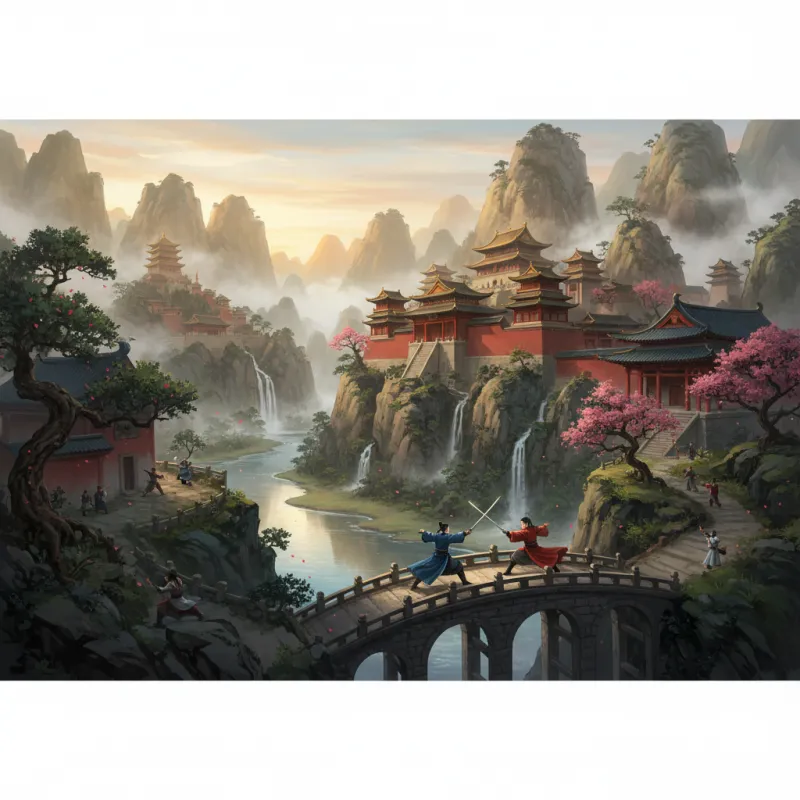
The abbot's staff strikes the stone floor three times. In the Thousand Buddha Hall, seventy-two monks move as one, their shadows dancing across ancient murals depicting battles fought centuries ago. This is Shaolin Temple (少林寺, Shàolín Sì)—not just a monastery, but the beating heart of every wuxia story worth reading.
The Myth That Became Reality
Walk into any Chinese bookstore and pick up a martial arts novel at random. Chances are, Shaolin appears within the first hundred pages. Jin Yong knew this. Gu Long knew this. Every wuxia author who's ever put pen to paper understands that Shaolin isn't just another sect—it's the measuring stick against which all others are judged.
The famous maxim "All martial arts under heaven originated from Shaolin" (天下武功出少林, tiānxià wǔgōng chū Shàolín) appears so frequently in wuxia fiction that readers accept it as gospel. But here's what makes it brilliant: the claim is historically questionable at best, yet it doesn't matter. In the world of martial arts fiction, Shaolin's supremacy is a narrative truth more powerful than historical fact.
The Bodhidharma Legend
Every great institution needs an origin story, and Shaolin's is a masterpiece. According to wuxia tradition, the Indian monk Bodhidharma (达摩祖师, Dámó Zǔshī) arrived at Shaolin around 527 AD and found the monks physically weak from meditation. His solution? Create martial arts exercises that would strengthen body and spirit simultaneously.
Did this actually happen? Historians argue endlessly. But in Jin Yong's Demi-Gods and Semi-Devils (天龙八部), the Shaolin abbot Xuanci guards the temple's Sutra Repository (藏经阁, Cángjīng Gé) where Bodhidharma's original martial arts manuals supposedly rest. That image—ancient texts containing the source code of all kung fu—has become more "real" to wuxia fans than any archaeological evidence.
The genius of this legend is how it ties martial prowess to Buddhist enlightenment. Shaolin monks don't just fight; they cultivate both external strength and internal virtue. This dual cultivation makes them fundamentally different from the Wudang Sect, which emphasizes Taoist internal energy, or the morally ambiguous Demon Cult that pursues power without ethical constraints.
The Seventy-Two Arts
Ask any wuxia fan about Shaolin, and they'll mention the Seventy-Two Arts (七十二绝技, qīshí'èr juéjì). These legendary techniques represent the complete martial arts curriculum—everything from Iron Head Skill (铁头功) to Finger Zen (一指禅). The number seventy-two itself carries Buddhist significance, but more importantly, it signals completeness. Shaolin doesn't specialize; it encompasses everything.
In The Smiling, Proud Wanderer (笑傲江湖), Jin Yong describes how Shaolin's Yijin Jing (易筋经, Muscle-Tendon Change Classic) serves as the foundation for all internal energy cultivation. Master the Yijin Jing, and you can learn any martial art in the world. It's the ultimate cheat code, which is why every villain in wuxia fiction either wants to steal it or has already tried.
But here's the catch that makes Shaolin interesting: these supreme techniques are locked behind Buddhist discipline. You can't just learn the moves; you must embrace the philosophy. This creates delicious narrative tension. Characters like Xuzhu in Demi-Gods and Semi-Devils stumble into Shaolin's greatest secrets by accident, while ambitious outsiders who try to steal them inevitably fail or go mad.
The Abbot's Burden
The Shaolin abbot in wuxia fiction carries an impossible weight. He must be the jianghu's moral authority while managing a monastery full of martial arts masters, each with their own interpretation of Buddhist teaching. Jin Yong understood this tension perfectly.
Take Abbot Xuanci from Demi-Gods and Semi-Devils. He's respected throughout the martial world as a paragon of virtue, yet he harbors a devastating secret—a past affair that produced an illegitimate son. When the truth emerges, it doesn't just destroy Xuanci; it shakes the entire jianghu's faith in moral authority. If even the Shaolin abbot can fall, what hope do ordinary martial artists have?
This is why Shaolin matters in wuxia fiction. It's not just about having the best kung fu. It's about representing an ideal that everyone knows is impossible to maintain, yet everyone desperately needs to believe in. The temple serves as the jianghu's conscience, even when—especially when—that conscience proves flawed.
The Warrior Monks
Shaolin's fighting monks are wuxia fiction's ultimate supporting cast. They appear in group formations, their robes flowing, their staffs spinning in perfect synchronization. Individually, they're rarely the protagonist. Collectively, they're unstoppable.
The Arhat Formation (罗汉阵, Luóhàn Zhèn) appears in countless novels as Shaolin's trump card. Eighteen monks moving in coordinated patterns can defeat opponents far above their individual skill level. It's a beautiful metaphor for Buddhist philosophy—the ego dissolves into collective action, and through that dissolution comes true power.
But the most interesting Shaolin monks are always the ones who leave. Qiao Feng's father in Demi-Gods and Semi-Devils abandoned the temple for love. The protagonist of Crouching Tiger, Hidden Dragon carries Shaolin training into the secular world. These departures create narrative gold because they force characters to test Shaolin's teachings against the messy reality of the jianghu.
The Sutra Repository Secret
Every major wuxia novel featuring Shaolin includes a scene in the Sutra Repository. This library isn't just a room full of books—it's a treasure vault of martial knowledge that makes the Library of Alexandria look like a used bookstore. The top floor, accessible only to the abbot, contains the most dangerous techniques ever created.
Jin Yong's genius was making the Sutra Repository a test of character. In Demi-Gods and Semi-Devils, Xuzhu accidentally enters and reads everything, but his pure heart means he uses the knowledge wisely. In The Heaven Sword and Dragon Saber (倚天屠龙记), Zhang Wuji studies there and emerges as the greatest martial artist of his generation—not because he learned the most powerful techniques, but because he understood their underlying principles.
The repository represents knowledge without wisdom, power without purpose. It's why Shaolin guards it so carefully and why every ambitious villain wants to break in. The temple understands what modern readers sometimes forget: information isn't the same as understanding.
Shaolin's Decline and Renewal
The best wuxia novels don't just celebrate Shaolin—they show its vulnerability. Temples burn. Abbots fall. Monks betray their vows. These moments of crisis reveal what Shaolin truly represents: not invincibility, but resilience.
In The Heaven Sword and Dragon Saber, the Six Major Sects (including Shaolin) besiege Bright Peak, convinced they're fighting evil. They're wrong, and their self-righteousness nearly destroys them. It's a reminder that even Shaolin can become so attached to its own righteousness that it loses sight of actual justice.
Yet Shaolin always rebuilds. New abbots rise. Young monks train. The temple endures because it represents something larger than any individual—the belief that martial arts can serve a higher purpose than personal glory or revenge. Whether that belief is naive or noble depends on which novel you're reading, but it's always compelling.
The Eternal Standard
Here's what makes Shaolin indispensable to wuxia fiction: it gives the genre a fixed point in a chaotic universe. The jianghu is full of betrayal, ambition, and moral ambiguity. Sects rise and fall. Heroes become villains. But Shaolin remains—flawed, hypocritical at times, yet still standing as a reminder of what martial arts could be if practitioners actually lived up to their ideals.
When a character in a wuxia novel says "I trained at Shaolin," readers immediately understand the implications. This person has discipline, moral grounding, and formidable skills. They might be rigid or naive, but they're not cruel or petty. That shorthand allows authors to build complex stories without spending chapters on backstory.
The temple on Song Mountain has become more than a setting. It's a narrative promise—that in a world of moral chaos, some standards still matter. That promise is why Shaolin appears in nearly every wuxia novel worth reading, and why it will continue to appear as long as authors write about the martial world.
The abbot's staff strikes the floor three times. The training continues. And somewhere, a young reader discovers wuxia fiction for the first time, learning that all martial arts under heaven originated from Shaolin—not because it's historically true, but because it's narratively essential.
Related Reading
- Exploring Chinese Martial Arts Fiction and Jianghu Culture in Kung Fu Novels
- The Beggar Sect: The Largest and Most Unlikely Martial Arts Organization
- Shaolin Temple: The Birthplace of Chinese Martial Arts
- The Beggars Sect: How a Gang of Homeless People Became the Largest Organization in the Martial World
- Wudang Mountain: The Daoist Heart of Internal Martial Arts
- The Wuxia Training Montage: How Heroes Are Made
- The Tang Clan: Masters of Hidden Weapons and Poison
- The Bizarre Plants of the Shanhaijing: Trees That Cure Death and Fruits That Grant Flight
Explore Chinese Culture
- Explore Jin Yong's martial arts novels
- Explore cultivation fiction and immortal heroes
- Explore the real history behind wuxia