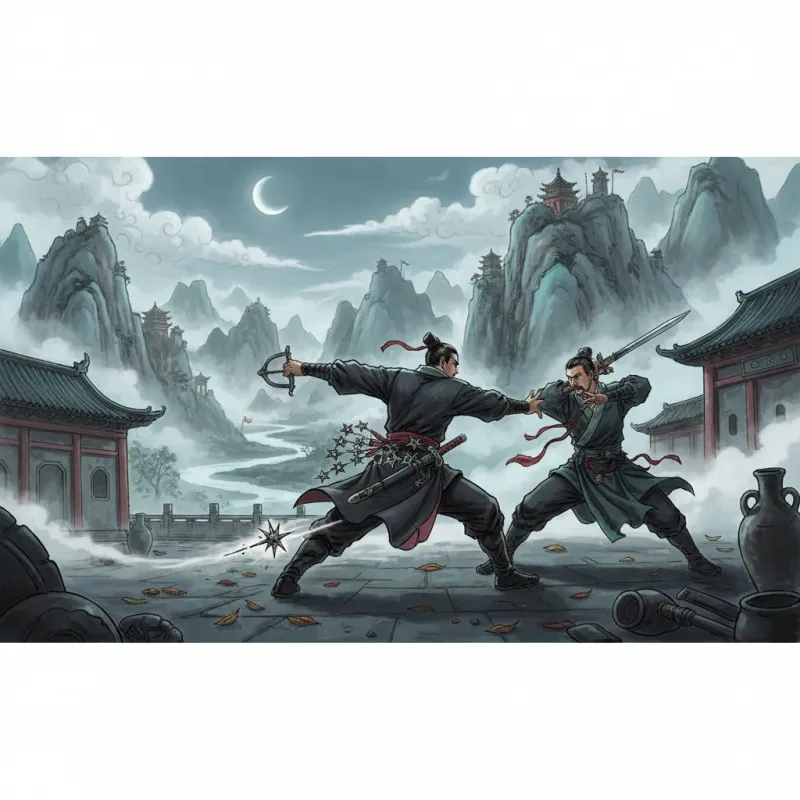
A needle no thicker than a hair pierces through a man's throat at thirty paces. He doesn't even see it coming. By the time his hand reaches up to touch the wound, the poison has already stopped his heart. This is the terror of hidden weapons (暗器, ànqì) — not the weapon itself, but the moment when you realize you never stood a chance.
The Paradox of Power and Shame
In the jianghu, how you kill matters as much as whether you kill. A swordsman who defeats his opponent in open combat earns respect even from his enemy's allies. But the master of hidden weapons? He's whispered about in teahouses, feared in dark alleys, and excluded from the ranks of "righteous heroes" no matter how many villains he eliminates.
This moral calculus seems absurd to modern readers. Dead is dead, after all. But wuxia operates on a different logic — one where martial virtue (武德, wǔdé) isn't just about winning, but about how you win. Hidden weapons violate the fundamental principle of fair combat. They strike from concealment, give no warning, and offer no chance for the opponent to display their skill. In a culture that values the demonstration of martial prowess above almost everything else, this is unforgivable.
Yet this stigma creates fascinating narrative space. When Gu Long writes about Li Xunhuan in Duoqing Jianke Wuqing Jian (多情剑客无情剑, The Sentimental Swordsman's Ruthless Sword), he gives his protagonist a hidden weapon — the Little Li Flying Dagger (小李飞刀, Xiǎo Lǐ Fēidāo) — that never misses. But Li Xunhuan isn't a villain. He's melancholic, honorable, and deeply principled. The weapon becomes a symbol of his pragmatism and his willingness to bear moral ambiguity for the sake of protecting others.
The Tang Sect's Monopoly on Respectability
If you're going to use hidden weapons without being branded a coward, you'd better be from the Tang Sect (唐门, Tángmén) of Sichuan. This family organization has somehow achieved what no other hidden weapons practitioners could: legitimacy.
The Tang Sect's reputation rests on three pillars. First, they're specialists. They don't dabble in hidden weapons as a backup plan — it's their entire martial tradition, refined over generations. Second, they've systematized the art. The Tang Sect doesn't just throw poisoned needles; they've developed elaborate mechanical devices, specialized poisons, and sophisticated delivery systems that qualify as genuine martial innovation. Third, and perhaps most importantly, they keep to themselves. The Tang Sect rarely involves itself in jianghu conflicts unless provoked, which means they haven't accumulated the kind of grudges that would undermine their reputation.
In Jin Yong's Xiao Ao Jianghu (笑傲江湖, The Smiling, Proud Wanderer), we see how other sects view hidden weapons through the character of Tian Boguang, who uses throwing knives. He's explicitly called a "lecher" and "scoundrel" — his weapon choice reinforces his moral status. But when Tang Sect members appear in various wuxia novels, they're treated as legitimate martial artists, even if they're antagonists. The difference isn't in the weapons themselves, but in the institutional authority behind them.
The Arsenal of Shadows
The variety of hidden weapons in wuxia fiction is staggering, limited only by an author's imagination and a character's willingness to sacrifice honor for effectiveness. The most common are throwing weapons: darts (飞镖, fēibiāo), needles (飞针, fēizhēn), and throwing knives (飞刀, fēidāo). These require genuine skill — calculating distance, accounting for wind, and achieving lethal accuracy under pressure.
Then there are the exotic variants. Sleeve arrows (袖箭, xiùjiàn) are spring-loaded projectiles concealed in one's sleeves, fired with a flick of the wrist. The Rainstorm Pear Blossom Needle (暴雨梨花针, Bàoyǔ Líhuā Zhēn) — a Tang Sect specialty — launches dozens of poisoned needles simultaneously, creating an unavoidable cloud of death. Some practitioners use weighted chains, rope darts, or even modified musical instruments that double as weapons.
Poison elevates hidden weapons from dangerous to absolutely lethal. A scratch from a poisoned needle can kill within seconds or hours, depending on the toxin. The Tang Sect's poisons are legendary: some cause instant death, others induce paralysis, and the most insidious create delayed effects that make the source of poisoning impossible to trace. In Gu Long's works, poison isn't just a weapon enhancement — it's a plot device that creates tension, forces characters into desperate searches for antidotes, and demonstrates the user's cold-blooded calculation.
When Heroes Break the Rules
The most compelling moments in wuxia fiction occur when traditionally honorable characters resort to hidden weapons. These moments reveal character depth and force readers to question their assumptions about martial morality.
Consider the scenario: a righteous hero faces an opponent who's stronger, faster, and more skilled. Open combat means certain death. Does the hero fight honorably and die, or use a hidden weapon and live with the shame? Different authors answer this question differently, and their answers reveal their philosophical stance.
Jin Yong tends toward moral absolutism. His heroes rarely use hidden weapons, and when they do, it's framed as a temporary compromise or a sign of desperation. The weapons themselves are often "borrowed" or used in ways that minimize the dishonor — perhaps thrown openly rather than from concealment, or used against opponents who've already violated martial ethics.
Gu Long, by contrast, embraces moral complexity. His characters use hidden weapons without excessive hand-wringing because they live in a jianghu that's darker and more pragmatic than Jin Yong's. Li Xunhuan's flying dagger isn't a source of shame — it's his signature technique, as much a part of his identity as any sword style. Gu Long seems to ask: if the jianghu is already full of hypocrites who preach honor while committing atrocities, why should the honest man handicap himself?
The Mechanics of Surprise
What makes hidden weapons effective isn't just their concealment — it's the psychological warfare they enable. A swordsman announces his presence through his stance, his weapon, and his intent. A hidden weapons master gives no such warning. The victim's first indication of danger is often the weapon itself, and by then it's too late.
This creates a specific kind of fear. You can prepare for a sword duel. You can't prepare for a needle you never see coming. In wuxia novels, characters who've survived hidden weapons attacks become paranoid, constantly scanning their surroundings, flinching at sudden movements. The weapon's true power isn't the physical damage — it's the psychological damage to everyone who knows you're out there.
The best hidden weapons practitioners understand this. They don't just train their throwing accuracy; they study human behavior, learning when people are most vulnerable, most distracted, most confident. They strike during conversations, during meals, during moments of triumph when their target's guard is down. The weapon is just the delivery mechanism for a deeper art: the exploitation of human nature.
The Price of Pragmatism
Using hidden weapons comes with costs beyond social stigma. Practitioners often find themselves isolated, trusted by neither the orthodox sects (who view them as dishonorable) nor the unorthodox factions (who see them as potential threats). They exist in a liminal space, useful but never fully accepted.
There's also the practical consideration: hidden weapons are consumable. Unlike a sword that lasts a lifetime, needles and darts must be constantly replenished. Poisons must be prepared, stored, and maintained. The Tang Sect's wealth and resources allow them to sustain this practice, but individual practitioners often struggle with logistics. How many poisoned needles can you carry? What happens when you run out mid-battle?
Yet despite these costs, hidden weapons persist in wuxia fiction because they represent something essential: the gap between ideals and reality. The jianghu preaches honor, but it's a brutal place where the honorable often die young. Hidden weapons are the acknowledgment that sometimes survival requires compromise, that the world doesn't always reward those who fight fair. They're the weapon of choice for those who've seen through the jianghu's noble rhetoric and decided that living matters more than reputation.
In the end, the deadly art of surprise isn't just about the weapons themselves — it's about the characters who choose to wield them and what that choice reveals about their relationship with the jianghu's moral order. Whether villain or pragmatist, coward or realist, the hidden weapons master forces us to confront an uncomfortable question: when your life is on the line, how much is honor really worth?
For more on the tools of the trade, see Poison in Wuxia and The Tang Sect's Legacy.
Related Reading
- Sleeve Arrows and Mechanical Weapons in Wuxia Fiction
- Unveiling Hidden Weapons in Wuxia: The Intrigue of Jianghu Culture
- The Tang Clan: Masters of Hidden Weapons and Poison
- Poison Needles and Flying Daggers: Hidden Weapons in Wuxia Combat
- Throwing Knives, Needles, and Darts: The Hidden Weapon Arsenal
- The Art of War: Exploring Weapons in Chinese Martial Arts (Wuxia) Fiction
- Iron Palm Training: Hardening the Body Through Discipline
- Yi and Qi: The Concepts of Righteousness and Brotherhood in Wuxia
Explore Chinese Culture
- Explore Jin Yong's martial arts novels
- Explore cultivation fiction and immortal heroes
- Explore the real history behind wuxia