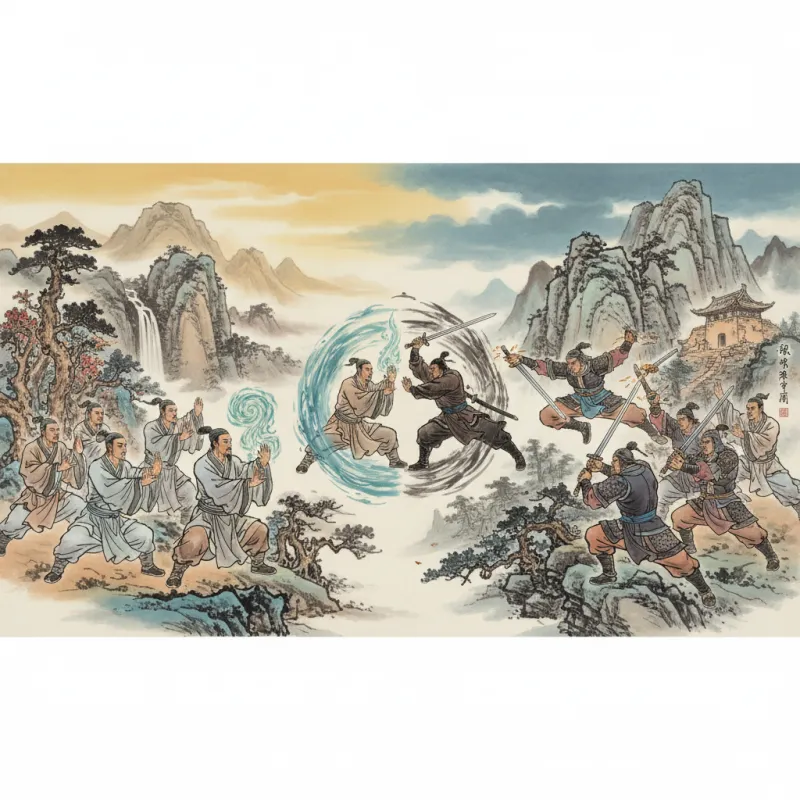
Walk into any martial arts forum — online or in a teahouse in Chengdu — and bring up the difference between internal and external martial arts. Then sit back and watch the fireworks. This debate has been raging for centuries, and nobody's won yet. That's because the question itself might be wrong.
But let's start with what people actually mean when they say "internal" and "external."
The Basic Division
In Chinese martial arts, the terms neijia (内家, nèijiā, "internal family") and waijia (外家, wàijiā, "external family") describe two broad approaches to combat. On paper, it sounds clean and simple. In practice? It's messier than a Beggar's Sect banquet.
Internal martial arts (内家拳, nèijiā quán) supposedly emphasize:
- Qi (气, qì) cultivation and breath control
- Relaxed, flowing movements that look deceptively gentle
- Redirecting an opponent's force rather than meeting it head-on
- Developing power from the dantian (丹田, dāntián) — the energy center below the navel
The "big three" internal arts are Taijiquan (太极拳, tàijíquán), Baguazhang (八卦掌, bāguàzhǎng), and Xingyiquan (形意拳, xíngyìquán). These are the styles that get all the mystical reputation in wuxia novels, where masters can defeat opponents without breaking a sweat.
External martial arts (外家拳, wàijiā quán) are characterized by:
- Visible muscular strength and conditioning
- Direct, powerful strikes and blocks
- Hard training methods that build physical toughness
- Emphasis on speed, power, and aggressive techniques
Shaolin (少林, shàolín) is the poster child for external arts. When you picture a martial artist doing horse stance until their legs shake, or conditioning their fists by punching iron sand bags, you're thinking external.
The Origin Story Nobody Agrees On
Here's where it gets interesting. The internal-external distinction didn't exist until relatively recently — around the 17th century during the late Ming and early Qing dynasties. Before that, martial artists just practiced martial arts.
The legend goes that a Daoist immortal named Zhang Sanfeng (张三丰, zhāng sānfēng) created Taijiquan on Wudang Mountain (武当山, wǔdāng shān) after watching a snake and crane fight. This supposedly happened during the Song Dynasty (960-1279 CE), though some versions place it in the Yuan or Ming. Zhang Sanfeng appears in countless wuxia novels as the founder of the Wudang Sect and the originator of internal martial arts.
The problem? There's zero historical evidence Zhang Sanfeng created Taijiquan. The earliest reliable records of Taijiquan trace back to the Chen family village in Henan province during the 1600s. The Zhang Sanfeng story was likely invented later to give internal arts a mystical pedigree that could compete with Shaolin's ancient Buddhist credentials.
The term "neijia" first appeared in Huang Zongxi's (黄宗羲) "Epitaph for Wang Zhengnan" in 1669. Huang claimed that internal martial arts originated with Zhang Sanfeng and were fundamentally different from Shaolin's external methods. This was less about actual martial arts taxonomy and more about Ming loyalist scholars trying to distinguish "Chinese" Daoist martial arts from "foreign" Buddhist ones. Politics, not physiology.
Why The Division Is Misleading
Here's my controversial take: the internal-external dichotomy is mostly marketing.
Every effective martial art uses both internal and external elements. Shaolin monks absolutely practice qigong (气功, qìgōng) and breath control — they're not just mindlessly punching trees. Meanwhile, Taiji practitioners who never develop physical conditioning and muscular strength can't actually fight. Zhang Wuji from The Heaven Sword and Dragon Saber didn't become invincible just by learning the Taiji principles from Zhang Sanfeng's ghost — he also had the Nine Yang Divine Skill giving him superhuman internal power and physical resilience.
Consider Xingyiquan, classified as internal. Its training methods include standing meditation (zhan zhuang, 站桩, zhàn zhuāng) for qi cultivation, sure. But it also involves thousands of repetitions of explosive, linear strikes. Practitioners condition their bodies through hard training. Is that really so different from external arts?
Or look at Baguazhang's circle walking practice. Yes, it develops internal energy flow. It also builds incredible leg strength and cardiovascular endurance — very external benefits.
The truth is that "internal" and "external" describe emphasis and training methodology, not mutually exclusive categories. It's more like a spectrum than a binary division.
What Wuxia Gets Right (And Wrong)
Wuxia novels have shaped how millions of people understand this debate, often in ways that diverge wildly from historical reality.
What they get right: The philosophical differences are real. Internal arts do tend to emphasize principles like "using softness to overcome hardness" (以柔克刚, yǐ róu kè gāng) and "four ounces deflecting a thousand pounds" (四两拨千斤, sì liǎng bō qiān jīn). These aren't just poetic phrases — they describe actual tactical approaches.
Jin Yong's portrayal of the Wudang-Shaolin rivalry in novels like The Smiling, Proud Wanderer captures something true about different martial philosophies. When Linghu Chong learns the Dugu Nine Swords, a sword technique that emphasizes reading the opponent and exploiting openings rather than overpowering them, that's very much in the internal tradition even though it's a weapon art.
What they get wrong: The power levels are absurd, obviously. But more subtly, wuxia novels often suggest that internal arts are inherently superior — that a true internal master will always defeat an external practitioner of equal skill. This feeds into a kind of mystical elitism that doesn't match reality.
In Demi-Gods and Semi-Devils, Xiao Feng (also known as Qiao Feng) uses external Shaolin techniques and is portrayed as one of the most formidable fighters in the jianghu. His Eighteen Dragon-Subduing Palms (降龙十八掌, jiàng lóng shíbā zhǎng) are pure external power, yet he defeats countless opponents who use supposedly superior internal methods. Jin Yong understood that effectiveness matters more than classification.
The Real Differences That Matter
If the internal-external division isn't as clear-cut as people think, what actually distinguishes different martial arts?
Training timeline: Internal arts typically take longer to develop combat effectiveness. A Shaolin student might be able to fight competently after a year of hard training. A Taiji student might need three to five years before their skills become martially viable. This isn't because internal arts are "better" — it's because they're teaching a different set of skills that take longer to internalize.
Power generation: This is where real differences emerge. External arts tend to generate power through muscular contraction, body weight, and momentum. Internal arts emphasize whole-body connection, using the ground force and coordinating movement through the body's center. Both work, but they feel different to execute and receive.
Aging curve: Internal arts are often said to improve with age, while external arts peak earlier. There's some truth here. A 60-year-old Taiji master can still be formidable because the art doesn't rely on speed and strength that decline with age. A 60-year-old external stylist has likely lost some of their physical edge. But a 60-year-old who never developed real skill in their youth won't suddenly become dangerous just because they practice an "internal" art.
Strategic approach: Internal arts tend to emphasize defensive tactics, waiting for the opponent to commit before responding. External arts are often more aggressive, seeking to overwhelm the opponent with speed and power. But again, this is tendency, not absolute rule. Xingyiquan is classified as internal but is extremely aggressive in application.
The Synthesis Approach
The most sophisticated martial artists have always understood that the internal-external debate is a false dichotomy. The goal isn't to choose one or the other, but to integrate both.
This is why many traditional schools teach both internal and external methods. The Wudang Sect in wuxia novels might be famous for internal arts, but they also teach sword techniques that require physical conditioning and speed. Shaolin monks practice both hard qigong (硬气功, yìng qìgōng) for external power and soft qigong (软气功, ruǎn qìgōng) for internal cultivation.
Modern martial artists often cross-train. A Taiji practitioner might supplement with weight training and cardio. A Shaolin practitioner might add meditation and breathing exercises. This isn't diluting the arts — it's recognizing that human bodies and combat situations are complex.
In The Book and the Sword, Chen Jialuo learns both the Wudang internal arts and various external techniques. His effectiveness comes from being able to adapt his approach to different opponents and situations. That's closer to how real martial arts work than the rigid style-versus-style battles that dominate lesser wuxia novels.
Why The Debate Persists
If the internal-external division is so problematic, why does it persist? Several reasons:
Identity and lineage: Martial arts schools need to differentiate themselves. Claiming to teach "internal" arts sounds more sophisticated and mysterious than just teaching "martial arts." It's branding.
Philosophical appeal: The internal arts align with Daoist philosophy, which has deep cultural resonance in China. The idea of achieving power through relaxation and natural flow rather than force appeals to people on a philosophical level, regardless of martial effectiveness.
Age and accessibility: As martial arts have become less about actual combat and more about health and personal development, internal arts have gained popularity. They're easier on the joints, can be practiced into old age, and don't require the brutal conditioning of external methods.
Wuxia influence: Generations have grown up reading novels where internal arts are portrayed as the pinnacle of martial achievement. This cultural narrative is powerful, even when it doesn't match historical or practical reality.
The Bottom Line
The internal versus external debate will never be settled because it's asking the wrong question. It's like arguing whether a sword is better than a saber — the answer depends on context, the wielder's skill, and what you're trying to accomplish.
Real martial arts mastery requires both internal and external development. You need physical conditioning, technical skill, strategic thinking, and the internal qualities of timing, sensitivity, and adaptability. The best fighters in wuxia novels understand this, even if the narration sometimes emphasizes one aspect over another.
If you're choosing a martial art to study, don't get hung up on whether it's classified as internal or external. Look at the teaching quality, the training methods, and whether it aligns with your goals. A good Shaolin school will teach you more than a mediocre Taiji school, and vice versa.
The great debate isn't really about internal versus external. It's about effective versus ineffective, dedicated versus casual, and understanding versus dogma. Everything else is just people arguing in teahouses, which — let's be honest — is half the fun of martial arts culture anyway.
For more on how these principles play out in actual combat, check out Qi Cultivation Techniques and The Eighteen Palms Technique.
Related Reading
- Wudang Sword Techniques: The Art of Taoist Swordsmanship
- Dianxue: The Deadly Art of Pressure Point Strikes
- Shaolin vs Wudang: The Rivalry That Shaped Chinese Martial Arts
- Qinggong: The Art of Lightness in Wuxia Fiction
- Exploring Wuxia Fiction: The Art and Culture of Chinese Martial Arts Novels
- Sects and Clans in Wuxia: The Organizations That Rule the Martial World
- Pangu and the Cosmic Egg: The Chinese Creation Myth
- The Jade Palace of Kunlun: Home of the Queen Mother of the West
Explore Chinese Culture
- Explore Jin Yong's martial arts novels
- Explore cultivation fiction and immortal heroes
- Explore the real history behind wuxia