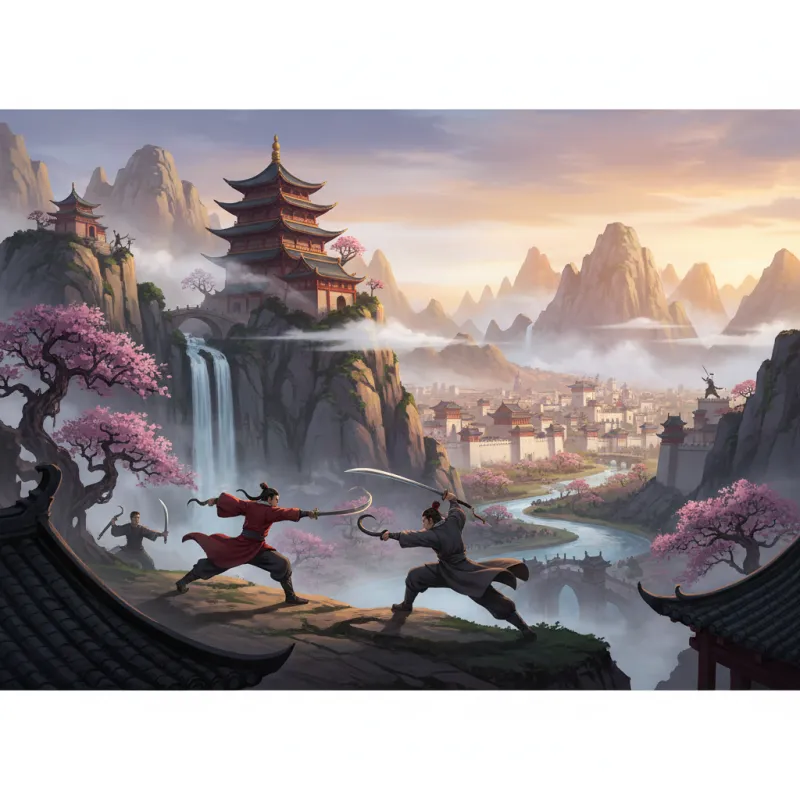
When Zhang Wuji refused the position of Wulin Alliance Leader in The Heaven Sword and Dragon Saber, he wasn't just being modest—he was rejecting the most poisoned chalice in the martial world. The leader who commands respect one day becomes the target of assassination plots the next. This paradox lies at the heart of wulin politics: the alliance meant to unite the martial world is often its greatest source of conflict.
The Illusion of Unity
The Wulin Alliance (武林盟, Wǔlín Méng) presents itself as the supreme governing body of the jianghu (江湖, jiānghú)—the "rivers and lakes" where martial artists operate beyond imperial law. In theory, it exists to mediate disputes, organize resistance against external threats, and maintain the moral standards of the martial community. In practice, it's a battlefield where ambitious sect leaders wage proxy wars through procedural manipulation and backroom deals.
Jin Yong understood this better than anyone. In Demi-Gods and Semi-Devils, the alliance convened at Shaolin Temple devolves into chaos when Qiao Feng is accused of being Khitan. The gathering meant to address the "Khitan threat" becomes a witch hunt, revealing how easily collective security concerns transform into tools of factional warfare. The alliance doesn't prevent conflict—it provides a legitimate stage for it.
The Mechanics of Martial Democracy
Alliance leadership typically follows one of three paths: hereditary succession, martial supremacy, or electoral consensus. Each method carries its own pathologies. Hereditary leadership, as seen with the Huashan Sect's internal struggles in The Smiling, Proud Wanderer, breeds complacency and entitlement. The second generation rarely possesses the founder's charisma or skill, yet expects the same deference.
The "might makes right" approach—where the strongest fighter claims leadership—sounds straightforward but creates perpetual instability. Every ambitious master with a new technique becomes a potential challenger. Gu Long's novels frequently explore this dynamic, where alliance leaders spend more energy defending their position than actually leading. The result is a martial world locked in endless tournament arcs, each succession crisis bleeding the community's strength.
Electoral systems, rare but present in some wuxia narratives, introduce their own complications. Voting blocs form along regional and stylistic lines. The Shaolin-Wudang axis dominates northern politics, while southern sects like Emei and Diancang form counter-coalitions. Smaller schools become kingmakers, their votes purchased with promises of protection or access to martial manuals. The orthodox and unorthodox sects divide becomes less about moral philosophy and more about political alignment.
The Sect System and Power Dynamics
Understanding wulin politics requires grasping the sect hierarchy. Major sects (大派, dàpài) like Shaolin, Wudang, and Kunlun function as great powers, each commanding networks of affiliated schools and sworn allies. Mid-tier sects (中等门派, zhōngděng ménpài) survive through strategic marriages, tribute relationships, and careful neutrality. Minor schools (小门小派, xiǎo mén xiǎo pài) exist at the mercy of their patrons, providing foot soldiers for larger conflicts while hoping to avoid annihilation.
This stratification mirrors the tributary system of imperial China, but without the emperor's stabilizing authority. The Wulin Alliance Leader theoretically fills that role, but lacks the institutional power to enforce decisions. When Zuo Lengchan attempts to merge the Five Mountains Sword Sects in The Smiling, Proud Wanderer, he can't simply decree unification—he must orchestrate a complex scheme involving manufactured crises, assassinations, and the manipulation of sect succession rules.
The alliance's weakness becomes most apparent during external threats. When the Mongols invade in The Legend of the Condor Heroes, the martial world's response is fragmented and ineffective. Guo Jing's defense of Xiangyang succeeds despite the alliance structure, not because of it. Individual heroes and small bands prove more effective than the bureaucratic machinery of formal martial politics.
The Economics of Martial Power
Wulin politics runs on resources rarely discussed in the heat of sword duels: money, land, and information. Major sects control economic assets—Shaolin's vast temple holdings, Wudang's mountain monopoly, the Beggar's Sect's intelligence network spanning every town and village. Alliance leadership provides access to these resources, making the position valuable beyond mere prestige.
The Beggar's Sect exemplifies how economic power translates to political influence. Despite its members' poverty, the sect's information-gathering capabilities make it indispensable to alliance operations. No major decision proceeds without consulting the Beggar's Sect leader, whose network of informants knows which sect master is secretly practicing demonic techniques or which alliance member is negotiating with foreign powers.
Merchant clans and escort agencies occupy an ambiguous space in this economy. They fund sect operations through donations and protection fees, yet remain excluded from formal alliance membership. This creates a shadow political layer where financial backers exercise influence without accountability. When the Shen Dao Escort Agency in Gu Long's works manipulates sect conflicts to increase demand for their services, they demonstrate how economic actors can exploit martial politics for profit.
The Ritual Performance of Authority
Alliance gatherings follow elaborate protocols that reinforce hierarchy while providing opportunities for subversion. Seating arrangements at conferences communicate relative status—proximity to the alliance leader indicates favor, while peripheral placement signals marginalization. The order of speakers, the formality of address, even the quality of tea served carries political meaning.
These rituals serve multiple functions. They provide predictable frameworks for interaction, reducing the likelihood that every disagreement escalates to violence. They also create opportunities for skilled operators to manipulate perceptions. In The Book and the Sword, Chen Jialuo's mastery of martial etiquette allows him to navigate alliance politics despite leading a rebel organization. He understands that proper performance of respect can substitute for actual submission.
The challenge-and-response system embedded in alliance protocols deserves particular attention. When one sect master questions another's honor, formal procedures dictate how the dispute proceeds—from verbal debate to demonstration matches to potentially lethal duels. This structured escalation theoretically prevents minor disagreements from destroying the alliance, but in practice, skilled provocateurs exploit these rules to engineer conflicts while maintaining plausible deniability.
The Demonic Sect Alternative
The existence of the Demonic Sect (魔教, Mójiào) or unorthodox factions provides a dark mirror to alliance politics. These organizations reject the alliance's moral framework while often replicating its power structures. The Sun Moon Holy Cult in The Smiling, Proud Wanderer maintains its own hierarchy, succession rules, and internal politics—proving that the problems of martial governance transcend ideological divisions.
What makes demonic sects politically significant isn't their evil—it's their role as the alliance's necessary enemy. Alliance leaders invoke the demonic threat to justify power consolidation, suppress internal dissent, and rally fractious members around common cause. When actual demonic activity is insufficient, ambitious leaders have been known to manufacture it. The false flag operations and agent provocateur tactics that appear throughout wuxia literature reveal a cynical understanding of how external threats serve internal political needs.
The Individual Against the System
The most compelling wuxia protagonists are those who recognize the alliance's dysfunction and choose their own path. Linghu Chong's rejection of sect politics in favor of personal loyalty, Qiao Feng's tragic position between two worlds, Yang Guo's complete disregard for martial orthodoxy—these characters succeed by operating outside alliance structures while still engaging with the martial world.
This tension between individual heroism and collective organization reflects deeper questions about governance and legitimacy. Can any system truly unite the martial world, or does the diversity of styles, philosophies, and ambitions make lasting unity impossible? Jin Yong's later novels suggest pessimism on this point. The alliance persists not because it works, but because the alternative—complete fragmentation—is worse.
The Wulin Alliance remains a flawed but necessary institution, a political compromise that satisfies no one while preventing total chaos. Its meetings produce more drama than decisions, its leaders command more resentment than respect, and its grand pronouncements rarely survive contact with reality. Yet it endures, because even in the martial world, politics—messy, frustrating, and inevitable—beats the alternative of endless war.
Related Reading
- Tea Houses and Wine Shops: The Social Hubs of the Martial World
- Wuxia Culture: How Martial Arts Fiction Shaped Modern Chinese Society
- Wuxia in Modern Culture: From Novels to Netflix
- Poison and Medicine in Wuxia: Two Sides of the Same Coin
- Tea Houses in Wuxia: Where Stories Begin
- The Four Seas and the Shape of the Ancient Chinese World
- Sacred Objects of Chinese Mythology: Seals, Mirrors, and Cauldrons
- The Origins of Wuxia: From Sima Qian to Jin Yong
Explore Chinese Culture
- Explore Jin Yong's martial arts novels
- Explore cultivation fiction and immortal heroes
- Explore the real history behind wuxia