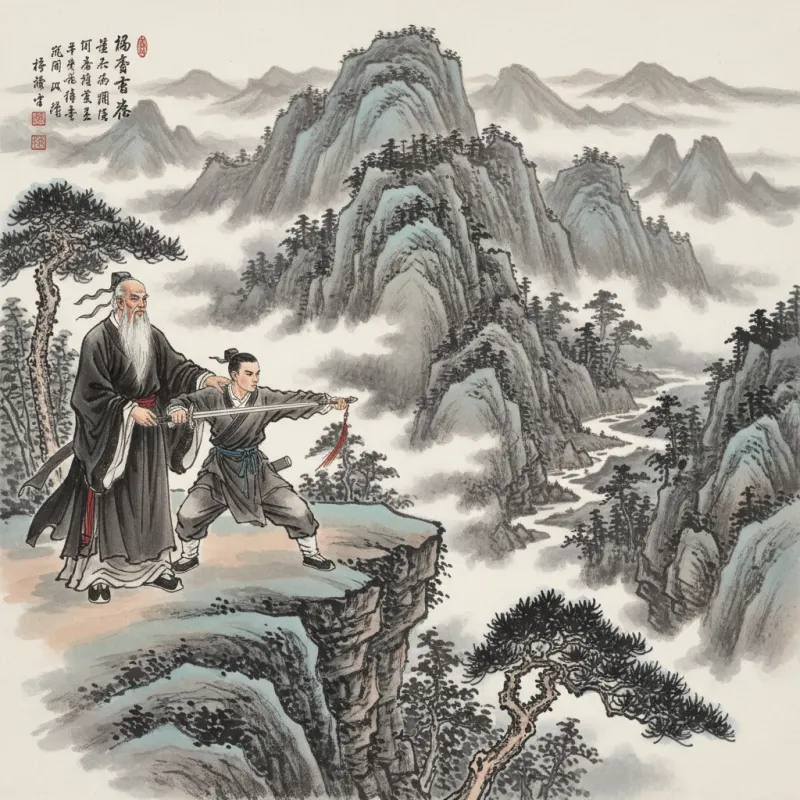
When Zhang Wuji knelt before Zhang Sanfeng in The Heaven Sword and Dragon Saber, he wasn't just asking for kung fu lessons. He was offering his entire life. The old Taoist master could have demanded anything—his fortune, his future, even his death—and Zhang Wuji would have been bound by honor to comply. This is the master-disciple relationship, and it's the most terrifying, beautiful, and misunderstood bond in all of wuxia fiction.
Beyond Teaching: What a Shifu Really Means
The word 师父 (shīfu) literally translates as "master-father," and that hyphen does a lot of work. Your shifu isn't your teacher in the modern sense—someone you pay for a service and leave when the semester ends. They're closer to a feudal lord who owns your loyalty, a parent who shapes your character, and a god who determines your fate in the martial world (武林 wǔlín).
一日为师,终身为父 (yī rì wéi shī, zhōngshēn wéi fù)—"one day as your teacher, a lifetime as your father." This Confucian proverb gets thrown around a lot, but in the jianghu (江湖 jiānghú), it's not a metaphor. It's a binding contract written in blood and honor. When Linghu Chong's shifu Yue Buqun orders him to do something in The Smiling, Proud Wanderer, Linghu Chong doesn't get to say "let me think about it." He obeys, even when those orders destroy his happiness, because the alternative is becoming a traitor to everything he is.
This isn't just about martial arts technique. Your shifu determines your sect affiliation, your moral framework, your enemies, and your friends. They're the reason you exist in the wulin at all. Without a shifu, you're not a martial artist—you're just someone who knows how to punch.
The Acceptance Ritual: Kneeling Into a New Life
You don't become a disciple by filling out an application form. The traditional acceptance ceremony (拜师礼 bàishī lǐ) is one of the most dramatic moments in any wuxia novel, and it's designed to be irreversible.
First, the prospective disciple kneels. Not a polite bow—a full kowtow (磕头 kētóu), forehead to the ground, three times or nine times depending on the sect's traditions. They offer tea to the master, who accepts it only if they're willing to take on this lifetime responsibility. Sometimes there's incense, sometimes witnesses from the sect, sometimes a formal contract written on red paper. In Demi-Gods and Semi-Devils, Xuzhu's acceptance into the Xiaoyao Sect happens in a cave with no witnesses at all—just an old woman and a terrified monk who doesn't want to be there. It still counts. The ritual isn't about paperwork; it's about the moment when one person says "I will teach you" and another says "I will follow you," and both of them mean it absolutely.
Some masters make it harder. They test you first—make you wait outside their door for days, send you on impossible errands, or refuse you three times to see if you're serious. Guo Jing spends months proving himself worthy before the Seven Freaks of Jiangnan accept him. This isn't hazing; it's the master making sure you understand what you're asking for. Because once you're in, you can't get out.
The Dark Side: When Your Master Is Wrong
Here's where wuxia fiction gets psychologically brutal. What happens when your shifu is corrupt, cruel, or just plain wrong?
In Western stories, the answer is simple: you leave. You find a better teacher. You become a free agent. In the jianghu, that's called 欺师灭祖 (qī shī miè zǔ)—"deceiving your master and destroying your ancestors"—and it's one of the worst crimes you can commit. You'll be hunted by your former sect, shunned by the entire martial world, and you'll carry the stain of betrayal for the rest of your life.
Yue Buqun in The Smiling, Proud Wanderer is the perfect example of this nightmare. He's a hypocrite who preaches righteousness while scheming for power, and his disciples know it. But they can't just walk away. Linghu Chong gets expelled (which is almost worse than staying—he loses his identity without gaining his freedom), while others stay and watch their shifu become a monster, bound by loyalty to a man who doesn't deserve it.
The tragedy is that the system offers no good options. Stay loyal to an evil master, and you become complicit in their crimes. Betray them, and you become a traitor to the very concept of honor and righteousness that defines the wulin. Some disciples choose death instead. It's not melodrama—it's the logical endpoint of a relationship that demands absolute loyalty.
The Inheritance: More Than Just Kung Fu
When a shifu teaches you martial arts, they're not just showing you how to throw a punch. They're passing down a lineage (传承 chuánchéng) that might stretch back centuries. Every technique has a history, every form has a philosophy, and every secret manual represents generations of accumulated wisdom.
This is why martial arts in wuxia fiction are so often tied to specific sects and masters. You don't just learn the Eighteen Dragon-Subduing Palms—you learn the Beggar Clan's version, taught by Hong Qigong, who learned it from his master, who learned it from their master, all the way back to the technique's creator. The lineage matters. It's your martial arts family tree, and it determines your place in the wulin hierarchy.
Some masters pass down more than technique. They pass down responsibilities, grudges, and unfinished business. When Zhou Botong teaches Yang Guo the Seventy-Two Arts of the Vacant Valley in The Return of the Condor Heroes, he's not just giving him powerful kung fu—he's making Yang Guo the inheritor of a specific martial tradition with its own enemies and allies. Your shifu's friends become your allies; their enemies become your enemies. Their debts become your debts.
The ultimate inheritance is the master's dying wish. In wuxia fiction, a shifu's final words carry the weight of a sacred command. They might ask you to avenge them, protect someone, destroy a technique so it can't fall into evil hands, or reunite the martial world. You don't get to say no. Zhang Wuji's shifu Zhang Sanfeng never actually dies in The Heaven Sword and Dragon Saber, but if he had asked Zhang Wuji to do something with his last breath, Zhang Wuji would have spent the rest of his life trying to fulfill it.
Sibling Bonds: Your Martial Family
Once you have a shifu, you gain martial siblings (师兄弟 shī xiōngdì for brothers, 师姐妹 shī jiěmèi for sisters). These aren't biological relatives, but in the jianghu, they might as well be. You train together, fight together, and you're bound by the same loyalty to your master.
The relationship between martial siblings is complex. There's camaraderie, but also competition. There's love, but also jealousy. Senior disciples (师兄 shīxiōng or 师姐 shījiě) have authority over junior ones, and the eldest disciple often inherits the sect's leadership. This creates natural tension—who's the favorite? Who's the most talented? Who will carry on the master's legacy?
Some of wuxia's greatest tragedies come from martial siblings turning against each other. In The Smiling, Proud Wanderer, the entire Huashan Sect nearly destroys itself because of conflicts between martial brothers. In Demi-Gods and Semi-Devils, Ding Chunqiu betrays and cripples his own shifu, then hunts down his martial siblings to eliminate witnesses. The betrayal cuts deeper because these are people who should have been family.
But when martial siblings stay loyal to each other, they're unstoppable. The Seven Freaks of Jiangnan in Legends of the Condor Heroes aren't the most powerful martial artists individually, but their bond makes them formidable. They fight as one unit, protect each other's weaknesses, and never abandon each other. That's the ideal—a martial family that's stronger than blood.
Breaking the Bond: Expulsion and Betrayal
There are only a few ways to end the master-disciple relationship, and none of them are pleasant.
Expulsion (逐出师门 zhú chū shī mén) is the master's nuclear option. It severs the bond completely, strips you of your sect identity, and marks you as an outcast. Sometimes it's deserved—you committed a crime, betrayed the sect, or violated its principles. Sometimes it's political—your shifu needs a scapegoat or wants to protect you by cutting ties. Either way, it's devastating. You lose your martial identity, your place in the wulin, and often your will to continue as a martial artist.
Linghu Chong's expulsion from the Huashan Sect is one of the most painful scenes in wuxia literature. He didn't betray anyone—he just refused to abandon his friends and his principles. But Yue Buqun expels him anyway, and Linghu Chong spends the rest of the novel as a wanderer, technically free but spiritually homeless.
Then there's voluntary betrayal—when a disciple consciously chooses to turn against their master. This is rare in wuxia fiction because it's so taboo, but when it happens, it's usually because the master has become irredeemably evil. Even then, the disciple suffers. They might be doing the right thing, but they're still breaking the most sacred bond in the jianghu. They become a 叛徒 (pàntú)—a traitor—and that label never washes off.
The only clean ending is death. When a shifu dies naturally and their disciple has fulfilled all their obligations, the bond is honored and complete. The disciple can then become a master themselves, taking on their own students and continuing the lineage. This is the ideal outcome—a relationship that ends not in betrayal or expulsion, but in the natural passing of one generation to the next.
Why It Still Matters: The Modern Reader's Dilemma
For contemporary readers, especially Western ones, the master-disciple relationship can feel oppressive. Why can't these characters just leave? Why do they let one person control their entire lives? Why is loyalty valued over personal freedom?
But that's exactly why it's compelling. Wuxia fiction explores a moral framework that's fundamentally different from modern individualism. In the jianghu, you're not a self-made hero—you're part of a web of relationships, obligations, and inherited responsibilities. Your shifu is the anchor of that web, and cutting yourself free means losing your identity, not gaining it.
The best wuxia novels don't just accept this system—they interrogate it. They show us disciples who struggle with unjust masters, masters who fail their students, and the terrible costs of absolute loyalty. They ask: what do you do when honor demands something your conscience can't accept? When does loyalty become complicity? When is betrayal actually courage?
These aren't easy questions, and wuxia fiction doesn't offer easy answers. But it does offer something valuable: a deep exploration of what it means to be bound to another person, to inherit their legacy, and to carry their teachings into an uncertain future. In a world that increasingly celebrates independence and self-reliance, there's something profound about stories that take seriously the idea that we're shaped by those who came before us—for better and for worse.
The master-disciple bond is sacred, terrifying, and sometimes tragic. But it's also the foundation of everything that makes the jianghu worth fighting for.
Related Reading
- The Jianghu Code: Honor Among Martial Artists
- Wulin Alliance: Politics of the Martial World
- The Code of Jianghu: Unwritten Rules of the Martial World
- Tea, Wine, and Food: The Culinary Culture of Wuxia
- Tea Houses in Wuxia: Where Stories Begin
- Wudang Sword Techniques: The Art of Taoist Swordsmanship
- Wire-Fu: The Art of Flying Swordsmen in Action Cinema
- Lingzhi: The Mushroom of Immortality from Myth to Medicine
Explore Chinese Culture
- Explore Jin Yong's martial arts novels
- Explore cultivation fiction and immortal heroes
- Explore the real history behind wuxia