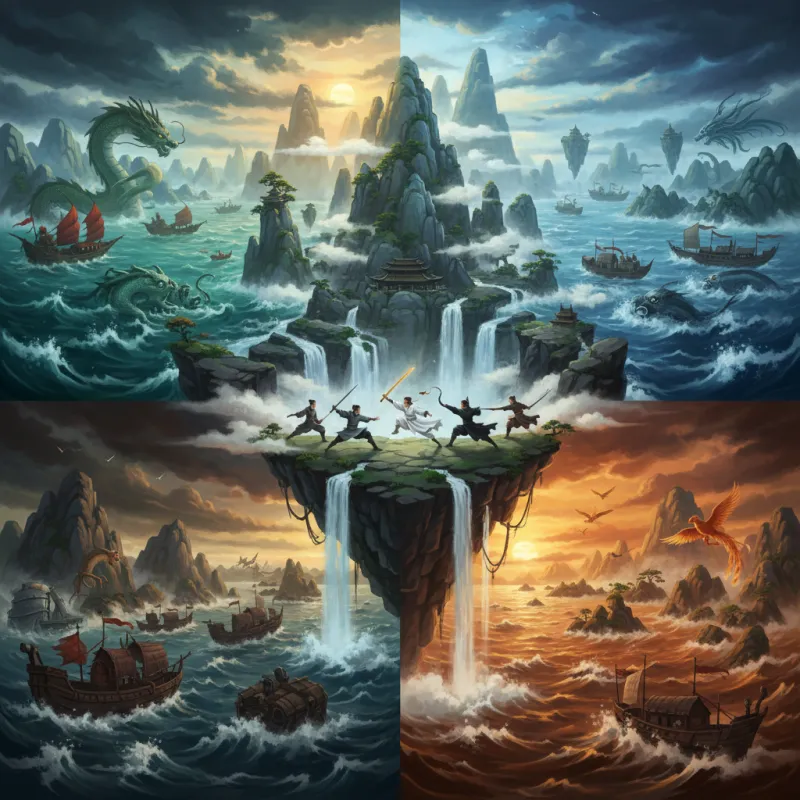
When the scholar Guo Pu (郭璞 Guō Pú) sat down in 276 CE to annotate the Shanhai Jing, he must have wondered what he'd gotten himself into. The text described a world where three-headed people lived in the east, one-armed nations thrived in the west, and mountains literally walked. But here's the thing: this wasn't fantasy fiction. This was geography. The ancient Chinese cartographers who compiled the Shanhai Jing (山海经 Shānhǎi Jīng, "Classic of Mountains and Seas") weren't writing a novel—they were mapping reality as they understood it, a reality where the world had edges, seas had boundaries, and beyond those boundaries, all bets were off.
The Flat Earth at the Center of Everything
Let's be clear: the ancient Chinese cosmological model wasn't a sphere. It was a square earth beneath a round heaven, a concept known as tianyuan difang (天圆地方, "heaven round, earth square"). The civilized world—what they called Zhongguo (中国, literally "Middle Kingdom")—sat at the absolute center of this square. This wasn't arrogance; it was geometry. If you're going to organize a cosmos, you need a fixed point, and the Chinese put themselves right on it.
The Shanhai Jing, compiled between the 4th and 1st centuries BCE (though claiming much older origins), describes this world in obsessive detail. It's divided into sections: the five "Classics of Mountains" (Shan Jing 山经) and the "Classics of Regions" (Hai Jing 海经), which cover everything within and beyond the four seas. Reading it is like watching a medieval map where the cartographer started with careful measurements near home, then gradually let their imagination fill in the blanks at the edges—except the Chinese never admitted they were guessing.
The Four Seas: Boundaries of the Known World
The four seas—Sihai (四海)—weren't oceans in the modern sense. They were conceptual boundaries, vast bodies of water that enclosed the civilized world on all sides. The Donghai (东海, Eastern Sea), Nanhai (南海, Southern Sea), Xihai (西海, Western Sea), and Beihai (北海, Northern Sea) formed a liquid wall between order and chaos.
Everything inside these seas was hainei (海内, "within the seas")—the realm of human civilization, imperial authority, and Confucian propriety. The Shanhai Jing describes this inner region with relative restraint: normal mountains, recognizable rivers, the occasional unusual animal. But the moment you cross those watery boundaries into haiwai (海外, "beyond the seas"), the text goes gloriously off the rails.
In the lands beyond the Eastern Sea, you'll find the Junzi Guo (君子国, "Kingdom of Gentlemen"), where everyone is unfailingly polite and yields to others—a Confucian utopia that probably made the text's compilers deeply homesick. But travel a bit further and you hit the Daren Guo (大人国, "Kingdom of Giants"), where people are thirty feet tall. Keep going and you reach the Maomin Guo (毛民国, "Kingdom of Hairy People"), whose inhabitants are covered in fur. The pattern is clear: distance from the center equals distance from normalcy.
The Four Wildernesses: Where Maps Become Nightmares
Beyond the four seas lay the four wildernesses—Sihuang (四荒) or Siyu (四域)—and this is where the Shanhai Jing fully commits to the weird. These weren't just foreign lands; they were the cosmic margins where the rules of nature itself began to break down.
The Dahuang (大荒, "Great Wilderness") sections of the Shanhai Jing read like fever dreams. In the Eastern Wilderness, there's a valley where the ten suns take turns rising—yes, ten suns, because apparently one wasn't enough. The goddess Xihe (羲和) bathes them in a lake before they ascend. In the Western Wilderness, you'll find the Kunlun (昆仑) mountains, home to the Queen Mother of the West (Xiwangmu 西王母), who guards the peaches of immortality that martial artists and Daoist cultivators have sought for millennia.
The Northern Wilderness contains the Youdu (幽都, "Dark Capital"), the land of the dead, while the Southern Wilderness hosts nations of people with holes through their chests, through which they thread carrying poles. The Shanhai Jing describes these details with the same matter-of-fact tone it uses for normal geography: "Three hundred li to the south is the Kingdom of the Chest-Pierced People. They are called Chest-Pierced because they have holes in their chests." No explanation, no justification—just cartographic fact.
The Logic of Distance and Difference
What makes the Shanhai Jing's worldview fascinating isn't just the monsters—it's the underlying logic. The text operates on a principle we might call "graduated strangeness": the further you get from the civilized center, the weirder things become. This isn't random. It's a sophisticated way of encoding cultural anxiety about the unknown.
Near the center, differences are minor: people speak different languages, wear different clothes, follow different customs. At the middle distances, differences become physical: people are taller, shorter, darker, paler. At the far edges, differences become ontological: people have multiple heads, missing limbs, animal features. The message is clear—civilization is what makes us fully human, and distance from civilization means distance from humanity itself.
This worldview profoundly influenced Chinese literature, including wuxia fiction. When Jin Yong (金庸) sends his heroes to the Western Regions in novels like Demi-Gods and Semi-Devils (Tianlong Babu 天龙八部), he's tapping into this ancient geography of strangeness. The further his characters travel from the Central Plains (Zhongyuan 中原), the more exotic the martial arts, the stranger the customs, the more dangerous the adventures. The Western Regions in wuxia aren't just geographically distant—they're cosmologically marginal.
Mountains as Cosmic Pillars
The Shanhai Jing doesn't just map horizontal space—it maps vertical space too. Mountains aren't just geological features; they're cosmic architecture, pillars holding up the sky. The text catalogs hundreds of mountains, each with its resident spirits, unique minerals, and strange fauna.
Mount Kunlun, the most important mountain in Chinese mythology, appears repeatedly in the Shanhai Jing as the axis mundi, the cosmic center where heaven and earth connect. It's eight hundred li around and eighty thousand feet high—numbers that are clearly symbolic rather than literal. The Queen Mother of the West lives there, guarding the boundaries between mortal and immortal realms.
This vertical cosmology matters because it adds a third dimension to the flat-earth model. You can travel horizontally toward the edges and encounter strangeness, or you can travel vertically—climbing sacred mountains or descending into underworld caverns—and encounter the divine or demonic. Wuxia novels inherited this vertical geography: think of all those hidden valleys, mountain-top monasteries, and underground palaces where legendary martial arts manuals are hidden.
The Shanhai Jing in Practice: Navigation and Power
Here's what often gets overlooked: people actually used the Shanhai Jing. Not as a fantasy novel, but as a practical guide. Emperors consulted it when planning expeditions. Merchants referenced it when organizing trade caravans. Generals studied it before military campaigns. The fact that much of it was obviously mythological didn't matter—the text provided a framework for understanding the world beyond the borders.
The Shanhai Jing was also a political document. By mapping the world with China at the center and everything else arranged in concentric circles of increasing barbarism, it justified imperial expansion. If the people beyond the seas were less than fully human, then bringing them under Chinese rule wasn't conquest—it was civilization. The text literally mapped power onto geography.
This political dimension echoes through wuxia fiction's treatment of space. The jianghu (江湖, "rivers and lakes") exists in tension with the imperial court, but both operate within a shared geography where the Central Plains represent orthodoxy and the peripheries represent heterodoxy. Unorthodox sects (mopai 魔派) often come from border regions or foreign lands, their martial arts as strange and dangerous as the territories they inhabit.
When the Map Met Reality
By the Tang Dynasty (618-907 CE), Chinese travelers had ventured far enough to know the Shanhai Jing's geography was, shall we say, creative. Buddhist pilgrims like Xuanzang (玄奘) traveled to India and back, encountering real foreign lands that didn't match the text's descriptions. Maritime trade brought Chinese merchants into contact with Southeast Asian kingdoms that weren't populated by giants or chest-pierced people.
But here's the remarkable thing: the Shanhai Jing's worldview persisted. Even as empirical geography improved, the conceptual geography remained. China was still the Middle Kingdom, still the center, still the measure of civilization. The four seas and four wildernesses became metaphorical rather than literal, but they continued to structure how Chinese culture understood its place in the world.
In wuxia fiction, this tension between mythological and empirical geography creates productive ambiguity. Is Mount Kunlun a real place or a spiritual realm? Are the Western Regions actual Central Asian territories or symbolic spaces of otherness? The best wuxia novels exploit this ambiguity, letting their geography be simultaneously realistic and mythological, mapped and mysterious.
The Edges of the World, the Edges of the Genre
The Shanhai Jing's greatest legacy might be its demonstration that geography is never just geography—it's always also cosmology, politics, and imagination. The text's four seas and four wildernesses created a spatial vocabulary that Chinese culture has used for over two thousand years to think about center and periphery, civilization and barbarism, known and unknown.
When you read wuxia novels and encounter those mysterious valleys where time flows differently, those border regions where strange martial arts flourish, those sacred mountains where immortals dwell—you're reading the Shanhai Jing's descendants. The ancient text established that the world has edges, and at those edges, the normal rules don't apply. That's not a bug in the worldview; it's a feature. Because the edges are where the interesting stories happen, where heroes prove themselves, where the familiar world dissolves into wonder and terror.
The ancient Chinese cartographers who compiled the Shanhai Jing understood something that modern fantasy writers are still learning: the best maps are the ones that leave room for dragons at the edges. They knew their world had boundaries, and they knew that beyond those boundaries, anything was possible. They were wrong about the geography, but they were absolutely right about the stories.
Related Reading
- Exploring Chinese Martial Arts Fiction and the Mythical Jianghu Culture
- Penglai Island: The Legendary Isle of Immortals
- The Fusang Tree: Where the Suns Rise and the World Begins
- Kunlun Mountain: The Paradise at the Center of the World
- Shanhai Jing Creatures in Modern Video Games
- Shaolin Temple: The Birthplace of Chinese Martial Arts
- The Enigmatic World of Shapeshifters in Wuxia Fiction: Unveiling Jianghu Adventures
Explore Chinese Culture
- Explore Jin Yong's martial arts novels
- Explore cultivation fiction and immortal heroes
- Explore the real history behind wuxia