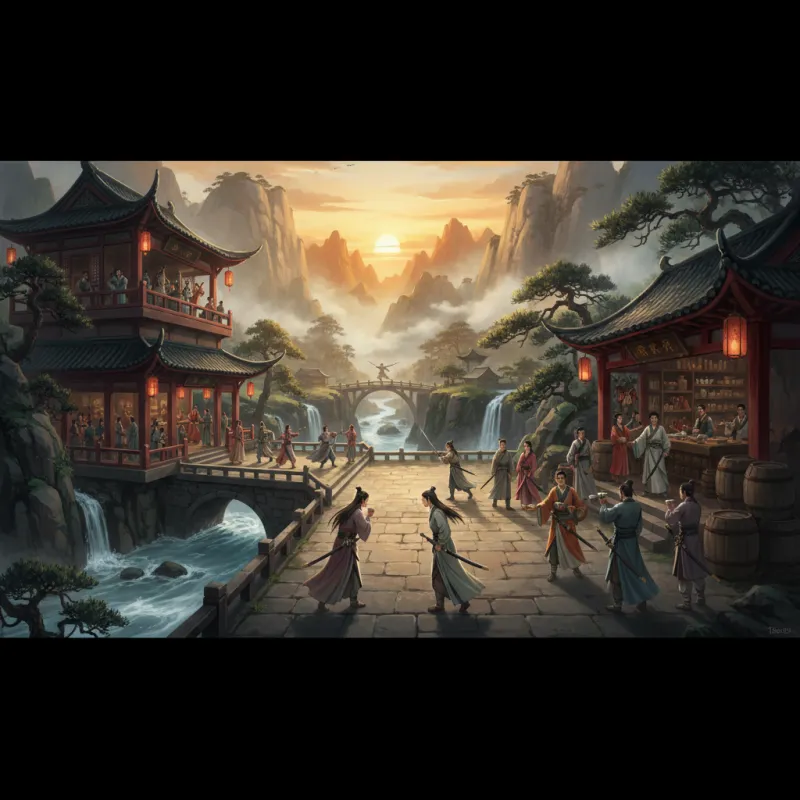
The waiter sets down a pot of Longjing tea, and before the steam clears, you've already learned three things: which sect is recruiting, who's carrying a price on their head, and where the next martial arts tournament will be held. In the jianghu (江湖, jiānghú) — the "rivers and lakes" world of wandering martial artists — tea houses and wine shops aren't just places to drink. They're intelligence networks, neutral zones, and stages where reputations are made or destroyed, all for the price of a cup of tea.
The Architecture of Information
Tea houses in wuxia fiction operate on a simple principle: everyone needs to rest, and everyone talks when they rest. Unlike sect headquarters or mountain retreats, these establishments belong to no faction. A Wudang disciple and a Shaolin monk can sit three tables apart, neither obligated to acknowledge the other, both listening to the same gossip about a demonic cult's movements near Luoyang.
Jin Yong weaponized this dynamic throughout his novels. In The Legend of the Condor Heroes (射雕英雄传, Shèdiāo Yīngxióng Zhuàn), Guo Jing first learns about the chaos in the martial world not from a master's lecture, but from eavesdropping in a Kalgan inn. The information isn't filtered through sect politics or personal bias — it's raw, contradictory, and exactly what a protagonist needs to understand that the jianghu is far more complicated than his teachers suggested.
The physical layout matters too. Tea houses in these stories are almost always two-story affairs: common folk downstairs, martial artists upstairs. The second floor offers better sightlines to the street (useful for spotting pursuers) and more privacy (useful for conversations you don't want overheard). Window seats are premium real estate. Corner tables even better. Gu Long's heroes always take the corner table. Always.
The Economics of Neutrality
Why don't tea houses get destroyed in sect wars? The answer is brutally practical: because everyone needs them. A tea house that maintains strict neutrality becomes more valuable than any single faction's temporary advantage. The owner who refuses to take sides, who serves the righteous and the demonic with equal courtesy, who never repeats what's said at his tables — that person wields a different kind of power.
In Demi-Gods and Semi-Devils (天龙八部, Tiānlóng Bābù), the Xingzilin (Apricot Forest) gathering technically happens outdoors, but it follows tea house rules: temporary truce, open discussion, violence only as a last resort. When those rules break down, the resulting chaos proves why the conventions exist. Thirty-seven people die because someone couldn't wait until they left the neutral ground.
The economics work because information has value. A tea house owner who hears everything and says nothing becomes a broker. Not of secrets — selling secrets gets you killed — but of introductions, of safe passage, of knowing which table to seat which customer at so that certain conversations happen "accidentally." The best tea house owners in wuxia fiction are retired martial artists themselves, powerful enough that no one wants to test them, wise enough to have left the jianghu's conflicts behind.
Wine Shops: Where Things Get Messy
If tea houses are where you gather intelligence, wine shops are where you act on it. The distinction matters. Tea promotes clarity, contemplation, strategic thinking. Wine promotes boldness, confession, and the kind of emotional honesty that sober martial artists spend years training themselves to suppress.
Gu Long understood this better than anyone. His heroes don't drink tea — they drink wine, often to excess, and the wine shops in his novels are places where masks slip. Li Xunhuan in Sentimental Swordsman, Ruthless Sword (多情剑客无情剑, Duōqíng Jiànkè Wúqíng Jiàn) does some of his most important thinking while drunk, and some of his most devastating fighting immediately after. The wine doesn't make him sloppy; it makes him honest, which in Gu Long's universe is far more dangerous.
Wine shops also serve as pressure release valves. The jianghu runs on face (面子, miànzi) and reputation, which means martial artists spend most of their time performing a version of themselves. Wine shops offer permission to drop the performance. You can boast, you can complain, you can admit fear or doubt or loneliness. Tomorrow you'll be the stoic swordsman again, but tonight, you're just another drunk telling stories that may or may not be true.
The Beggar in the Corner
Every tea house has one: the figure no one notices until it's too late. Sometimes it's literally a beggar from the Beggars' Sect, the jianghu's most extensive intelligence network. Sometimes it's a disguised master. Sometimes it's both.
The trope works because tea houses are designed for observation. The background noise, the constant flow of customers, the assumption that everyone's focused on their own business — it creates perfect cover for someone who's actually paying attention to everything. In The Smiling, Proud Wanderer (笑傲江湖, Xiào'ào Jiānghú), Linghu Chong stumbles into crucial information half a dozen times simply by being in the right tea house at the right moment, usually while drunk, which everyone assumes means he's not a threat.
The beggar-in-the-corner also serves a narrative function: it reminds readers that in the jianghu, privacy is an illusion. That conversation you're having in what you think is a quiet corner? Someone's listening. That "random" encounter with another martial artist? Probably not random. The tea house's openness is both its appeal and its danger. You come for information, but you also become information.
The Rules of Engagement
Tea houses and wine shops operate under unwritten but universally understood rules. First: no fighting inside unless absolutely necessary, and even then, you pay for damages. Second: what's said at the table stays at the table, unless it's clearly meant to be spread. Third: the owner's word is law. If they tell you to leave, you leave. If they tell you to sit down and shut up, you do that too.
These rules hold because the alternative is chaos. In The Book and the Sword (书剑恩仇录, Shū Jiàn Ēnchóu Lù), when a fight breaks out in a Hangzhou tea house, the owner — a retired master of the Kunlun Sect — ends it with a single palm strike that cracks the floor but harms no one. Message received: this is neutral ground, and neutral ground will be defended.
The rules also create interesting narrative tension. Characters who desperately want to fight must restrain themselves. Information that could save lives can't be shared openly without breaking protocol. The tea house becomes a pressure cooker where everyone's armed, everyone's alert, and everyone's pretending to be calm. One wrong word, one misunderstood gesture, and the whole thing explodes.
Modern Echoes
Contemporary wuxia adaptations often struggle with tea houses because modern audiences don't have the same relationship with these spaces. Coffee shops don't work the same way — they're too bright, too corporate, too temporary. Bars are too loud. The tea house's specific combination of public accessibility and private conversation, of transience and tradition, is hard to replicate.
The best modern wuxia stories find equivalents. In The Grandmaster (2013), Wong Kar-wai uses a train station waiting room the same way Jin Yong uses tea houses: a liminal space where different worlds intersect, where information flows, where the rules of the outside world are temporarily suspended. The principle remains even when the setting changes.
What endures is the understanding that the jianghu needs these spaces. Martial artists can't spend all their time fighting or training. They need places to rest, to hear news, to make contact with allies or enemies under controlled conditions. They need stages where they can perform their identities and audiences who understand the performance. Tea houses and wine shops provide all of this, which is why they appear in virtually every wuxia story ever written.
The Last Cup
The final scene in many wuxia novels happens in a tea house. The hero, having resolved whatever conflict drove the plot, sits down for a quiet cup of tea. Sometimes alone, sometimes with companions. The tea house is where the story began — with rumors, with chance encounters, with information that set everything in motion — and it's where the story ends, the circle complete.
This isn't just narrative symmetry. It's a statement about the jianghu itself. The martial world continues. New rumors are already spreading. New conflicts are brewing. The hero's story may be over, but the tea house remains, serving the next generation of wandering swordsmen, listening to their stories, keeping its secrets. The jianghu is eternal, and so are the places where it gathers to drink, to talk, and to pretend, just for a moment, that it's not always watching its back.
Pour another cup. Listen carefully. You never know what you might hear.
Related Reading
- The Code of Jianghu: Unwritten Rules of the Martial World
- The Jianghu Code: Honor Among Martial Artists
- The Enigma of Jianghu: Discovering the Roots of Chinese Wuxia Literature
- Wuxia in Modern Culture: From Novels to Netflix
- Tea Houses in Wuxia: Where Stories Begin
- The Wuxia Film Renaissance: Why Hong Kong Cinema Matters
- The Art of War: Exploring Weapons in Chinese Martial Arts (Wuxia) Fiction
- Wuxia Web Novels: The Online Revolution in Martial Arts Fiction
Explore Chinese Culture
- Explore Jin Yong's martial arts novels
- Explore cultivation fiction and immortal heroes
- Explore the real history behind wuxia