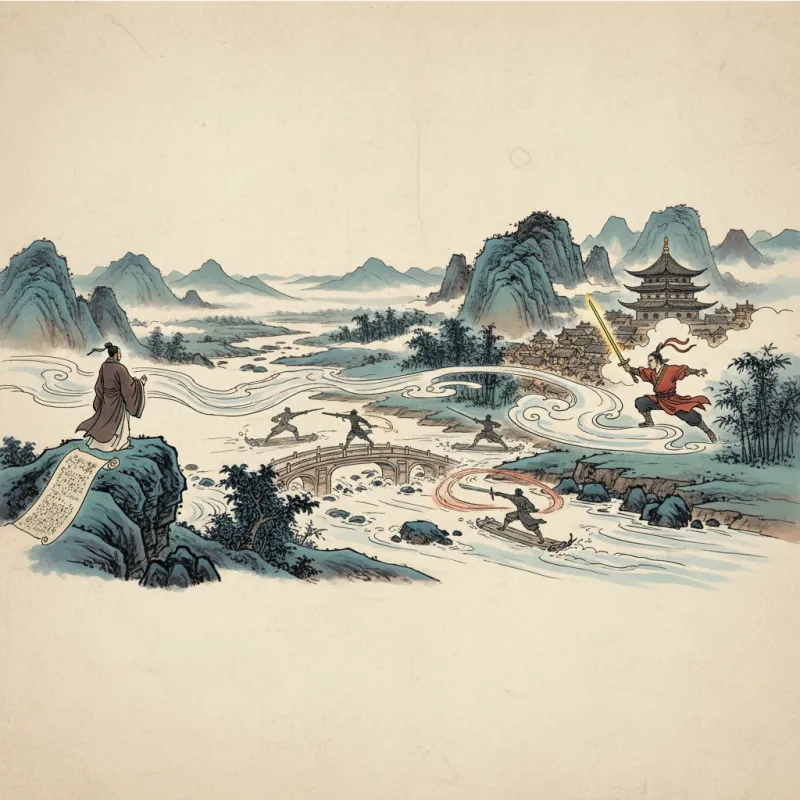
The assassin Jing Ke (荆轲 Jīng Kē) walked into the Qin throne room in 227 BCE carrying a dagger hidden inside a rolled map. He was there to kill the future First Emperor. The attempt failed — Jing Ke died, Qin Shi Huang lived, and China was unified under brutal imperial rule. But Sima Qian (司马迁 Sīmǎ Qiān), writing a century later, made sure Jing Ke's story survived. In his Records of the Grand Historian (史记 Shǐjì), completed around 94 BCE, Sima Qian devoted an entire chapter to assassins and wandering swordsmen — not emperors or generals, but outcasts who lived by personal codes of honor. That chapter, "Biographies of Assassins" (刺客列传 Cìkè Lièzhuàn), is where wuxia begins.
The Youxia: China's First Martial Heroes
Sima Qian didn't just record history — he created a template. His youxia (游侠 yóuxiá), or "wandering knights," were men who operated outside official power structures. They kept their promises, avenged wrongs, and died for causes that had nothing to do with the state. Sima Qian wrote about them with obvious admiration, even though he knew it was dangerous. The Confucian establishment hated the youxia. These were people who answered to no one, who made their own justice, who valued personal loyalty over filial piety or imperial authority.
The most famous youxia in Sima Qian's histories is probably Zhu Hai (朱亥 Zhū Hài), a butcher who killed a general with a forty-pound iron hammer to save the state of Wei. Or Nie Zheng (聂政 Niè Zhèng), who assassinated a minister in broad daylight, then mutilated his own face and disemboweled himself so his family wouldn't be punished. These stories are brutal, specific, and completely unlike the sanitized Confucian biographies that filled most historical texts. They're also the DNA of every wuxia novel written in the last two thousand years.
What Sima Qian gave wuxia was legitimacy. By including these figures in official history, he made a radical argument: that people who lived outside the system, who rejected conventional morality, could still be heroes. That argument echoes through Jin Yong's novels, where the greatest heroes are almost always outsiders — orphans, beggars, rebels, or members of unorthodox sects.
The Tang Dynasty: Swordsmen Become Supernatural
For over a thousand years after Sima Qian, the youxia remained grounded in reality. Then came the Tang Dynasty (618-907 CE), and everything changed. Tang writers started producing chuanqi (传奇 chuánqí), or "tales of the strange," and suddenly swordsmen could fly. They could become invisible. They could kill from a hundred paces with a single glance.
The most influential Tang tale is probably "The Curly-Bearded Warrior" (虬髯客传 Qiúránkè Zhuàn), written by Du Guangting (杜光庭 Dù Guāngtíng) around 900 CE. It features a mysterious swordsman with a curly beard who can predict the future and commands supernatural powers. He meets the future Emperor Taizong, recognizes his imperial destiny, and voluntarily withdraws from China to become king of some foreign land. The story is absurd, melodramatic, and completely addictive.
What the Tang writers did was merge the youxia tradition with Daoist immortal tales and Buddhist miracle stories. The result was a new kind of hero: someone who combined martial skill with supernatural abilities, who existed in a world where the boundaries between human and divine were porous. This is the world of qinggong (轻功 qīnggōng) — the lightness skill that lets wuxia heroes leap over rooftops and run across water. It's pure fantasy, but it's fantasy rooted in Chinese religious and philosophical traditions.
The Tang tales were short, though — usually just a few pages. They proved the concept, but they didn't build the genre. That would take another thousand years and a completely different medium: the newspaper serial.
The Late Qing: Wuxia Meets Mass Media
By the late 19th century, China was in crisis. The Qing Dynasty was collapsing, foreign powers were carving up the country, and traditional Confucian values seemed increasingly irrelevant. Into this chaos came the newspaper serial novel, and with it, the first true wuxia novels.
The pioneer was Xiang Kairan (向恺然 Xiàng Kǎirán), who wrote under the pen name Pingjiang Buxiaosheng (平江不肖生). His Legends of the Jianghu Knights-Errant (江湖奇侠传 Jiānghú Qíxiá Zhuàn), serialized starting in 1923, was a sensation. Xiang Kairan took the supernatural elements from Tang tales, the moral framework from Sima Qian's youxia, and added something new: detailed descriptions of martial arts techniques and internal energy cultivation. His heroes didn't just fight — they trained in specific styles, learned from masters, and progressed through levels of skill.
This is where the jianghu (江湖 jiānghú) — the "rivers and lakes," the martial arts underworld — became a fully realized fictional space. Xiang Kairan's jianghu had its own geography, its own social hierarchy, its own rules. There were orthodox sects and unorthodox sects, righteous heroes and demonic villains, ancient manuals and legendary weapons. It was a complete alternate universe, and readers couldn't get enough.
But Xiang Kairan's novels were still rough. The plots meandered, the prose was uneven, and the supernatural elements sometimes overwhelmed the human drama. It would take another generation of writers to refine the formula — and that generation emerged in Hong Kong in the 1950s.
The Golden Age: Jin Yong and the Modern Wuxia Novel
Jin Yong (金庸 Jīn Yōng), born Louis Cha (查良镛 Zhā Liángyōng), started serializing The Book and the Sword (书剑恩仇录 Shū Jiàn Ēnchóu Lù) in 1955. Over the next seventeen years, he wrote fifteen novels that completely redefined the genre. What Jin Yong did was take all the accumulated elements of wuxia — the youxia ethics, the supernatural abilities, the jianghu setting, the martial arts detail — and combine them with sophisticated plotting, psychological depth, and serious engagement with Chinese history and philosophy.
His heroes are complex. Guo Jing from The Legend of the Condor Heroes (射雕英雄传 Shèdiāo Yīngxióng Zhuàn) is loyal and righteous but also slow-witted and naive. Yang Guo from The Return of the Condor Heroes (神雕侠侣 Shéndiāo Xiálǚ) is brilliant and passionate but also arrogant and self-destructive. Wei Xiaobao from The Deer and the Cauldron (鹿鼎记 Lùdǐng Jì) is a con artist and a coward who somehow becomes the most successful character in Jin Yong's entire corpus. These aren't cardboard heroes — they're people with flaws, contradictions, and genuine character development.
Jin Yong also took wuxia seriously as a vehicle for exploring Chinese culture. His novels engage with Buddhism, Daoism, and Confucianism. They grapple with questions of loyalty versus justice, individual freedom versus social obligation, Han Chinese identity versus Manchu rule. The Smiling, Proud Wanderer (笑傲江湖 Xiào'ào Jiānghú) is a meditation on political power and corruption. Demi-Gods and Semi-Devils (天龙八部 Tiānlóng Bābù) explores Buddhist concepts of suffering and compassion through its three protagonists.
The result was a genre that could be both popular entertainment and serious literature. Jin Yong's novels sold millions of copies, were adapted into countless films and TV series, and influenced every Chinese-language writer who came after him. When he died in 2018, obituaries appeared in major newspapers worldwide. Not bad for a genre that started with a butcher wielding an iron hammer.
The Unbroken Thread
What's remarkable about wuxia's evolution is its continuity. The core elements — the outsider hero, the code of honor, the rejection of official authority — have remained constant from Sima Qian to Jin Yong. The genre has absorbed Buddhism, Daoism, newspaper serials, cinema, and the internet, but it's never lost sight of what made Jing Ke's story compelling in the first place: the idea that an individual, armed with skill and courage, can challenge the powerful and make their own justice.
Modern wuxia has splintered into subgenres. There's xuanhuan (玄幻 xuánhuàn), which adds Western fantasy elements. There's xianxia (仙侠 xiānxiá), which focuses on Daoist cultivation and immortality. There are web novels with thousands of chapters and cultivation systems so complex they require spreadsheets to track. But they all trace back to that chapter in Sima Qian's histories, to those wandering swordsmen who lived by their own codes.
The literary establishment still doesn't take wuxia seriously. Jin Yong never won a major Chinese literary prize during his lifetime. But wuxia has never needed establishment approval. It's survived for two thousand years by giving readers what they want: heroes who fight for what's right, even when the system is against them. In a culture that has always valued social harmony and obedience to authority, wuxia offers something subversive and necessary — the fantasy of individual freedom.
That's why the genre endures. That's why readers in 2024 still care about stories that began in 94 BCE. The names change, the settings evolve, but the core appeal remains: the dream of being skilled enough, brave enough, and free enough to make your own path through the world. Sima Qian understood that. Jin Yong understood that. And every wuxia writer since has been exploring the same essential truth.
For more on how these martial traditions developed into distinct fighting styles, see The Major Wuxia Sects and Their Philosophies. And if you're curious about how wuxia weapons evolved from historical reality to fictional legend, check out Legendary Weapons of the Jianghu.
Related Reading
- Real Chinese Martial Arts Schools That Inspired Wuxia Fiction
- The Knight-Errant (游侠): Real Warriors Who Inspired Wuxia
- The Real History Behind Wuxia: Knight-Errants of Ancient China
- The Real History Behind Wuxia Fiction
- Pangu and the Cosmic Egg: The Chinese Creation Myth
- The Hetu and Luoshu: Magical Diagrams from the Rivers
- Mythical Plants of the Shanhaijing: Trees That Grant Immortality and Flowers That Kill
- 12 Best Wuxia Novels for Beginners: Where to Start Reading
Explore Chinese Culture
- Explore Jin Yong's martial arts novels
- Explore cultivation fiction and immortal heroes
- Explore the real history behind wuxia