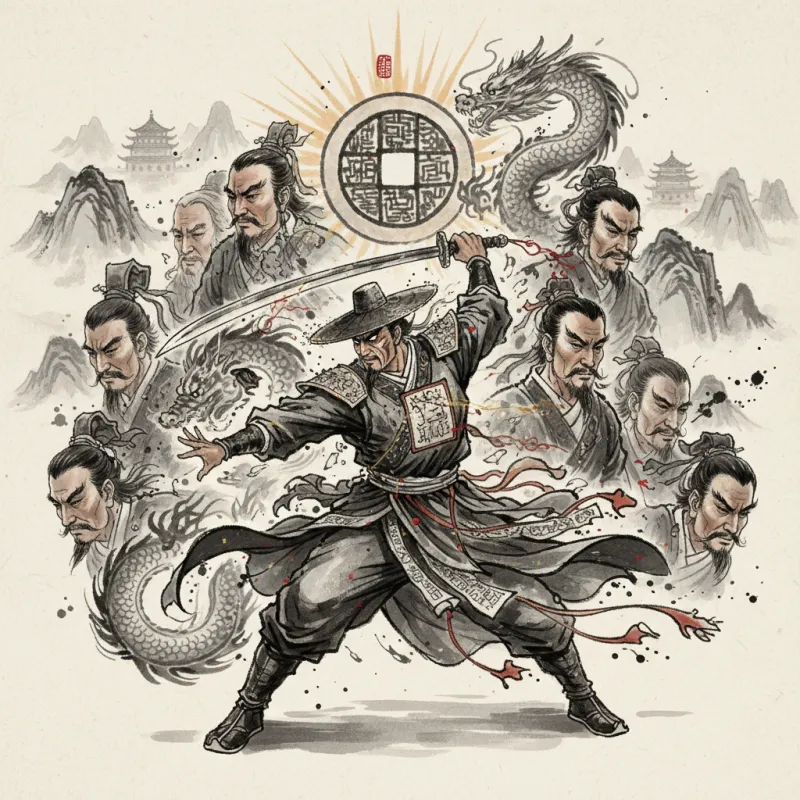
A young swordsman stands in the rain outside the Huashan Sect's gates for three days and three nights, refusing food, refusing shelter, refusing to leave. He's not there to challenge anyone. He's not there to beg for mercy. He's there because the sect leader's daughter publicly called him a coward at a banquet, and if he doesn't stand there until she apologizes, his martial arts career is over before it begins. This is 面子 (miànzi) — face — and in the jianghu (江湖 jiānghú, the martial world), it's worth more than your life.
The Invisible Ledger
English translations call it "reputation" or "honor," and technically they're not wrong. But those words don't capture the transactional nature of 面子. In the martial world (武林 wǔlín), face isn't just what people think of you — it's a currency that determines every interaction. Who bows first when two masters meet? Who gets the seat closest to the host at a banquet? Who can walk away from an insult without drawing their sword? The answers depend entirely on how much face each person holds in that moment.
Jin Yong understood this better than anyone. In The Legend of the Condor Heroes (射雕英雄传), when Hong Qigong first meets Guo Jing, he doesn't test the boy's martial arts — he tests whether Guo Jing knows how to give face to an elder. The entire relationship between master and student hinges on that initial exchange of respect. Later, when Huang Yaoshi refuses to attend the second Huashan tournament, it's not because he's afraid of losing — it's because attending would mean acknowledging that the other masters have the right to judge who's the strongest. That acknowledgment would cost him face.
面子 vs 脸: The Two Faces
Here's where it gets interesting: Chinese actually has two words for face, and they're not interchangeable. 面子 (miànzi) is the face you show the world — your social standing, your reputation, the respect others give you. 脸 (liǎn) is your inner face — your sense of shame, your moral character, the respect you give yourself.
You can lose 面子 and regain it. You lose 脸, and you're done.
In Demi-Gods and Semi-Devils (天龙八部), when Qiao Feng discovers he's actually Khitan, not Han Chinese, he loses massive amounts of 面子 — the beggar clan expels him, his friends turn against him, his entire social position collapses. But he doesn't lose 脸 because he maintains his moral principles. He refuses to betray his Han brothers even when they betray him. That's why readers still respect him, why he remains a hero despite losing everything else.
Compare that to Yue Buqun in The Smiling, Proud Wanderer (笑傲江湖). Yue maintains perfect 面子 for decades — he's called "Gentleman Sword," everyone respects him, he leads a major sect. But he has no 脸. He's willing to castrate himself for power, betray his students, murder his way to the top. When his true nature is revealed, he doesn't just lose 面子 — he's exposed as someone who never had 脸 to begin with. That's the unforgivable sin in wuxia fiction.
The Economics of Face
Every interaction in the jianghu is a transaction. When you give someone face, you're making an investment. When you take face from someone, you're declaring war.
The mechanics are precise. If a junior martial artist meets a senior, the junior cups their fists and bows first — that's giving face. If the senior returns the gesture with equal formality, they're giving face back, acknowledging the junior as a peer. If the senior just nods, they're accepting the face but not reciprocating — establishing hierarchy. If the senior ignores the greeting entirely, that's taking face, and the junior now has to decide whether to swallow the insult or demand satisfaction.
This is why martial arts etiquette is so elaborate. Every gesture, every word, every seating arrangement at a banquet is a negotiation of face. In The Book and the Sword (书剑恩仇录), the Red Flower Society spends an entire chapter arguing about who should sit where at a meeting, because the seating chart is a public declaration of everyone's relative status. Get it wrong, and you've either given too much face to someone who doesn't deserve it, or taken face from someone powerful enough to destroy you.
The Face Tax
Here's what makes 面子 so dangerous: you can't opt out. The moment you enter the jianghu, you're playing the game whether you want to or not.
令狐冲 (Linghu Chong) in The Smiling, Proud Wanderer tries to avoid face politics. He just wants to drink wine and live freely. But he can't. When he learns the Dugu Nine Swords, he gains face whether he wants it or not, because now everyone knows he's powerful. When he refuses to compete for leadership of the Huashan Sect, that's seen as giving face to his martial brother — which means his martial brother now owes him, which creates a debt that has to be repaid. Even doing nothing is a face transaction.
The only characters who successfully escape the face economy are the true hermits — the ones who disappear so completely that the jianghu forgets they exist. But that's not freedom; that's erasure. You can't have relationships, can't have students, can't have any connection to the martial world. Most characters aren't willing to pay that price.
Face and Violence
This is the part Western readers often miss: in wuxia fiction, most violence isn't about revenge or justice or protecting the innocent. It's about face.
Someone insults you at a banquet. You can't let it pass, because if you do, everyone present will know you're weak. But you also can't just kill them on the spot, because that would make you look like a barbarian who can't control his temper — you'd lose face even while defending it. So you issue a formal challenge, set a time and place, make sure witnesses are present. The duel itself might be about settling the insult, but the elaborate ritual around it is about managing face for both parties.
In The Heaven Sword and Dragon Saber (倚天屠龙记), the six major sects besiege Bright Peak not because the Ming Cult has actually done anything to them recently, but because the cult's growing power threatens their face. If they don't act, they're implicitly admitting the Ming Cult is stronger than they are. The entire siege — which kills hundreds of people — is fundamentally a face transaction.
The Breaking Point
There's a moment in many wuxia novels where a character has to choose between face and something else — love, justice, truth, survival. That choice defines who they are.
Zhang Wuji in The Heaven Sword and Dragon Saber repeatedly sacrifices face to do what he thinks is right. He apologizes when he's not wrong, backs down from fights he could win, lets people insult him without responding. The other characters think he's weak. But Jin Yong makes it clear that this requires more strength than maintaining face ever would. It's easy to fight when someone insults you. It's hard to let the insult pass when you know you could destroy them.
The tragedy of 面子 is that it's both essential and hollow. You need it to function in society, but pursuing it for its own sake destroys you. The wisest characters in wuxia fiction — Hong Qigong, Dugu Qiubai, Feng Qingyang — are the ones who understand that face is a tool, not a goal. They maintain enough face to be respected, but they're not enslaved by it.
The Modern Resonance
面子 isn't just a historical curiosity or a quirk of wuxia fiction. It's still how Chinese social dynamics work today, from business negotiations to family dinners to international diplomacy. Understanding 面子 is understanding why certain conflicts escalate, why certain compromises are impossible, why certain gestures matter more than they seem to.
When you read wuxia fiction, pay attention to the moments when characters talk about face. Notice who gives it, who takes it, who refuses to play the game. The sword fights are exciting, but the face transactions are where the real story happens. In the jianghu, you can survive losing a fight. You can't survive losing face — unless you're strong enough not to care, and very few people are.
The young swordsman standing in the rain? He's not being stubborn or foolish. He's making a calculated investment. Three days of discomfort now, in exchange for a lifetime of people knowing he's someone who won't accept disrespect. That's the economy of face. That's the currency of the jianghu. And that's why understanding 面子 transforms how you read every wuxia novel you'll ever pick up.
Related Reading
- Wulin Alliance: Politics of the Martial World
- Wuxia in Modern Culture: From Novels to Netflix
- Poison and Medicine in Wuxia: Two Sides of the Same Coin
- Wuxia Culture: How Martial Arts Fiction Shaped Modern Chinese Society
- The Jianghu Code: Honor Among Martial Artists
- The Tang Clan: Masters of Hidden Weapons and Poison
- Daoist Poetry: Finding the Way Through Nature
- Crouching Tiger, Hidden Dragon: How One Film Changed Everything
Explore Chinese Culture
- Explore Jin Yong's martial arts novels
- Explore cultivation fiction and immortal heroes
- Explore the real history behind wuxia