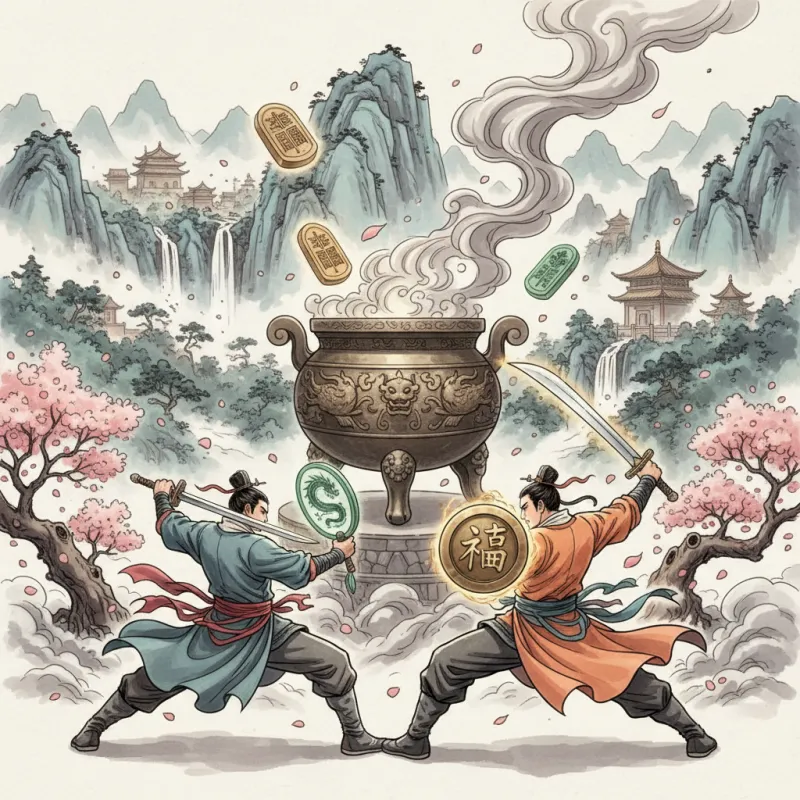
When the First Emperor of Qin unified China in 221 BCE, he didn't just conquer territories — he commissioned a seal carved from the legendary He Shi Bi jade. This wasn't vanity. Without that seal, his edicts were just suggestions. With it, they were the voice of heaven itself. The Imperial Seal, or Chuanguo Yuxi (传国玉玺 Chuánguó Yùxǐ), became the most fought-over object in Chinese history, changing hands through blood and betrayal for over a thousand years before vanishing completely. Its loss didn't just mark the end of dynasties — it marked the end of an entire cosmological order.
The Seal That Legitimized Emperors
The Chuanguo Yuxi wasn't the only imperial seal, but it was the seal. Carved by master craftsman Sun Shou during the Qin Dynasty, it bore eight characters: "受命于天,既寿永昌" (Shòu mìng yú tiān, jì shòu yǒng chāng) — "Having received the Mandate from Heaven, may the emperor lead a long and prosperous life." These weren't decorative words. They were a contract between heaven and earth, physically manifested in jade.
The seal's power came from its material as much as its inscription. The He Shi Bi jade had its own legendary origin story: discovered by Bian He in the state of Chu, who had both his feet amputated when two successive kings didn't believe the rough stone contained precious jade. When the third king finally had it cut open, the jade inside was flawless. This jade carried the weight of sacrifice, truth revealed through suffering — the perfect material for an object that would determine who truly held heaven's favor.
What made the Chuanguo Yuxi different from other sacred artifacts was its function as proof rather than power. A magical sword might make you invincible in battle, but the Imperial Seal made your victories legitimate. Generals who seized power without it were usurpers. Emperors who possessed it, even if they'd murdered their way to the throne, had heaven's endorsement. This is why the seal's history reads like a thriller: stolen by a child emperor's mother, thrown from a bridge in rage, recovered from a fish's belly, seized by warlords, used to negotiate surrenders.
The seal disappeared sometime during the chaos of the Five Dynasties period (907-960 CE). Some say the last emperor of Later Tang destroyed it rather than let it fall into enemy hands. Others claim it sank with a fleeing emperor's ship. The mystery of its disappearance haunts Chinese historical consciousness because without it, every subsequent dynasty ruled with a kind of cosmic asterisk — legitimate by conquest and governance, perhaps, but missing that tangible link to heaven.
Mirrors That Reveal Truth
While seals conferred authority, mirrors revealed it. The bronze mirrors of Chinese mythology weren't for checking your hair — they were instruments of cosmic detection. The most famous, the Zhaoyao Jing (照妖镜 Zhàoyāo Jìng) or "demon-revealing mirror," appears throughout Chinese folklore and fiction as the ultimate lie detector. Point it at someone, and their true form appears: demon, fox spirit, or honest human.
The Journey to the West (西游记 Xīyóu Jì) features several scenes where mirrors expose disguised demons, but the concept goes deeper than simple monster-hunting. Mirrors in Chinese thought represent the Daoist principle of wuwei (无为 wúwéi) — effortless action. A mirror doesn't try to reveal truth; it simply reflects what is. This passive revelation is more powerful than active investigation because it cannot be deceived or corrupted.
Historical bronze mirrors from the Han Dynasty onward often bore inscriptions about warding off evil and bringing clarity. These weren't metaphorical. People genuinely believed that certain mirrors, properly crafted and consecrated, could pierce illusions. The "light-penetrating mirrors" discovered by archaeologists — bronze mirrors that, when light hits them at certain angles, project the pattern from their decorated backs through the seemingly solid bronze — suggest that ancient craftsmen understood optics in ways that seemed magical to observers.
In wuxia fiction, mirrors serve a narrative function similar to their mythological role: they're plot devices that cut through deception. But they also represent a philosophical stance. In a world of martial arts techniques that can disguise appearance, alter voice, and mask qi signatures, the mirror is the ultimate counter — not through superior technique, but through fundamental truth-telling.
Cauldrons of Cosmic Order
If seals legitimized rulers and mirrors revealed truth, cauldrons — specifically the Nine Tripod Cauldrons or Jiuding (九鼎 Jiǔdǐng) — literally held the world together. According to the Records of the Grand Historian (史记 Shǐjì), the legendary Emperor Yu cast nine bronze cauldrons after controlling the Great Flood, each representing one of the nine provinces of China. These weren't cooking vessels. They were anchors of cosmic geography.
The Jiuding embodied the concept of ding (定 dìng) — stability, settledness, the fixed order of things. As long as the nine cauldrons stood in the capital, the dynasty was stable. When they were moved or lost, chaos followed. The cauldrons were so heavy that moving them required massive logistical efforts, which itself became a metaphor: legitimate power doesn't need to be moved around. It sits, stable and immovable, at the center.
The Zhou Dynasty claimed the cauldrons from the Shang Dynasty, legitimizing their conquest. The Qin Dynasty tried to recover them when one sank in a river — the First Emperor personally supervised the failed salvage operation, understanding that without the cauldrons, his new empire lacked a crucial symbolic foundation. By the Han Dynasty, the cauldrons were lost entirely, and subsequent dynasties had to rule without them, creating new symbols of legitimacy but never quite replacing the cosmic weight of those nine bronze vessels.
What's fascinating is how the cauldron's symbolism evolved in Daoist alchemy and internal cultivation practices. The dantian (丹田 dāntián), the energy center in the lower abdomen, is often called the "cauldron" where qi is refined. The external cosmic cauldrons that stabilized the empire became internalized as the cauldron within each practitioner that stabilizes their personal cultivation. This is classic Chinese philosophical move: the macrocosm reflects the microcosm, and vice versa.
The Difference Between Power and Authority
Western fantasy often treats magical objects as power multipliers — put on the ring, wield the sword, drink the potion, become stronger. Chinese mythological objects work differently. They don't make you powerful; they make you authorized. This distinction matters enormously for understanding Chinese narrative logic.
A usurper with the Imperial Seal is the legitimate emperor, even if he's weak. A demon with the demon-revealing mirror is still exposed, even if the mirror-holder is powerless to fight it. The Nine Cauldrons stabilize the realm regardless of the emperor's personal virtue. The objects themselves carry the authority, and humans are merely their temporary custodians.
This creates a different kind of dramatic tension in stories. The question isn't "can the hero become strong enough to defeat the villain?" but "can the hero obtain the object that legitimizes their claim?" Entire plot arcs in Chinese historical fiction revolve around the search for, theft of, or authentication of sacred objects. The objects are MacGuffins, yes, but MacGuffins with philosophical weight.
When Objects Outlive Their Purpose
The Imperial Seal is gone. The Nine Cauldrons are lost. Most demon-revealing mirrors exist only in stories. What happens when the objects that held cosmic authority disappear?
One answer: the authority becomes internalized and democratized. Without the Imperial Seal to legitimize emperors, legitimacy had to come from other sources — effective governance, military strength, popular support, bureaucratic competence. Without the Nine Cauldrons to anchor the realm, stability had to come from institutions rather than artifacts. The loss of sacred objects forced Chinese political philosophy to mature beyond object-based legitimacy.
But the longing for those objects never quite disappeared. Every few decades, someone claims to have found the real Imperial Seal. Archaeologists uncover bronze mirrors with demon-warding inscriptions. The symbolic power of these objects persists even in their absence, which might be the most Chinese thing about them: the idea that an object's authority can outlive the object itself, existing as a kind of cosmic placeholder for an order that once was and might someday be again.
In modern wuxia and xianxia fiction, authors create new sacred objects — divine weapons, cultivation manuals, immortal pills — but they're almost always echoes of these classical prototypes. The seal that proves identity, the mirror that reveals truth, the cauldron that stabilizes power. The forms change, but the underlying logic remains: in Chinese narrative tradition, objects aren't just tools. They're witnesses, judges, and anchors of cosmic order. Lose them, and you don't just lose power. You lose the very framework that makes power meaningful.
Related Reading
- The Jade Palace of Kunlun: Home of the Queen Mother of the West
- The Hetu and Luoshu: Magical Diagrams from the Rivers
- Exploring the Cultural Depth of Wuxia: The Art of Chinese Martial Arts Fiction
- The Fusang Tree: Where the Suns Rise and the World Begins
- Iron Palm Training: Hardening the Body Through Discipline
- Shaolin Temple: The Birthplace of Chinese Martial Arts
Explore Chinese Culture
- Explore Jin Yong's martial arts novels
- Explore cultivation fiction and immortal heroes
- Explore the real history behind wuxia