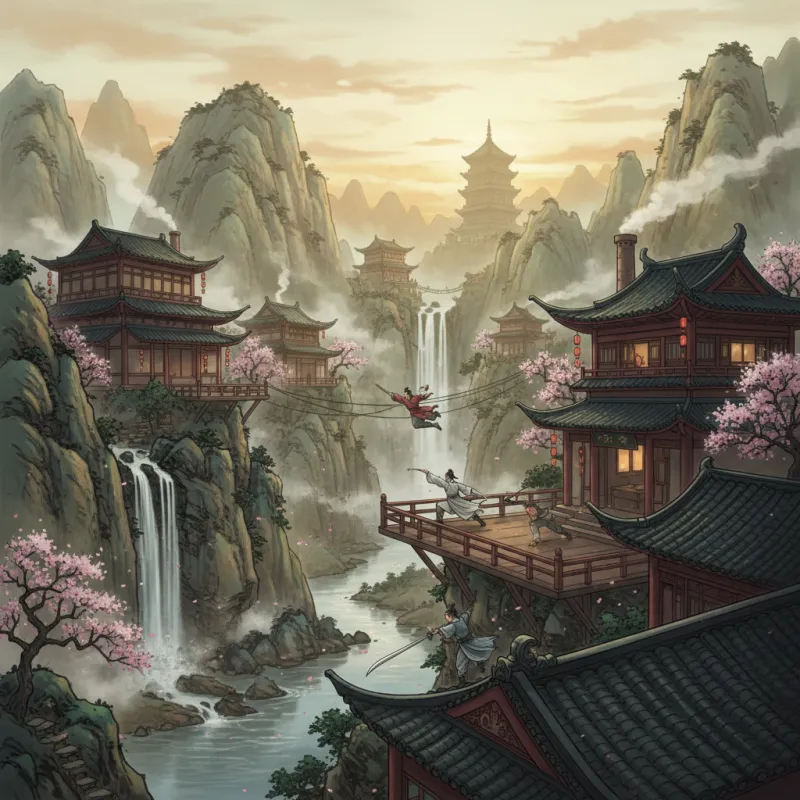
The storyteller's voice cuts through the din of clinking porcelain and hushed conversations. Every head in the tea house turns as he slams his wooden block against the table—pah!—and begins: "Speaking of which, twenty years ago in Luoyang..." This is how legends enter the jianghu (江湖, jiānghú)—not through imperial decrees or monastery scrolls, but through the steam-filled air of a crowded tea house where anyone with two copper coins can hear how the Beggar Clan's chief lost his arm, or why the Huashan Sect split into two factions.
The Architecture of Information
Tea houses in wuxia aren't just atmospheric set dressing—they're the internet of the jianghu, the social media platform where information flows faster than wine. Jin Yong understood this instinctively. In The Legend of the Condor Heroes (射雕英雄传, Shèdiāo Yīngxióng Zhuàn), Guo Jing learns about the upcoming martial arts tournament at a Kalgan tea house, overhearing travelers gossip between sips of jasmine tea. In Demi-Gods and Semi-Devils (天龙八部, Tiānlóng Bābù), the entire first chapter unfolds in a Wuxi tea house where patrons debate the mysterious identity of the "Leading Big Brother" who's been killing off martial artists.
This isn't coincidence—it's structural genius. Tea houses solve a fundamental problem in wuxia storytelling: how do wandering martial artists, who spend most of their time on dusty roads or hidden mountain peaks, learn what's happening in the wider world? The tea house provides the answer. It's where the oral traditions of jianghu collide with the physical reality of travelers needing rest, creating a perfect storm of information exchange.
The Social Hierarchy in a Cup
Walk into any tea house in a Jin Yong or Gu Long novel, and you'll immediately notice the seating arrangement tells you everything about the jianghu's social order. The best seats—near the window on the second floor—go to established masters or wealthy merchants. The ground floor fills with common folk, small-time martial artists, and those hoping to overhear something useful. The truly desperate stand near the entrance, nursing a single cup of the cheapest tea for hours.
But here's what makes tea houses fascinating: this hierarchy is constantly being challenged. A beggar in rags might be the Beggar Clan's chief in disguise. That quiet scholar in the corner could be a retired sword master. The serving girl refilling teapots might be the daughter of a murdered sect leader, gathering intelligence for her revenge. Gu Long particularly loved this trope—in The Eleventh Son (萧十一郎, Xiāo Shíyīláng), crucial plot revelations happen because characters underestimate who's listening in tea houses.
The tea itself matters too. Ordering Longjing (龙井, lóngjǐng, Dragon Well tea) marks you as someone with refined taste and money. Asking for rough brick tea suggests you're a northerner, possibly from beyond the Great Wall. The truly knowledgeable might request specific brewing temperatures or water sources—details that signal to other patrons that you're not just any wanderer, but someone who understands the finer points of culture. It's a form of social signaling as complex as the ranking systems within martial sects.
The Storyteller's Power
The professional storyteller (说书人, shuōshūrén) deserves special attention because they're essentially meta-characters—people within wuxia stories who tell wuxia stories. They're historians, entertainers, and sometimes unwitting intelligence operatives all at once. In The Smiling, Proud Wanderer (笑傲江湖, Xiào'ào Jiānghú), storytellers spread exaggerated tales of Linghu Chong's exploits, which both helps and hinders him as he navigates sect politics.
These storytellers work on tips and repeat business, which creates interesting incentives. They embellish, certainly—a fight between two martial artists becomes a battle between twenty. A minor sect dispute transforms into a blood feud spanning three generations. But they also preserve genuine history. When the orthodox sects want to erase someone from jianghu memory, storytellers keep those names alive. When a technique is lost, sometimes the only record exists in a storyteller's repertoire, passed down through generations of performers.
The storyteller's wooden block (醒木, xǐngmù, "awakening wood") isn't just theatrical—it's a symbol of authority. When that block hits the table, everyone listens. It's the closest thing the jianghu has to a free press, and tea houses are where this press operates.
Neutral Ground and Unwritten Rules
Tea houses function as Switzerland in the constant warfare of jianghu politics. There's an unwritten rule, respected even by the most vicious villains: you don't start fights in tea houses. Oh, tensions run high—hands drift toward sword hilts, internal energy circulates in preparation—but actual violence? Rare. When it does happen, it's a sign that things have gone catastrophically wrong.
This neutrality serves everyone's interests. The Wudang Sect master needs somewhere to rest without worrying about Shaolin ambushes. The demonic cult member wants to gather information without immediately being attacked by righteous sect disciples. Even the government benefits—tea houses are where magistrates' spies listen for hints of rebellion or banditry.
The tea house owner plays a crucial role in maintaining this neutrality. In many wuxia novels, these owners are retired martial artists themselves, powerful enough to enforce the peace if necessary. They're like bartenders in Western saloons, but with the ability to kill you with a flick of their sleeve if you break the rules. Respect the tea house, and you're safe. Start trouble, and you might find yourself ejected through a second-story window.
The Geography of Gossip
Not all tea houses are created equal. Location determines what kind of information flows through them. A tea house in Luoyang, the ancient capital, buzzes with political intrigue and news from the imperial court. One in Chengdu might specialize in information about the Tang Clan and their hidden weapons. A tea house on the Yangtze River serves as a clearinghouse for news traveling between north and south.
Border town tea houses are particularly interesting. In Demi-Gods and Semi-Devils, the Wuxi tea house where the novel opens sits at a cultural crossroads, which is why patrons debate the identity of martial artists from different regions—nobody knows everyone, creating perfect conditions for mystery and mistaken identity. These liminal spaces, neither fully one region nor another, become stages where the full complexity of jianghu politics plays out.
Gu Long often set crucial scenes in run-down tea houses in small towns, places where the desperate and the dangerous congregate. These aren't the refined establishments serving Longjing to wealthy merchants—these are rough places where the tea is bitter, the cups are chipped, and the clientele includes assassins, fugitives, and those with nowhere else to go. The atmosphere is completely different from Jin Yong's often more genteel tea houses, reflecting Gu Long's grittier vision of the jianghu.
The Economics of Eavesdropping
Here's something Western readers might miss: tea houses operate on razor-thin margins, which is why they're perfect for the wandering martial artist. Two copper coins buy you a pot of tea and, more importantly, a seat for several hours. You can nurse that tea, refilling it with hot water multiple times, while listening to everything happening around you. It's the cheapest intelligence gathering operation in the jianghu.
This economic accessibility is crucial to wuxia's democratic spirit. Unlike restaurants or inns, which require real money, tea houses welcome everyone. The poorest beggar and the wealthiest merchant sit in the same establishment (if not at the same tables). This creates opportunities for chance encounters that drive plots forward—the young protagonist overhears the villain's plans, the disguised master recognizes a technique being described, the lost heir learns about their true parentage from a storyteller's tale.
Smart tea house owners understand they're not really in the tea business—they're in the information business. They make their real money from the storytellers' performances, from gambling that happens in back rooms, from serving wine and snacks to patrons who stay for hours. The tea is just the entry fee to a much more complex economy.
Modern Echoes and Timeless Functions
Contemporary wuxia adaptations sometimes struggle with tea houses because modern audiences don't have the same cultural reference points. Coffee shops don't quite work the same way—they're too transient, too focused on individual productivity rather than communal gathering. Internet cafes come closer, but lack the cross-class mixing that makes tea houses narratively rich.
The best modern wuxia understands that tea houses represent something deeper than just a setting—they're about the human need for gathering places where stories are shared and communities form. They're about the tension between public and private information, about how reputations are made and destroyed through gossip and rumor. They're about the democracy of storytelling, where anyone can listen and everyone has opinions.
When you read a wuxia novel and encounter a tea house scene, pay attention. The author isn't just moving pieces around the board—they're tapping into centuries of cultural tradition about how communities share information, how strangers become allies, and how legends begin. That storyteller slamming his wooden block against the table? He's not just entertaining the crowd. He's keeping the jianghu alive, one tale at a time, one cup of tea at a time, in the only place where everyone—heroes and villains, beggars and masters—can sit together and listen.
Related Reading
- The Concept of Face (Mianzi) in the Martial World
- Wulin Alliance: Politics of the Martial World
- Tea Houses and Wine Shops: The Social Hubs of the Martial World
- The Master-Disciple Bond: Wuxia Fiction's Most Sacred Relationship
- The Jianghu Code: Honor Among Martial Artists
- Sun Wukong: The Great Sage Who Challenged Heaven
- Yang Guo: The One-Armed Swordsman
- Best Wuxia TV Dramas: A Streaming Guide for International Viewers
Explore Chinese Culture
- Explore Jin Yong's martial arts novels
- Explore cultivation fiction and immortal heroes
- Explore the real history behind wuxia