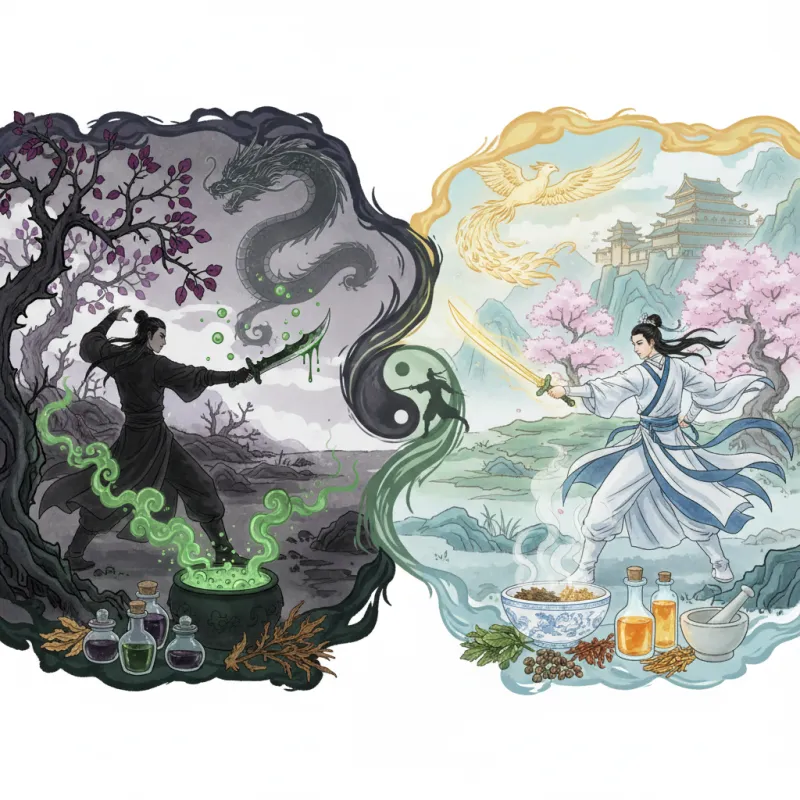
A physician kneels beside a dying swordsman in a mountain temple, grinding herbs with practiced efficiency. The warrior's meridians are blocked, his qi circulation reversed by a palm strike that should have killed him instantly. The physician adds three drops of aconite tincture to the decoction — enough to restart the heart or stop it permanently. His hand doesn't shake. In wuxia fiction, this is not a metaphor. This is Tuesday.
The relationship between poison and medicine in Chinese martial arts literature isn't philosophical window dressing. It's structural DNA. Every major wuxia novel worth reading treats pharmaceutical knowledge as a martial art unto itself — complete with secret techniques, legendary masters, and the understanding that the same substance that saves your sworn brother today might kill your enemy tomorrow. The difference isn't in the herb. It's in the hand that administers it.
The Pharmacological Foundation
Chinese medicine operates on a principle that Western readers often find unsettling: there are no inherently safe substances, only appropriate dosages and contexts. The Shennong Bencao Jing (神农本草经, Shénnóng Běncǎo Jīng), compiled during the Han Dynasty, classifies 365 medicinal substances into three categories — superior, medium, and inferior. But "inferior" doesn't mean useless. It means toxic enough to require expertise. Aconite, arsenic, cinnabar — these aren't villain props. They're legitimate medicines that demand respect and precision.
Wuxia authors didn't invent this ambiguity. They inherited it from a medical tradition that never pretended drugs were benign. Jin Yong's The Deer and the Cauldron features the physician Cheng Guan, who explains that the "Leopard Fetus Tendon Transforming Pill" contains seven poisons that, in combination, produce a net healing effect. Remove one ingredient and you have a murder weapon. This isn't fantasy pharmacology — it's an exaggerated but recognizable version of actual Chinese medical theory, where "fighting poison with poison" (以毒攻毒, yǐ dú gōng dú) is a documented therapeutic strategy.
The genre's most sophisticated poison-medicine practitioners understand something deeper: that toxicity is contextual. What kills a healthy person might cure someone whose internal balance has already been disrupted. The Five Poisons Sect in Gu Long's novels doesn't just use venoms as weapons — they use them as diagnostic tools, introducing controlled toxins to reveal hidden injuries or qi deviations that conventional examination would miss.
The Physician-Assassin Archetype
Wuxia fiction loves a good doctor who could kill you. Not the cackling poisoner type — those are boring. The interesting ones are the physicians who genuinely heal most of the time, who have reputations for saving lives, who maintain the ethical framework of their profession right up until the moment they decide you need to die for reasons that seem, to them, perfectly justified.
Ping Yizhi (平一指, Píng Yīzhǐ) from Jin Yong's Demi-Gods and Semi-Devils embodies this tension perfectly. He's bound by an oath to save one life for every life he takes — a self-imposed karmic accounting system that acknowledges his dual nature without resolving it. He's not conflicted about being both healer and killer. He's just keeping the books balanced. The novel treats this as psychologically coherent rather than contradictory, which tells you something about how wuxia fiction understands expertise: knowledge is power, and power doesn't come with built-in moral alignment.
The physician-assassin isn't a corruption of medical ethics. In the jianghu context, it's an acknowledgment that medical knowledge is martial knowledge. A doctor who understands meridian points well enough to unblock them also understands how to seal them. Someone who knows which herbs restore qi circulation knows which ones disrupt it. The Tangmen poison masters take this to its logical extreme — their entire martial tradition is built on the premise that pharmaceutical expertise is a combat discipline, not a healing art that occasionally gets weaponized.
Poison as Narrative Architecture
Smart wuxia authors use poison the way mystery writers use locked rooms — as a structural device that forces characters into specific types of problem-solving. When Huang Rong is poisoned in The Legend of the Condor Heroes, the plot doesn't just add a ticking clock. It creates a situation where martial prowess becomes irrelevant. Guo Jing can't punch the poison out of her system. He needs knowledge he doesn't have, which means he needs to negotiate, trade, humble himself before people he'd rather fight.
Poison is the great equalizer in wuxia fiction. It doesn't care about your internal energy cultivation or your legendary sword technique. A novice with the right powder can kill a grandmaster, which introduces a permanent element of vulnerability into a genre that loves depicting near-invincible martial artists. The threat of poison means that even the most powerful characters have to think tactically, maintain alliances, and respect expertise outside their own domain.
Gu Long understood this better than most. His novels are full of poisons that can't be cured by finding the right antidote herb — they require understanding the poisoner's intent, their psychological state, the specific grudge that motivated this particular toxin. In The Eleventh Son, the protagonist survives multiple poisoning attempts not by out-fighting his enemies but by out-thinking them, by understanding that poison is communication as much as it is weapon. Every toxin tells a story about who wants you dead and why.
The best poison plots in wuxia fiction aren't about whether the hero will survive — of course they will. They're about what the hero has to sacrifice or compromise to survive. Does finding the antidote require betraying an ally? Does it mean revealing a secret that was supposed to stay buried? Poison creates moral complexity in a genre that could otherwise devolve into endless fight choreography.
The Antidote Economy
Wuxia fiction runs on a barter economy where antidotes are currency. Not metaphorical currency — actual tradeable assets more valuable than gold or martial arts manuals. If you have the only known cure for Thousand Day Drunk poison, you have leverage over anyone who's been exposed to it. This creates an entire shadow economy of pharmaceutical knowledge, where information about antidotes is hoarded, traded, stolen, and killed for.
The Yitian Tulong Ji (倚天屠龙记, The Heaven Sword and Dragon Saber) features the Butterfly Valley Medicine King, who possesses antidotes to poisons that haven't been used in decades. His value to the jianghu isn't his martial arts — it's his pharmaceutical library, his accumulated knowledge of toxins and their counters. Characters who would never bow to a sect leader will humble themselves before him because he controls access to survival itself.
This antidote economy reveals something about how wuxia fiction thinks about knowledge distribution. Medical expertise isn't democratized. It's concentrated in the hands of individuals and sects who guard it jealously, pass it down through closed lineages, and use it as leverage in jianghu politics. The genre doesn't critique this — it accepts it as the natural order of things. Knowledge is power, power creates hierarchy, and hierarchy is how the martial world organizes itself.
But there's a darker implication here too. If antidotes are valuable, then creating demand for antidotes is profitable. Some wuxia villains don't just poison people — they create poison epidemics, spreading toxins that only they can cure, building empires on pharmaceutical dependency. It's a surprisingly modern anxiety dressed up in period costume: the fear that those who control medicine might have incentives to keep you sick.
The Alchemical Tradition
Chinese alchemy (炼丹术, liàndān shù) hovers in the background of wuxia poison-medicine dynamics, providing a pseudo-historical justification for all the impossible pills and elixirs that characters consume. The historical alchemical tradition was genuinely trying to create immortality drugs, and it genuinely killed a lot of people in the process — including several emperors who died from mercury and lead poisoning while pursuing eternal life.
Wuxia fiction inherits this alchemical ambition and its catastrophic failure rate. The genre is full of legendary pills that grant immense power at terrible cost, elixirs that extend life while destroying something essential about the person who takes them. Jin Yong's The Smiling, Proud Wanderer features the Three Corpse Brain Pill, which grants the Demon Sect control over its members by requiring regular antidotes. It's alchemy as social control — the pharmaceutical embodiment of organizational loyalty.
The alchemical tradition also explains why wuxia physicians are often hermits living in remote valleys or mountain caves. Historical alchemists withdrew from society to pursue their experiments, and wuxia fiction preserves this geography of expertise. The greatest medical knowledge exists at the margins of civilization, guarded by eccentrics who may or may not help you depending on their mood, your manners, and whether they find your problem intellectually interesting.
This creates a recurring narrative pattern: the desperate journey to find the reclusive physician, the tests and trials required to gain their assistance, the revelation that the cure might be worse than the disease. It's a quest structure borrowed from fairy tales, but grounded in the historical reality that advanced medical knowledge in pre-modern China really was geographically concentrated and socially gatekept.
The Moral Neutrality of Expertise
What makes wuxia's treatment of poison and medicine genuinely interesting is its refusal to moralize expertise itself. The genre doesn't pretend that medical knowledge makes you good or that using poison makes you evil. It treats pharmaceutical expertise as a tool set — powerful, dangerous, and morally neutral until someone picks it up and decides what to do with it.
This stands in sharp contrast to how Western fantasy often handles similar themes. In Western narratives, healing magic is usually coded as good and poison as evil, with clear moral boundaries between the two. Wuxia fiction rejects this binary. The same character might poison an enemy in the morning and heal a stranger in the afternoon, and the narrative doesn't treat this as hypocrisy. It treats it as competence applied to different situations with different ethical requirements.
The jianghu moral code doesn't forbid poison. It forbids using poison dishonorably — which is a very different prohibition. Poisoning someone in open combat after declaring your intent? Acceptable. Poisoning someone's tea while pretending to be their friend? Dishonorable. The ethics aren't about the substance. They're about the context of use, the relationship between poisoner and victim, the transparency of intent.
This moral framework produces characters who are genuinely difficult to categorize. Is the physician who poisons a tyrant a murderer or a hero? Is the martial artist who uses antidotes as leverage a savior or an extortionist? Wuxia fiction doesn't answer these questions definitively. It presents them as genuinely complicated, acknowledging that expertise creates moral complexity rather than moral clarity.
The genre's most memorable poison-medicine practitioners are the ones who understand this ambiguity and inhabit it fully — who don't apologize for their knowledge or pretend it's inherently virtuous, who recognize that the same skills that make them valuable also make them dangerous, and who accept that this is simply the nature of expertise in a world where knowledge is power and power is always double-edged.
Related Reading
- Wulin Alliance: Politics of the Martial World
- The Enigma of Jianghu: Discovering the Roots of Chinese Wuxia Literature
- The Jianghu Code: Honor Among Martial Artists
- Wuxia Culture: How Martial Arts Fiction Shaped Modern Chinese Society
- Tea Houses and Wine Shops: The Social Hubs of the Martial World
- Hidden Weapons: The Dark Arts of Wuxia Combat
- External vs. Internal Martial Arts: The Great Divide in Wuxia
- Mountain and Water Poetry (山水诗): When Landscape Becomes Literature
Explore Chinese Culture
- Explore Jin Yong's martial arts novels
- Explore cultivation fiction and immortal heroes
- Explore the real history behind wuxia