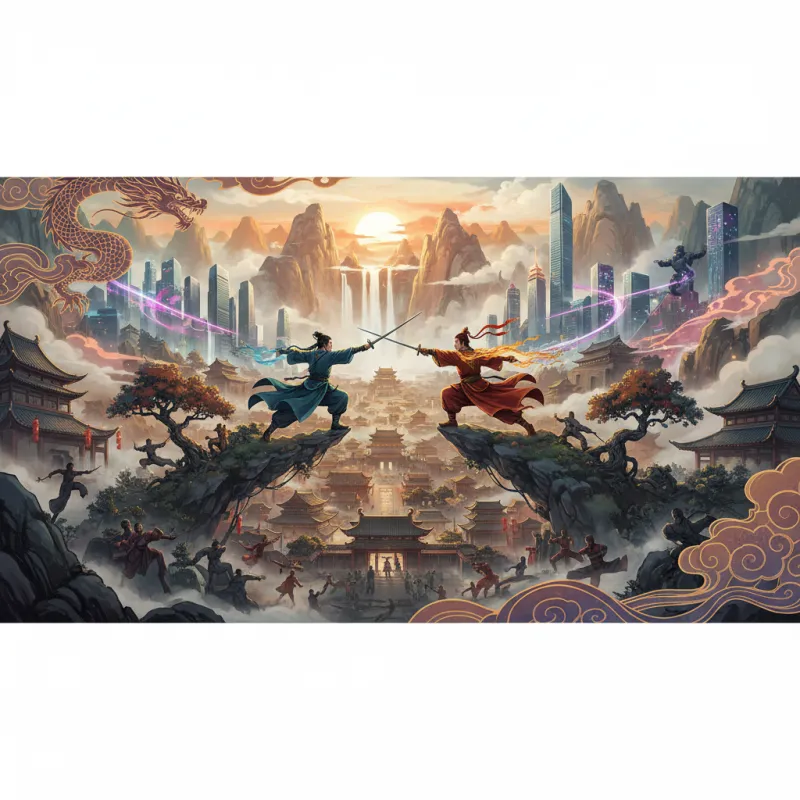
A programmer at Alibaba describes his team as a "sect" (门派 ménpài). A startup founder talks about finding her "shifu" (师父 shīfu) — her mentor. Two rival companies engage in what business journalists call a "jianghu war" (江湖大战 jiānghú dàzhàn). These aren't just colorful metaphors borrowed from old novels. They represent something deeper: wuxia fiction has fundamentally rewired how modern Chinese society thinks about power, loyalty, and human relationships.
The Jianghu Mindset in Corporate China
The martial world (江湖 jiānghú) — that lawless realm of wandering heroes and hidden masters from Jin Yong and Gu Long novels — has become the dominant framework for understanding modern Chinese business. When Tencent and Alibaba compete for market dominance, Chinese media doesn't just report on corporate rivalry. They frame it as a clash between two great sects, complete with alliances, betrayals, and shifting loyalties that would feel at home in The Legend of the Condor Heroes.
This isn't superficial language. The jianghu framework shapes actual business behavior. Chinese companies organize themselves around loyalty networks that mirror the master-disciple relationships in wuxia fiction. Employees don't just work for a company — they follow a particular leader, their "shifu," and that personal loyalty often matters more than institutional allegiance. When a senior executive leaves to start a new venture, entire teams follow, just as disciples would follow their master to establish a new sect. Western business analysts often misread these moves as simple poaching or corporate espionage, missing the deeper cultural logic at play.
The concept of "face" (面子 miànzi) in Chinese business negotiations also draws heavily from wuxia traditions. In Jin Yong's novels, martial artists rarely fight to the death in their first encounter. They exchange moves, test each other's skills, and establish relative standing before deciding whether to become friends or enemies. Modern Chinese business negotiations follow remarkably similar patterns — the initial meetings aren't really about terms and conditions, they're about establishing mutual respect and relative position in the social hierarchy.
Social Media as the New Jianghu
Chinese internet culture is incomprehensible without understanding wuxia. When users on Weibo or Zhihu describe online communities, they instinctively reach for martial world terminology. Popular forums become "sects," influential users are "masters" (大侠 dàxiá), and online conflicts are "jianghu disputes" (江湖恩怨 jiānghú ēnyuàn). This isn't just playful language — it reflects a genuine conceptual framework.
Consider how Chinese netizens handle online conflicts. The wuxia concept of "settling grudges" (了结恩怨 liǎojié ēnyuàn) shapes everything from how people argue in comment sections to how influencers resolve public disputes. There's an expectation that conflicts should be resolved through direct confrontation between the principals, not through institutional mechanisms. When two popular bloggers have a falling out, their followers expect them to "fight it out" publicly, state their grievances clearly, and reach some form of resolution — exactly as martial artists would in a wuxia novel.
The idea of "hidden masters" (隐世高人 yǐnshì gāorén) from wuxia has created a persistent belief in Chinese internet culture that the most skilled and knowledgeable people are lurking anonymously in forums, occasionally emerging to share profound insights before disappearing again. This belief shapes how Chinese users interact with anonymous content in ways that differ markedly from Western internet culture, where anonymity is often associated with trolling rather than hidden wisdom.
Education and the Cultivation Metaphor
Perhaps nowhere is wuxia's influence more profound than in how Chinese parents and educators think about learning and self-improvement. The martial arts concept of "cultivation" (修炼 xiūliàn) has become the dominant metaphor for education, completely overshadowing Western ideas about innate talent or natural ability.
In wuxia novels, heroes don't succeed because they're born special — they succeed through dedicated practice, often under harsh conditions, guided by a master who knows the correct path. This framework has shaped Chinese educational philosophy in ways that Western observers often misunderstand. When Chinese parents push their children to practice piano for hours daily or attend weekend cram schools, they're not being cruel or obsessive by their own cultural logic. They're helping their children "cultivate" skills, following the same logic that led Yang Guo to practice swordsmanship under the waterfall in The Return of the Condor Heroes.
The wuxia concept of "internal strength" (内功 nèigōng) versus "external techniques" (外功 wàigōng) has also influenced Chinese thinking about education. There's a widespread belief that true mastery requires building strong foundations — internal strength — before learning flashy techniques. This explains why Chinese math education focuses so heavily on repetitive practice and memorization before moving to creative problem-solving, an approach that often puzzles Western educators but makes perfect sense within the wuxia cultivation framework.
The Dark Side: Hierarchy and Conformity
Wuxia's influence isn't entirely positive. The genre's emphasis on master-disciple relationships and sect loyalty has reinforced hierarchical thinking in ways that can stifle innovation and independent thought. In traditional wuxia novels, disciples who question their masters or leave their sects are often portrayed as traitors. This narrative has real consequences in modern Chinese institutions.
Chinese academia, for instance, operates on a master-disciple model that would be immediately recognizable to any wuxia reader. Graduate students are expected to show absolute loyalty to their advisors, often working on their advisor's projects rather than pursuing independent research. Challenging your advisor's ideas or switching to work with another professor is seen as a profound betrayal, not as intellectual independence. This system produces tight-knit research groups but can also suppress innovative thinking and create toxic power dynamics.
The wuxia emphasis on sect loyalty over universal principles has also shaped how Chinese people think about ethics and morality. In Jin Yong's novels, characters routinely commit morally questionable acts out of loyalty to their masters or sects, and these acts are often portrayed sympathetically. This framework can make it difficult to establish universal ethical standards that transcend personal relationships — a challenge that manifests in everything from business ethics to academic integrity.
Wuxia and Chinese Soft Power
The Chinese government has recognized wuxia's cultural power and increasingly deploys it as a tool of soft power. But there's a tension here. The jianghu of classic wuxia novels is fundamentally anti-authoritarian — it's a realm where state power is absent or corrupt, and justice comes from individual heroes, not institutions. The wandering swordsman (游侠 yóuxiá) tradition celebrates people who operate outside official structures, following their own moral code.
Modern Chinese authorities want to harness wuxia's cultural appeal while neutering its anti-authoritarian elements. Recent state-approved wuxia productions increasingly emphasize patriotism and service to the nation, a significant departure from the genre's roots. When Jin Yong wrote The Deer and the Cauldron in the 1960s, his protagonist Wei Xiaobao was a morally ambiguous trickster who served the Qing emperor while secretly supporting the anti-Qing resistance. It's hard to imagine such a politically complex character appearing in a contemporary Chinese wuxia production.
This tension between wuxia's rebellious spirit and state control plays out in interesting ways. Chinese youth still romanticize the jianghu as a space of freedom and personal loyalty, even as they live in an increasingly surveilled and controlled society. The martial world offers an imaginative escape valve, a cultural space where individual agency and personal relationships still matter more than institutional power. Whether this makes wuxia a form of resistance or a harmless fantasy that prevents real resistance is an open question.
The Global Spread of Wuxia Logic
As Chinese cultural influence expands globally, wuxia frameworks are beginning to shape how non-Chinese people think about certain domains. The explosion of Chinese web novels in translation has introduced millions of English-speaking readers to cultivation systems, sect hierarchies, and jianghu logic. These readers are absorbing not just entertaining stories but an entire framework for thinking about power, relationships, and self-improvement.
The influence is particularly visible in gaming culture. Chinese mobile games and MMORPGs have introduced global audiences to sect-based social organization, master-disciple progression systems, and cultivation mechanics. Players who've never read a wuxia novel now instinctively understand concepts like "breaking through to the next realm" or "consolidating your foundation" — ideas that come directly from martial arts fiction.
This cultural export is more subtle but potentially more profound than the spread of Chinese political or economic models. Wuxia provides a complete alternative framework for thinking about human relationships and social organization, one that emphasizes personal loyalty over institutional rules, cultivation over innate talent, and informal hierarchies over formal structures. As this framework spreads, it may reshape how people around the world think about everything from education to business to online communities.
Living in the Martial World
The deepest truth about wuxia's influence on modern Chinese society is this: most Chinese people don't think of it as influence at all. The jianghu isn't a metaphor they consciously apply — it's simply how the world works. When a Chinese entrepreneur talks about finding a mentor, she's not thinking "this is like a wuxia novel." She's just describing reality as she understands it.
This is what makes wuxia's cultural impact so profound and so difficult for outsiders to grasp. It's not that Chinese people are obsessed with martial arts fiction. It's that martial arts fiction has provided the conceptual vocabulary through which several generations of Chinese people understand loyalty, hierarchy, conflict, and self-improvement. The martial world isn't a fantasy realm separate from modern life — it's the lens through which modern life is perceived and understood.
For anyone trying to understand contemporary Chinese society, whether for business, diplomacy, or simple curiosity, grasping wuxia's influence isn't optional. You can't understand why Chinese companies organize the way they do, why Chinese internet culture functions as it does, or why Chinese parents approach education the way they do without understanding the jianghu framework that underlies all of it. The martial world is real, not because people believe in flying swordsmen, but because the social logic of wuxia has become the social logic of modern China itself.
Related Reading
- Tea Houses in Wuxia: Where Stories Begin
- The Enigma of Jianghu: Discovering the Roots of Chinese Wuxia Literature
- Tea Houses and Wine Shops: The Social Hubs of the Martial World
- The Master-Disciple Bond: Wuxia Fiction's Most Sacred Relationship
- The Jianghu Code: Honor Among Martial Artists
- Wudang Sword Techniques: The Art of Taoist Swordsmanship
- The Concealed Weapon Arsenal: Every Hidden Weapon in the Jianghu
- Animal Spirits and the Path to Becoming Yaoguai
Explore Chinese Culture
- Explore Jin Yong's martial arts novels
- Explore cultivation fiction and immortal heroes
- Explore the real history behind wuxia