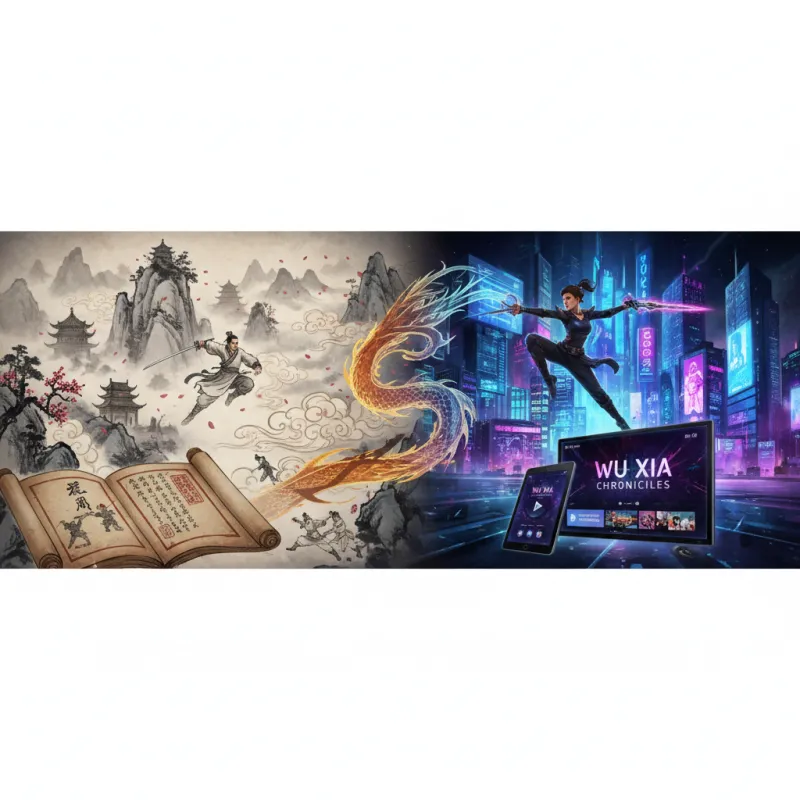
When Crouching Tiger, Hidden Dragon swept into American theaters in 2000, Western audiences gasped at warriors gliding across bamboo forests and dueling on rooftops. Chinese viewers had a different reaction: "Finally." They'd been watching this for decades. What seemed revolutionary to the West was simply wuxia (武侠, wǔxiá) — a genre as fundamental to Chinese culture as westerns are to America, now exploding across global streaming platforms, video games, and international bestseller lists in ways that would have seemed impossible just twenty years ago.
The Hong Kong Cinema Revolution
The transformation of wuxia from page to screen didn't happen in mainland China. It happened in Hong Kong, in the cramped studios of Shaw Brothers and Golden Harvest, where directors like King Hu and Chang Cheh were inventing a visual language for martial arts fantasy in the 1960s and 70s.
King Hu's A Touch of Zen (1971) proved wuxia could be art cinema. His bamboo forest battle sequence — with warriors leaping between stalks, their movements creating rhythmic patterns of light and shadow — influenced everyone from Ang Lee to the Wachowskis. But it was Chang Cheh who made wuxia visceral and masculine, replacing the genre's traditional emphasis on righteous heroes with tragic antiheroes who bled real blood. His One-Armed Swordsman (1967) became the first Hong Kong film to gross over HK$1 million, proving that wuxia could be commercially dominant.
Then came the 1990s and the wire work revolution. Tsui Hark's Once Upon a Time in China series turned Wong Fei-hung into a conflicted hero navigating China's collision with Western imperialism. Jet Li's portrayal balanced spectacular martial arts with genuine dramatic weight. Meanwhile, Ching Siu-tung's choreography in films like Swordsman II pushed wire work to operatic extremes — warriors didn't just fight, they danced through the air in sequences that defied physics entirely.
The Hong Kong approach to wuxia combat emphasized spectacle over realism, emotion over technique. This wasn't about authentic martial arts; it was about translating the impossible feats described in novels into visual poetry.
Crouching Tiger's Global Breakthrough
Ang Lee's Crouching Tiger, Hidden Dragon didn't just succeed internationally — it redefined what wuxia could be. With a $128 million worldwide gross and four Academy Awards, it proved that subtitled martial arts fantasy could dominate Western markets.
Lee understood something crucial: wuxia works globally because its core themes are universal. Duty versus desire. Master versus student. The burden of skill and reputation. Yu Shu Lien's restrained longing and Jen's rebellious hunger for freedom resonated across cultures because they're fundamentally human conflicts, just dressed in silk robes and expressed through sword fights.
The film also benefited from perfect timing. The Matrix had primed Western audiences for wire-fu aesthetics just a year earlier. Yuen Woo-ping choreographed both films, creating a visual bridge between Hong Kong tradition and Hollywood spectacle. Suddenly, American teenagers who'd never heard of Jin Yong were arguing about whether Zhang Ziyi's character was justified in her choices.
But Crouching Tiger's success created a problem: Hollywood kept trying to replicate it without understanding it. Zhang Yimou's Hero (2002) and House of Flying Daggers (2004) were visually stunning but emotionally hollow — all spectacle, no soul. They treated wuxia as exotic aesthetic rather than narrative tradition with its own rules and rhythms.
The Television Long Game
While Hollywood fumbled with wuxia films, Chinese television was quietly building something more sustainable: serialized adaptations that could match the scope of the source novels.
The 2003 adaptation of Demi-Gods and Semi-Devils ran 40 episodes. The 2017 version of The Legend of the Condor Heroes stretched to 52. This length isn't padding — it's necessary. Jin Yong's novels are sprawling epics with dozens of characters, complex political intrigue, and martial arts philosophies that require time to develop. A two-hour film can capture a wuxia story's action, but only a long-form series can capture its soul.
Chinese streaming platforms like iQiyi and Tencent Video have invested billions in wuxia content, producing series with film-quality production values. The Untamed (2019), adapted from a web novel, became a global phenomenon with over 7 billion views. Its success came from understanding that modern audiences want the traditional wuxia framework — righteous sects versus demonic cults, sworn brotherhood, martial arts cultivation — but with contemporary sensibilities about character complexity and moral ambiguity.
The series also demonstrated wuxia's adaptability. By centering a deep friendship between two male leads (with heavy subtext that delighted international fans), it found new audiences while maintaining core genre elements. The jianghu (江湖, jiānghú) — the martial arts world — proved flexible enough to accommodate evolving social values.
Netflix and the Streaming Wars
When Netflix began investing in Asian content, wuxia was inevitable. The platform's algorithm had already identified a global appetite for martial arts fantasy through viewing patterns of Hong Kong classics and anime. But Netflix's approach has been scattershot.
The Yin-Yang Master (2021) tried to blend wuxia with fantasy elements, resulting in a visually impressive but narratively confused film. Sword of Destiny (2016), a Crouching Tiger sequel, felt like a corporate product rather than an artistic vision. These failures share a common problem: they treat wuxia as a collection of aesthetic elements rather than a coherent narrative tradition.
More successful have been Korean adaptations that understand the genre's core appeal. Kingdom isn't technically wuxia — it's zombie horror — but it borrows the genre's emphasis on honor, hierarchy, and spectacular combat choreography. The result feels more authentically wuxia in spirit than many Chinese productions that have all the surface elements but lack the thematic depth.
The real streaming success story is donghua — Chinese animation. Series like Mo Dao Zu Shi and Heaven Official's Blessing have found massive international audiences by embracing wuxia's fantastical elements without the constraints of live-action budgets. Animation allows for the kind of impossible martial arts and magical abilities that define xianxia (仙侠, xiānxiá), wuxia's more supernatural cousin. When a character can level mountains with sword energy, animation is simply the better medium.
Gaming: The Interactive Jianghu
Video games might be wuxia's most natural modern form. The genre has always been about progression — learning new techniques, mastering martial arts, growing in power. That's literally the structure of an RPG.
Chinese developers understood this early. Sword and Fairy (1995) adapted wuxia and xianxia tropes into a turn-based RPG that spawned a franchise still running today. But it was Sucker Punch's Ghost of Tsushima (2020) — made by an American studio about Japanese samurai — that showed Western developers how to translate martial arts fantasy into compelling gameplay.
The irony isn't lost on Chinese gamers. Here was a Western studio creating the kind of immersive, beautiful martial arts experience that Chinese developers had struggled to achieve with international audiences. Ghost of Tsushima's success came from respecting its source material while making it accessible, something wuxia adaptations often fail to balance.
More recently, Black Myth: Wukong has generated massive anticipation by combining Chinese mythology with AAA production values. While not strictly wuxia — it's based on Journey to the West — it demonstrates growing confidence in Chinese studios to create globally competitive games rooted in their own cultural traditions.
The real innovation is in mobile gaming. Games like Justice Online and Moonlight Blade offer massive multiplayer wuxia experiences where players join martial arts sects, learn techniques, and navigate jianghu politics. These games generate billions in revenue, primarily from Chinese audiences, proving that wuxia doesn't need Western validation to be commercially successful.
Web Fiction and the Democratization of Wuxia
The most significant development in modern wuxia isn't happening on screens — it's happening in web browsers. Platforms like Qidian and Webnovel host thousands of serialized wuxia and xianxia novels, many running millions of words, written by authors who bypass traditional publishing entirely.
This has transformed wuxia from a genre defined by masters like Jin Yong and Gu Long into something more democratic and experimental. Authors can test ideas in real-time, responding to reader feedback, building communities around their work. The result is explosive creativity and, admittedly, a lot of mediocrity.
But the best web novels are pushing wuxia in fascinating directions. They're more willing to deconstruct genre tropes, question traditional hierarchies, and experiment with narrative structure. Some incorporate game mechanics explicitly, creating "LitRPG" hybrids where characters literally level up and gain stats. Others blend wuxia with science fiction, creating stories where martial artists cultivate qi in space stations.
This democratization has also made wuxia more accessible internationally. Fan translations of popular web novels have created global communities of readers who discuss the finer points of cultivation systems and debate character choices across language barriers. When a novel like Coiling Dragon or I Shall Seal the Heavens gains millions of international readers, it's not through official channels — it's through passionate fans who translate chapters for free because they love the stories.
The Cultural Export Challenge
Despite all this success, wuxia faces a fundamental challenge in global markets: cultural specificity. The genre is deeply rooted in Chinese concepts of honor, filial piety, master-student relationships, and Confucian social hierarchy. These aren't universal values — they're culturally specific frameworks that don't always translate.
When Western audiences watch wuxia, they often miss crucial context. Why is a character's decision to betray their master so devastating? Because the master-student relationship in Chinese culture carries weight that Western individualism doesn't recognize. Why do characters spend so much time discussing righteousness and orthodoxy? Because these concepts have specific meanings in Chinese philosophy that don't map neatly onto Western ethics.
The most successful international wuxia adaptations either simplify these elements or find ways to make them accessible without condescension. Crouching Tiger worked because Ang Lee focused on universal emotions while maintaining cultural authenticity. The Untamed succeeded because it let international fans discover the cultural context through community discussion and fan-created guides.
What Comes Next
Wuxia's future is probably not in trying to replicate Crouching Tiger's crossover success. It's in recognizing that the genre can sustain multiple markets simultaneously — massive domestic audiences in China, dedicated international fanbases, and occasional mainstream breakthroughs.
The next generation of wuxia creators are growing up with global perspectives. They've watched Hollywood blockbusters and Korean dramas alongside Hong Kong classics. They're comfortable blending influences while maintaining genre identity. This might produce wuxia that's less "pure" by traditionalist standards, but more vital and adaptable.
Technology will play a role too. Virtual reality could finally deliver the immersive jianghu experience that fans have imagined since reading their first Jin Yong novel. AI-assisted translation might make web novels accessible in real-time across languages. Streaming platforms' global reach means a wuxia series can find its audience anywhere in the world.
But the core appeal remains unchanged: wuxia offers escape into a world where skill and honor matter, where personal cultivation leads to extraordinary abilities, where conflicts are resolved through spectacular combat, and where the wandering hero can find their place in the jianghu. That fantasy has sustained the genre for eighty years. It will sustain it for eighty more.
The question isn't whether wuxia will remain relevant in modern culture. It's how many new forms it will take, how many new audiences it will find, and how it will continue evolving while staying true to the traditions that made it powerful in the first place. From Jin Yong's newspaper serials to Netflix series, from Shaw Brothers films to mobile games, wuxia has proven endlessly adaptable. The next chapter is just beginning.
Related Reading
- Tea Houses and Wine Shops: The Social Hubs of the Martial World
- The Concept of Face (Mianzi) in the Martial World
- The Enigma of Jianghu: Discovering the Roots of Chinese Wuxia Literature
- Poison and Medicine in Wuxia: Two Sides of the Same Coin
- The Code of Jianghu: Unwritten Rules of the Martial World
- The Real History Behind Wuxia Fiction
- Poison Needles and Flying Daggers: Hidden Weapons in Wuxia Combat
- The Hetu and Luoshu: Magical Diagrams from the Rivers
Explore Chinese Culture
- Explore Jin Yong's martial arts novels
- Explore cultivation fiction and immortal heroes
- Explore the real history behind wuxia