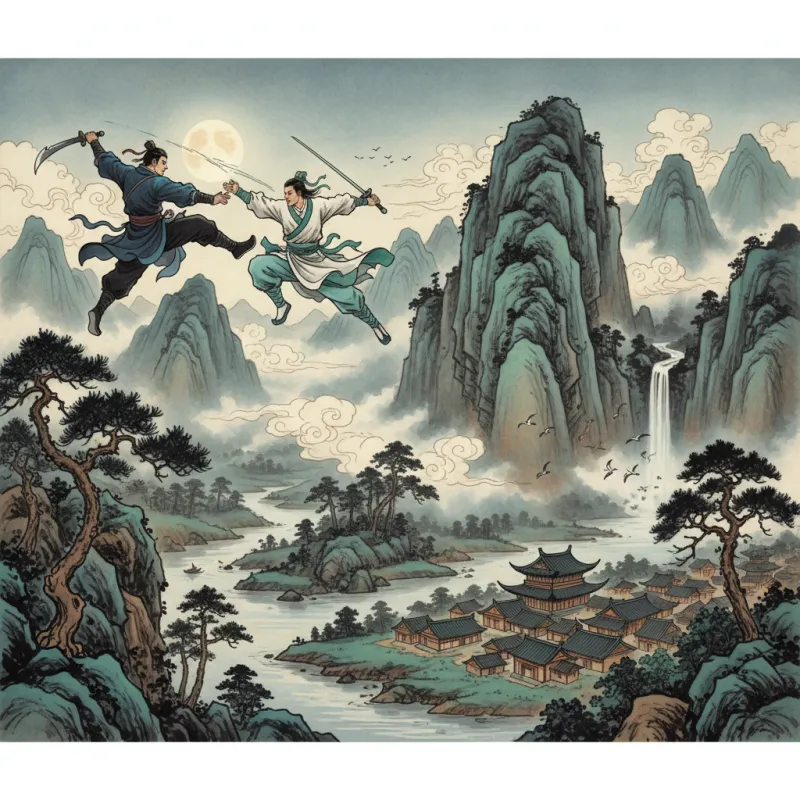
A swordsman stands at the edge of a cliff, his white robes whipping in the mountain wind. Below him, the jianghu (江湖, jiānghú) — literally "rivers and lakes" — stretches endlessly: a shadow world where imperial law holds no sway, where reputation is currency, and where a single duel can reshape the balance of power across a dozen provinces. This is not history as scholars record it, but history as the Chinese imagination has dreamed it for over a thousand years.
The Jianghu: A World Beyond the Emperor's Reach
The jianghu exists in the cracks of civilization. While Confucian bureaucrats administered the empire from their yamen offices, wuxia literature conjured an alternate society governed by different rules entirely. The term itself first appeared in the Zhuangzi (莊子, Zhuāngzǐ), the Daoist philosophical text from the 4th century BCE, where it described the freedom of fish swimming in rivers and lakes — a metaphor for living outside conventional society's constraints.
By the Tang Dynasty (618-907 CE), this concept had evolved into something more concrete: a semi-mythical underworld populated by martial artists, assassins, courtesans, merchants, and wandering heroes. These figures operated in the margins, bound not by imperial edicts but by the code of wulin (武林, wǔlín) — the martial forest, another evocative term for the martial arts community. Here, debts were settled with swords, alliances forged over wine, and a person's word carried more weight than any government contract.
From Tang Legends to Ming Novels: The Literary Evolution
The earliest wuxia narratives weren't novels at all. They were chuanqi (傳奇, chuánqí) — "tales of the strange" — short stories that circulated during the Tang Dynasty. Pei Xing's "The Kunlun Slave" told of a foreign warrior with superhuman abilities. Du Guangting's "The Curly-Bearded Warrior" featured a mysterious hero who could have seized the throne but chose instead to sail away to foreign lands. These stories established templates that would echo through the centuries: the wandering master, the hidden identity, the martial skill that transcends normal human limits.
But wuxia truly crystallized as a genre during the Ming Dynasty (1368-1644). Water Margin (水滸傳, Shuǐhǔ Zhuàn), attributed to Shi Nai'an, gave readers 108 outlaws, each with distinct personalities and fighting styles, banding together at Mount Liang. This wasn't just adventure fiction — it was social commentary, showing how good people could be driven outside the law by corrupt officials. The novel's influence on later wuxia cannot be overstated; nearly every trope of the genre appears here in embryonic form.
The Qing Dynasty (1644-1912) added another layer with novels like The Seven Heroes and Five Gallants (七俠五義, Qīxiá Wǔyì), which introduced the concept of xiake (俠客, xiákè) — knight-errants who righted wrongs and protected the innocent. These weren't rebels like the Water Margin bandits, but righteous heroes working within (or at least not directly against) the social order. The tension between rebellion and righteousness would become one of wuxia's defining contradictions.
The Republican Era: When Wuxia Became Mass Entertainment
Everything changed in the early 20th century. As the Qing Dynasty collapsed and China lurched into modernity, wuxia fiction exploded in popularity through a new medium: serialized novels in newspapers and pulp magazines. Xiang Kairan (pen name: Pingjiang Buxiaosheng) published The Peculiar Knights-Errant of the Jianghu (江湖奇俠傳, Jiānghú Qíxiá Zhuàn) in 1923, and suddenly martial artists could fly, project energy from their palms, and battle for hundreds of rounds without tiring.
This was xuanhuan (玄幻, xuánhuàn) — the mystical fantasy element — cranked up to eleven. Critics at the time dismissed these stories as superstitious nonsense, but readers devoured them. The genre spoke to something deep in the Chinese psyche: a longing for individual agency in a time of national humiliation, for a world where personal virtue and martial skill mattered more than foreign gunboats and unequal treaties.
The most influential writer of this era was arguably Huanzhulouzhu (還珠樓主, Huánzhū Lóuzhǔ), whose Legend of the Swordsmen of the Mountains of Shu (蜀山劍俠傳, Shǔshān Jiànxiá Zhuàn) ran to 50 volumes and featured Daoist immortals, flying swords, and cosmic battles. His baroque imagination influenced everyone from Jin Yong to contemporary Chinese fantasy writers. The evolution of martial arts sects owes much to his elaborate hierarchies of cultivation and power.
Jin Yong and the Golden Age
Then came Jin Yong (金庸, Jīn Yōng), pen name of Louis Cha, who between 1955 and 1972 wrote fifteen novels that redefined the genre. Jin Yong brought literary sophistication to wuxia, weaving in historical events, philosophical depth, and psychologically complex characters. His heroes weren't perfect — Guo Jing was loyal but slow-witted, Yang Guo was brilliant but arrogant, Wei Xiaobao was a scoundrel who somehow embodied certain Chinese survival virtues.
The Legend of the Condor Heroes (射鵰英雄傳, Shèdiāo Yīngxióng Zhuàn) unfolded against the backdrop of the Song-Jin wars. The Deer and the Cauldron (鹿鼎記, Lùdǐng Jì) satirized the early Qing Dynasty while questioning the very foundations of the wuxia hero myth. Jin Yong understood that the jianghu was never just about martial arts — it was about Chinese identity, about how individuals navigate between personal loyalty and national duty, between tradition and change.
His contemporary Gu Long (古龍, Gǔ Lóng) took a different approach, writing spare, almost noir-ish tales focused on atmosphere and psychology rather than elaborate fight choreography. Where Jin Yong gave you sweeping historical epics, Gu Long gave you existential loners drinking in shabby inns, contemplating the emptiness of revenge. Together, they established the two poles of modern wuxia.
The Philosophy Beneath the Swordplay
What makes wuxia endure isn't the acrobatics or the magic — it's the moral universe it constructs. The concept of xia (俠, xiá) — often translated as "chivalry" or "knight-errantry" — carries specific Confucian and Daoist connotations. A true xiake uses martial skill (wu, 武, wǔ) in service of righteousness (yi, 義, yì). They protect the weak, honor their word, repay debts of gratitude, and avenge wrongs.
But wuxia literature constantly interrogates these ideals. What happens when righteousness conflicts with loyalty? When your master orders you to do something unjust? When the person you must kill to avenge your family is actually innocent? The best wuxia novels are moral laboratories, testing Confucian ethics against the messy realities of human nature.
The jianghu itself embodies a Daoist counterpoint to Confucian order. It's a space of freedom and danger, where social hierarchies can be overturned, where a beggar might be a master in disguise, where the legendary weapons matter more than official seals. This tension between structure and freedom, between the court and the rivers-and-lakes, gives wuxia its perpetual dynamism.
The Jianghu Today: From Page to Screen to Game
Modern wuxia has exploded across media. Zhang Yimou's Hero and Ang Lee's Crouching Tiger, Hidden Dragon brought the genre to global audiences, though purists argue they sacrificed narrative complexity for visual spectacle. Television adaptations of Jin Yong's novels have been remade dozens of times, each generation reimagining the jianghu for contemporary sensibilities.
Video games like Sword and Fairy and Gujian Qitan let players inhabit the jianghu, making choices that shape their martial path. Web novels have created new subgenres — xianxia (仙俠, xiānxiá) adds Daoist cultivation, xuanhuan goes full fantasy, wuxia itself has splintered into countless variations. The jianghu has become a shared imaginative space, constantly being rewritten and reinterpreted.
Yet something essential remains constant: the dream of a world where individual virtue and skill matter, where you can wander freely, where bonds of loyalty transcend law and blood, where a sword and a code of honor are enough. In an increasingly bureaucratized, surveilled, and regulated world, the jianghu offers an escape into meaningful freedom — even if that freedom is, and always has been, imaginary.
The rivers and lakes still call to us, just as they called to readers a thousand years ago. The jianghu endures because it speaks to something fundamental in the human spirit: the desire to live by our own code, to test ourselves against worthy opponents, to find meaning in a world that often seems meaningless. As long as people dream of such things, wuxia literature will continue to flourish, and the jianghu will remain eternal.
Related Reading
- Tea, Wine, and Food: The Culinary Culture of Wuxia
- Wuxia Culture: How Martial Arts Fiction Shaped Modern Chinese Society
- Wuxia in Modern Culture: From Novels to Netflix
- The Code of Jianghu: Unwritten Rules of the Martial World
- The Jianghu Code: Honor Among Martial Artists
- Chinese Horror Novels That Will Keep You Up at Night
- Shaolin vs Wudang: The Rivalry That Shaped Chinese Martial Arts
- Exploring Chinese Martial Arts Fiction and the Mythical Jianghu Culture
Explore Chinese Culture
- Explore Jin Yong's martial arts novels
- Explore cultivation fiction and immortal heroes
- Explore the real history behind wuxia