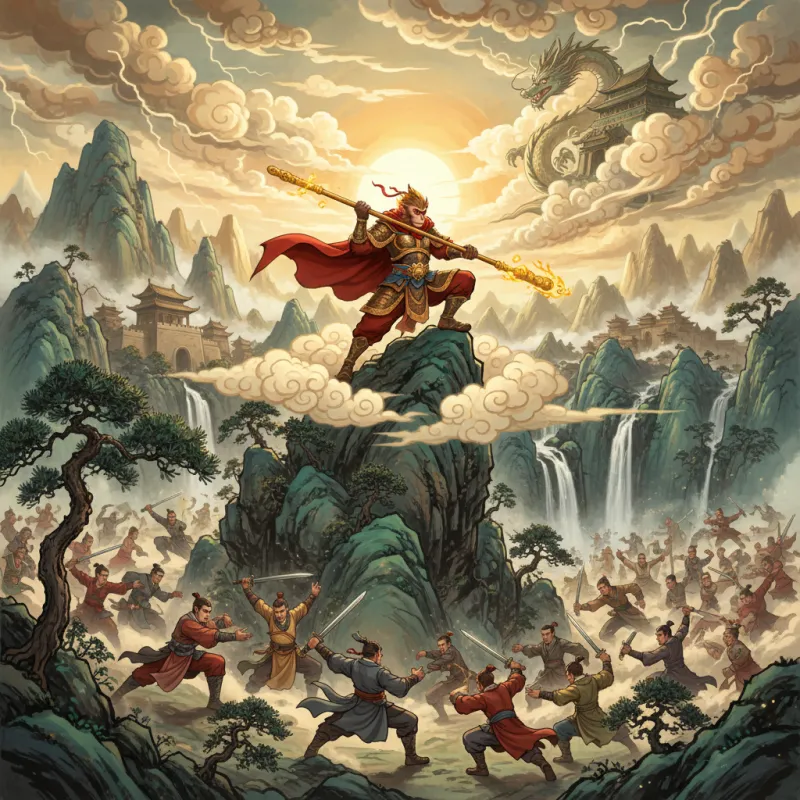
The Jade Emperor's throne room fell silent when the monkey walked in. Not because he announced himself—Sun Wukong (孙悟空 Sūn Wùkōng) never bothered with formalities—but because he was eating a peach. Not just any peach: one of the Immortal Peaches of the Queen Mother of the West, the kind that bloomed once every three thousand years. He took another bite, juice running down his fur, and grinned at the assembled gods. "So," he said, "who wants to try stopping me?"
This wasn't bravado. This was a calculated insult from someone who had already defeated the best warriors Heaven could send. The Great Sage Equal to Heaven (齐天大圣 Qítiān Dàshèng)—a title he'd demanded and received—had come to understand something the celestial bureaucracy refused to acknowledge: their power was administrative, not absolute. And administration meant nothing to someone born from stone.
The Stone That Learned to Fight
Sun Wukong's origin story reads like a cosmic accident. A stone egg on the Mountain of Flowers and Fruit (花果山 Huāguǒ Shān) absorbed the essence of heaven and earth for untold centuries. When it finally cracked open, what emerged wasn't an infant but a fully formed being who immediately began exploring, testing boundaries, pushing limits. Within hours, he'd organized the local monkey population. Within days, he'd claimed their kingship by leaping through a waterfall that terrified everyone else.
But kingship over monkeys wasn't enough. The problem with being born from stone is that you have no ancestors to teach you your place. No parents to say "this is how things are done." Sun Wukong looked at the world and saw only possibilities, not hierarchies. When he discovered that even the Monkey King must eventually die, he didn't accept it—he went looking for a solution.
His teacher, Patriarch Subodhi (菩提祖师 Pútí Zǔshī), recognized the danger immediately. This student learned too quickly, questioned too much, and showed no natural deference to authority. Subodhi taught him the seventy-two transformations (七十二变 qīshí'èr biàn), cloud-somersaulting (筋斗云 jīndǒuyún), and immortality itself—then expelled him, knowing that such power in such hands would inevitably lead to chaos. He was right.
Building an Arsenal for War
Sun Wukong's rebellion wasn't impulsive. He prepared methodically, and his first target was the Dragon King of the Eastern Sea. The scene in the underwater palace reveals everything about his approach to power: he didn't steal the Ruyi Jingu Bang (如意金箍棒 Rúyì Jīngū Bàng)—the legendary staff that could change size at will—he simply asked for a weapon "suitable for someone of my abilities." When the Dragon King tried to fob him off with ordinary weapons, Sun Wukong kept testing them until the palace itself began to shake. The staff, which had been used by Yu the Great to measure ocean depths, recognized a worthy wielder and flew to his hand.
This pattern repeated across the Three Realms. He erased his name from the Book of Life and Death (生死簿 Shēngsǐ Bù), making himself truly immortal. He ate the Immortal Peaches, drank the imperial wine, and consumed Laozi's pills of immortality—not because he needed them (he was already immortal several times over) but because he could. Each act was both practical and symbolic, a demonstration that the celestial order's treasures and privileges were only protected by convention, not by any inherent right.
The Heavenly Court's bureaucracy tried to contain him through co-option first. They offered him the title of Keeper of the Heavenly Horses (弼马温 Bìmǎwēn), a position that sounded grand but was actually a stable hand. When Sun Wukong discovered the insult, his response was to return to his mountain and declare himself the Great Sage Equal to Heaven. The audacity of this claim cannot be overstated—he was asserting equality with the Jade Emperor himself.
The War That Shook Heaven
The celestial army that descended on the Mountain of Flowers and Fruit was led by some of Heaven's finest warriors. Sun Wukong defeated them all. Not through overwhelming power alone, but through creativity, adaptability, and an absolute refusal to fight by anyone else's rules. He transformed into different forms mid-battle, used his staff to create duplicates of himself, and turned his opponents' assumptions against them.
The battle escalated until the Jade Emperor had to call in Erlang Shen (二郎神 Èrláng Shén), the three-eyed god who was himself a rebel of sorts—a nephew of the Jade Emperor who'd earned his position through merit rather than birth. The fight between Erlang Shen and Sun Wukong is one of the great transformation duels in Chinese literature: hawk versus fish, temple versus temple, each trying to out-think and out-transform the other. It took Laozi dropping his Diamond Snare (金刚琢 Jīngāng Zhuó) on Sun Wukong's head to finally capture him.
But capture wasn't defeat. They tried to execute him in every way Heaven knew: beheading, burning, lightning strikes. Nothing worked. The multiple layers of immortality he'd accumulated made him indestructible. Finally, Laozi suggested placing him in the Eight Trigrams Furnace (八卦炉 Bāguà Lú) for forty-nine days, hoping the alchemical fires would reduce him to ash.
Instead, they gave him fiery golden eyes that could see through any transformation or illusion. When Sun Wukong burst from the furnace, he was angrier, stronger, and now immune to fire. He fought his way to the highest hall of Heaven, staff in hand, ready to challenge the Jade Emperor himself for the throne.
The Buddha's Wager
This is where the story takes its most interesting turn. The Buddha arrived not with an army but with a question: "Why do you think you deserve to rule Heaven?" Sun Wukong's answer was pure confidence: "I'm stronger, smarter, and more capable than anyone here. Why shouldn't I rule?"
The Buddha proposed a wager. If Sun Wukong could leap out of his palm, he could have Heaven. If not, he would submit to punishment. Sun Wukong laughed—his cloud-somersault could cover 108,000 li in a single bound. He leaped, traveled what felt like the edge of the universe, found five pillars he assumed marked the boundary of existence, urinated on one to mark his territory (a delightfully crude touch), and somersaulted back.
The Buddha opened his hand. The five pillars were his fingers. Sun Wukong had never left his palm. The lesson wasn't about power—Sun Wukong had plenty of that. It was about perspective, about understanding that strength alone doesn't grant wisdom or the right to rule. The Buddha trapped him under Five Elements Mountain (五行山 Wǔxíng Shān) for five hundred years, not as punishment but as education.
What the Rebellion Actually Meant
Sun Wukong's challenge to Heaven wasn't really about overthrowing the Jade Emperor. It was about forcing the celestial order to acknowledge that power based solely on hierarchy and tradition is inherently unstable. Every title he mocked, every treasure he consumed, every warrior he defeated exposed the same truth: the Heavenly Court maintained order through consensus and convention, not through inherent superiority.
The novel's genius is that it doesn't entirely side with either Heaven or the rebel. Yes, Sun Wukong was arrogant, destructive, and needed to learn restraint. But Heaven was also rigid, obsessed with face-saving, and more concerned with maintaining hierarchy than with justice or merit. The real resolution comes not when Sun Wukong is defeated but when he finally finds a purpose beyond proving himself—protecting the monk Xuanzang on the journey to retrieve Buddhist scriptures from India.
His transformation from rebel to guardian, from the Great Sage Equal to Heaven to the Victorious Fighting Buddha (斗战胜佛 Dòuzhàn Shèng Fó), suggests that the problem was never his power but his lack of direction. A stone monkey born without place or purpose in the cosmic order needed to find meaning beyond simply disrupting that order.
The Rebel's Legacy
What makes Sun Wukong's rebellion resonate across centuries is its fundamental ambiguity. He was simultaneously right and wrong, justified and excessive, a hero and a menace. He exposed the weaknesses in Heaven's authority while also demonstrating why unchecked power and ego lead to chaos. His story asks uncomfortable questions about legitimacy, merit, and the relationship between strength and the right to rule.
The fact that Heaven eventually granted him genuine divine status—not as a consolation prize but as recognition of his achievements during the journey west—suggests that the celestial order learned something too. Sometimes the system needs rebels, not to destroy it but to force it to evolve, to acknowledge that power must be earned and re-earned, not simply inherited or assumed.
Sun Wukong remains dangerous in Chinese cultural memory precisely because his rebellion succeeded in ways that matter more than military victory. He forced the gods to take him seriously, to negotiate with him, to eventually accept him as an equal. The stone monkey who bowed to no one eventually chose to bow—but only after Heaven proved it deserved his respect. That's not defeat. That's revolution.
Related Reading
- Exploring Chinese Martial Arts Fiction: Training and Tradition in Wuxia Novels
- Unraveling the Mystique of Wuxia: A Dive into Jianghu Culture and Kung Fu Novels
- Real Chinese Martial Arts Schools That Inspired Wuxia Fiction
Explore Chinese Culture
- Explore Jin Yong's martial arts novels
- Explore cultivation fiction and immortal heroes
- Explore the real history behind wuxia