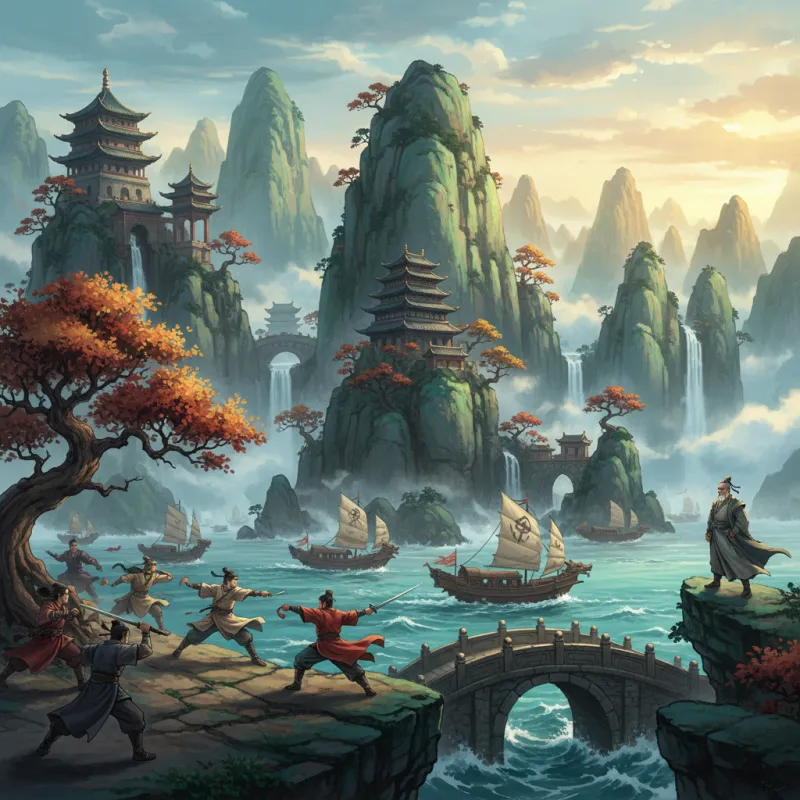
The first emperor of China sent thousands of young men and women to their deaths chasing a mirage. In 219 BCE, Qin Shi Huang (秦始皇 Qín Shǐhuáng) dispatched an expedition of three thousand youths across the Eastern Sea, commanded by the court alchemist Xu Fu (徐福 Xú Fú), with a single mission: find Penglai Island and bring back the elixir of immortality. They never returned. Some say they founded Japan. Others claim they died at sea. But the legend of Penglai (蓬莱 Pénglái) — the floating paradise where immortals dwell and death holds no dominion — has outlived every dynasty that sought it.
The Archipelago That Moves With the Tides
Penglai wasn't alone in the eastern mists. According to the Liezi (列子 Lièzǐ), a Daoist text from the Warring States period, five immortal islands originally floated in the Bohai Sea: Penglai, Fangzhang (方丈 Fāngzhàng), Yingzhou (瀛洲 Yíngzhōu), Daiyu (岱舆 Dàiyú), and Yuanqiao (员峤 Yuánqiáo). These weren't fixed landmasses but drifting paradises, each carried on the backs of fifteen giant sea turtles working in rotating shifts. The islands would rise and fall with the tides, appearing on the horizon only to vanish when ships drew near.
The mythology gets darker. A giant from the Longbo Kingdom (龙伯国 Lóngbó Guó) once went fishing and caught six of the turtles in a single day. Without their bearers, two islands — Daiyu and Yuanqiao — drifted to the North Pole and sank beneath the waves. The Jade Emperor, furious at this cosmic vandalism, shrank the Longbo giants to human size and reduced their lifespans as punishment. Only three islands remained: Penglai, Fangzhang, and Yingzhou, forever beyond mortal reach.
This detail matters because it establishes a crucial theme in Chinese immortality mythology: paradise exists, but it actively resists human ambition. Unlike Mount Kunlun, which sits fixed at the center of the world, Penglai moves. It doesn't want to be found.
What the Immortals Actually Do There
Wuxia novels love to place their most powerful sects on remote islands, but they rarely capture what the classical texts say about Penglai's inhabitants. According to the Shanhaijing (山海经 Shānhǎi Jīng), the immortals (仙人 xiānrén) who live there don't spend their time cultivating martial arts or hoarding secret manuals. They eat a fungus called zhicao (芝草 zhīcǎo) — a type of lingzhi mushroom that grows wild across the island — and drink from springs that flow with liquid jade. Their bodies become light as air. Some develop the ability to fly. Others simply stop aging, their hair remaining black for thousands of years.
The architecture reflects this otherworldly existence. Buildings aren't constructed from wood or stone but from gold, silver, and jade. The Shiji (史记 Shǐjì), Sima Qian's historical records, notes that Xu Fu described palaces with "pillars of white jade and trees bearing pearls." Even the animals are different: white deer wander freely, and cranes — symbols of longevity — serve as the immortals' preferred mode of transportation.
But here's what makes Penglai distinct from other paradise myths: it's not a reward for virtue. You can't earn your way there through good deeds or spiritual cultivation. The island appears to those it chooses, and it chooses seemingly at random. Fishermen report seeing it more often than emperors. This randomness drove the imperial court mad with frustration.
The Expeditions That Changed History
Qin Shi Huang's obsession with Penglai wasn't unique, but it was the most consequential. After unifying China in 221 BCE, the emperor became fixated on immortality. Court alchemists and Daoist mystics competed to offer him solutions: mercury pills, breathing exercises, sexual techniques. But the most ambitious proposal came from Xu Fu, who claimed he could sail to Penglai and negotiate with the immortals directly.
The first expedition failed. Xu Fu returned claiming that a giant sea creature had blocked their path. The emperor, undeterred, sent him out again with more ships, more supplies, and three thousand young people — supposedly because the immortals preferred dealing with the young and pure. This second expedition vanished completely. Japanese legends claim Xu Fu landed in Kyushu and became the ancestor of certain noble families, but Chinese sources simply record his disappearance.
Emperor Wu of Han (汉武帝 Hàn Wǔdì), ruling three centuries later, repeated the same mistake. He built observation towers along the coast, hoping to spot Penglai on the horizon. He sent multiple expeditions. He consulted every alchemist and mystic in the empire. None of it worked. The island remained a shimmer in the distance, visible but unreachable.
What's fascinating is how this failure shaped Chinese philosophy. The Daoist concept of wuwei (无为 wúwéi) — effortless action, non-striving — partly developed as a response to these doomed expeditions. You cannot force your way to immortality. You cannot conquer paradise through imperial decree. The more desperately you chase Penglai, the faster it recedes.
Penglai in Wuxia Fiction: A Missed Opportunity
Modern wuxia novels have largely domesticated Penglai, turning it into just another sect headquarters or hidden valley. Jin Yong (金庸 Jīn Yōng) barely mentions it. Gu Long (古龙 Gǔ Lóng) ignores it entirely. When Penglai does appear, it's usually as a generic "immortal sect" with powerful elders and secret techniques, stripped of its mythological strangeness.
This is a shame because the original mythology offers so much narrative potential. Imagine a wuxia story where the protagonist actually reaches Penglai, only to discover they can never leave — the island's immortality comes with the price of eternal exile. Or a tale where Penglai appears to a dying martial artist, offering salvation, but vanishes the moment they try to board a boat. The island's fundamental unreachability is its most interesting feature, and most modern writers ignore it.
The few exceptions are worth noting. Huang Yi's (黄易 Huáng Yì) Xunqin Ji (寻秦记 Xúnqín Jì) engages directly with the Xu Fu legend, weaving time travel into the historical search for Penglai. Some cultivation novels (修真小说 xiūzhēn xiǎoshuō) use Penglai as a higher realm accessible only after achieving certain breakthroughs, which at least preserves the idea of it being beyond normal reach.
The Real Penglai: When Myth Meets Geography
Here's where it gets interesting: there's an actual place called Penglai in Shandong Province, and it's been trading on the mythological association for over two thousand years. The city of Penglai sits on the northern coast of the Shandong Peninsula, overlooking the Bohai Sea — exactly where ancient texts placed the immortal islands.
The connection isn't accidental. This stretch of coastline experiences frequent mirages, a meteorological phenomenon where atmospheric conditions create the illusion of floating islands and inverted cities on the horizon. Sailors and fishermen have reported these visions for millennia. The Penglai Pavilion (蓬莱阁 Pénglái Gé), built during the Song Dynasty, became a famous spot for observing these mirages, which locals called "Penglai fairyland" (蓬莱仙境 Pénglái xiānjìng).
This raises a question that scholars still debate: did the myth inspire the mirages' interpretation, or did the mirages inspire the myth? Probably both. Ancient sailors saw something real — optical illusions created by temperature inversions — and their culture provided a framework for understanding it. The islands they glimpsed weren't just tricks of light; they were Penglai, Fangzhang, and Yingzhou, the dwelling places of immortals.
The modern city of Penglai leans heavily into this heritage. Tourist sites promise views of the "immortal realm." Souvenir shops sell lingzhi mushrooms and longevity charms. It's commercialized mythology, but there's something poignant about it too — a recognition that even if we can't reach the real Penglai, we can at least visit the place where people once believed it existed.
Why We Still Need Unreachable Islands
The Penglai myth endures because it articulates something true about human desire: we want what we cannot have, and we want it more intensely because we cannot have it. Every generation produces its own version of Penglai — El Dorado, Shangri-La, Atlantis — a perfect place just beyond the horizon that justifies one more expedition, one more sacrifice, one more doomed attempt.
But Penglai differs from Western paradise myths in a crucial way. It's not heaven, earned through righteousness. It's not Valhalla, reserved for warriors. It's not even Avalon, hidden by magic but theoretically accessible. Penglai simply exists, indifferent to human merit or effort, appearing and disappearing according to its own logic. This makes it more honest than most paradise myths. It doesn't promise that good people get rewarded or that hard work pays off. It just floats there, beautiful and impossible, reminding us that some things remain forever out of reach.
The immortals on Penglai aren't gods. They're not even particularly powerful in the martial sense. They're just people who stopped aging, who found themselves on an island that happened to drift into their path. They didn't earn immortality through cultivation or virtue. They got lucky. And maybe that's the real lesson of Penglai: immortality, like the island itself, isn't something you can chase down and capture. It comes to you, or it doesn't.
In wuxia terms, this connects to the concept of yuanfen (缘分 yuánfèn) — the fateful coincidence that brings people together or tears them apart. You can't force yuanfen. You can't manufacture destiny. And you definitely can't sail to Penglai just because an emperor commands it. The island appears when it wants to, to whom it wants to, and all the ships and soldiers and young people in the world won't change that.
Perhaps that's why Xu Fu's expedition never returned. Perhaps they did reach Penglai, and the island simply refused to let them leave. Or perhaps they're still sailing, generation after generation, chasing a shimmer on the horizon that stays forever just out of reach. Either way, they're still looking for what we're all looking for: a place where time stops, where suffering ends, where we can finally rest. The island where no one grows old.
Related Reading
- Exploring Chinese Martial Arts Fiction and the Mythical Jianghu Culture
- The Fusang Tree: Where the Suns Rise and the World Begins
- The Four Seas and the Shape of the Ancient Chinese World
- Kunlun Mountain: The Paradise at the Center of the World
- The Three Pure Ones: Supreme Deities of Daoism
- Legendary Swords in Wuxia Fiction
- Wuxia Video Games: From Chinese RPGs to Global AAA Titles
Explore Chinese Culture
- Explore Jin Yong's martial arts novels
- Explore cultivation fiction and immortal heroes
- Explore the real history behind wuxia